Kevin Mwangi

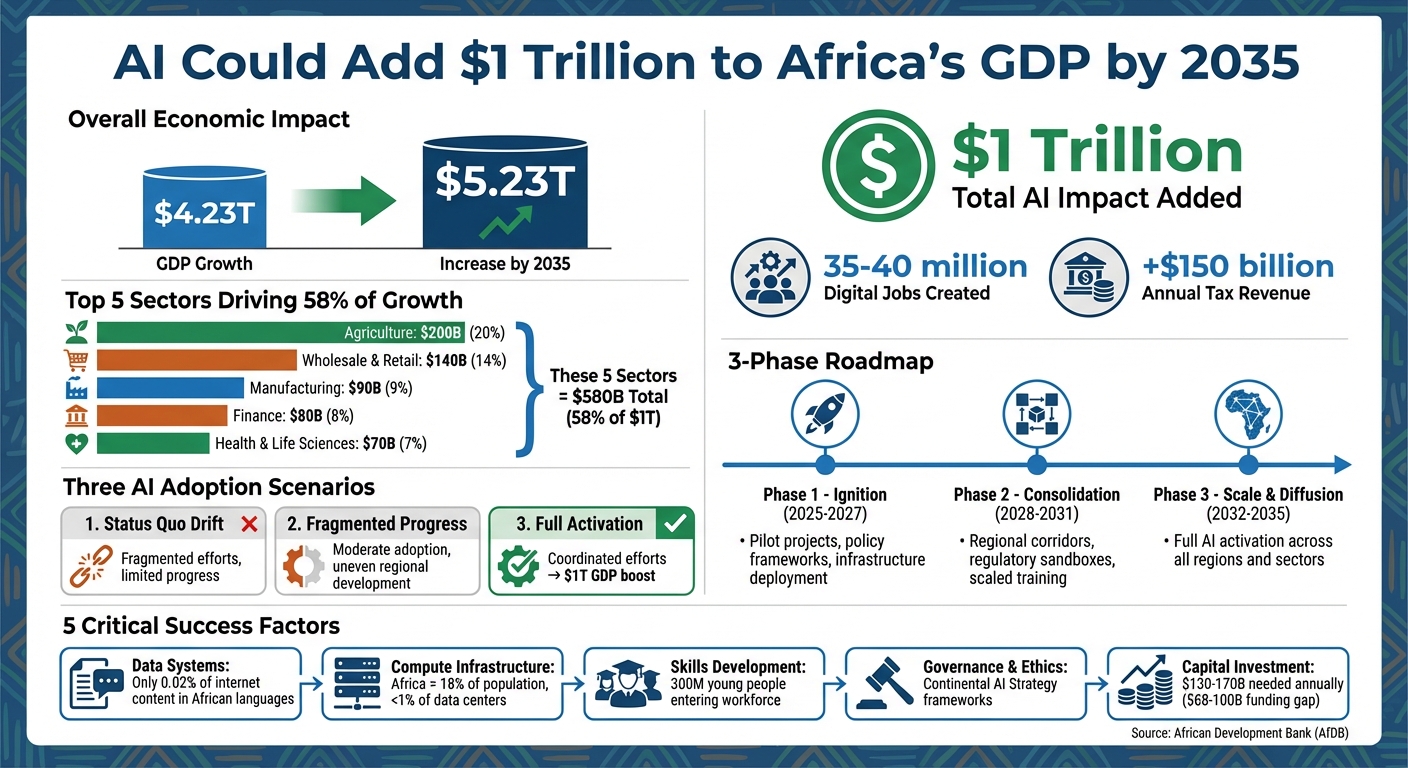
Africa could see a $1 trillion boost in GDP by 2035 through AI adoption, according to the African Development Bank (AfDB). This growth, representing nearly a third of Africa’s current economic output, hinges on advancing AI in sectors like agriculture, manufacturing, finance, healthcare, and retail. Key highlights from the report include:
- Economic Growth: Africa’s GDP could grow from $4.23 trillion to $5.23 trillion by 2035.
- Job Creation: AI could create 35–40 million digital jobs.
- Tax Revenue: An additional $150 billion in annual tax revenues is possible.
- Top Sectors: Agriculture ($200B), retail ($140B), manufacturing ($90B), finance ($80B), and healthcare ($70B) will drive 58% of the gains.
To achieve this, Africa must address five main challenges: building reliable data systems, expanding computing infrastructure, developing a skilled workforce, establishing governance frameworks, and securing investment. A three-phase roadmap outlines steps to AI readiness by 2035, starting with pilot projects (2025–2027) and scaling to full adoption (2032–2035). Success depends on timely, coordinated action.

Africa’s $1 Trillion AI Opportunity by 2035: Key Statistics and Sector Breakdown
How AI Can Generate $1 Trillion for Africa
3 AI Adoption Scenarios for Africa
The African Development Bank (AfDB) report outlines three possible paths for AI adoption across Africa, each leading to different outcomes. The first, called "Status Quo Drift", involves fragmented efforts that result in limited progress. The second, "Fragmented Progress", envisions moderate adoption where some countries and industries advance while others fall behind, creating a "two-speed" transition. This uneven progress could leave smaller or less-developed regions struggling to keep up. The third and most ambitious scenario, "Full Activation", requires coordinated efforts across the continent, significant investments in infrastructure, and unified policies. If this pathway is achieved, AI could drive Africa’s economy from $4.23 trillion to $5.23 trillion by 2035. It could also lead to the creation of 35 to 40 million net new digital jobs and generate an additional $150 billion in annual tax revenue for African governments by that time.
These scenarios highlight the importance of identifying the key factors needed to unlock AI’s full potential.
5 Critical Factors for AI Growth
For Africa to achieve the transformative "Full Activation" scenario, five essential factors must be addressed:
- Data Systems: Developing robust and interoperable data systems that reflect local languages and contexts is crucial. Currently, only 0.02% of global internet content is available in African languages.
- Compute Infrastructure: Expanding access to scalable and cost-effective GPU-powered compute infrastructure is vital. Although Africa makes up 18% of the world’s population, it accounts for less than 1% of global data center capacity. Bridging this gap will require aligning GPU costs, power supply, and demand.
- Skills Development: Training millions of AI professionals is critical to integrating 300 million young people into the workforce over the next decade.
- Governance and Ethics: Establishing strong governance frameworks and ethical AI standards will encourage widespread adoption.
- Capital Investment: Securing sufficient funding is necessary to reduce risks, support innovation, and scale successful projects across the continent.
3-Phase Roadmap to AI Readiness by 2035
A phased approach offers a clear path to AI readiness for Africa:
- Ignition Phase (2025–2027): This phase focuses on launching pilot projects, creating policy frameworks, and beginning the deployment of critical compute infrastructure.
- Consolidation Phase (2028–2031): During this period, countries will work on building regional corridors, introducing regulatory sandboxes for safe AI experimentation, and scaling up training programs and investments.
- Scale and Diffusion Phase (2032–2035): This final phase aims to fully activate AI adoption across all regions and sectors. By 2035, with all the enablers in place, AI could boost Africa’s GDP by $1 trillion. Nearly 58% of this growth – around $580 billion – will come from five key sectors: agriculture ($200 billion), wholesale and retail ($140 billion), manufacturing ($90 billion), finance ($80 billion), and health ($70 billion).
AI for Africa- Harnessing AI for jobs, growth, and investment
Top Sectors for AI-Driven Economic Growth
The AfDB/Bazara Tech Report highlights five key sectors expected to account for 58% of Africa’s projected $1 trillion AI-driven economic gains by 2035. Agriculture takes the lead with an estimated $200 billion (20% of the total), followed by finance at $80 billion (8%) and health and life sciences at $70 billion (7%). These industries face specific challenges that AI can help tackle, from enhancing agricultural productivity to expanding access to financial and healthcare services. Let’s dive into how AI is reshaping agriculture, finance, and healthcare in Africa.
Agriculture and Food Systems
Agriculture in Africa faces hurdles like unpredictable weather, low yields, and limited access to markets. AI offers solutions to these issues through innovations like climate-resilient seed research, which speeds up the development of crops suited to changing weather patterns. Precision farming tools, on the other hand, provide real-time soil monitoring and early detection of pests and diseases, helping farmers optimize their efforts. Even after harvesting, AI systems improve supply chain efficiency with traceability tools and smart contracts, reducing spoilage and ensuring fair market practices.
Smallholder farmers, who produce about a third of the world’s food, stand to gain immensely from AI applications. For instance, AI-driven weather forecasts and price predictions empower farmers to make better decisions about planting and selling. Additionally, AI enables alternative credit scoring using mobile data, opening up financial opportunities for farmers without access to traditional banking. Climate-indexed insurance, which triggers payouts automatically based on weather conditions, is another game-changer for these communities.
"The Bank is ready to release investment to support these actions. We expect the private sector and the government to utilise this investment to ensure we achieve the identified productivity gains and create quality jobs."
- Nicholas Williams, Manager of the ICT Operations Division, African Development Bank
But agriculture isn’t the only sector seeing a transformation. AI is also making waves in financial services.
Finance and Financial Inclusion
AI-powered financial technology is breaking barriers to bring banking services to the unbanked. By analyzing mobile data, transaction histories, and payment patterns, AI builds credit profiles for individuals who don’t have formal banking records. This approach reduces costs, making it feasible to serve low-income and rural populations.
Several real-world examples illustrate this impact. In Kenya, Tala uses AI to analyze mobile data, helping unbanked individuals access loans as of August 2025. In Togo, the Novissi Cash Transfer Program employed AI in May 2021 to identify 57,000 recipients in 100 of the poorest towns for contactless cash transfers. Similarly, Nigeria’s Kudi.ai leverages AI to provide microfinance services to underserved communities. Beyond inclusion, AI enhances security with advanced fraud detection models, building trust in digital financial systems.
"AI-enabled credit scoring and fraud prevention can increase access to formal finance… responsible, locally rooted AI can drive inclusive growth and connect more people to opportunity."
- Mark Elliott, Division President, Africa, Mastercard
Health and Life Sciences
In healthcare, AI is helping to bridge critical gaps. For instance, AI-powered diagnostic imaging can quickly and accurately detect diseases, a vital tool in regions with shortages of radiologists. Telemedicine platforms, often supported by AI chatbots, extend healthcare access to remote areas. Startups are also using AI to monitor maternal health, reducing risks through early detection. Additionally, AI enhances efficiency by optimizing supply chains for essential medicines and supporting clinical decision-making.
However, a major challenge lies in creating AI models that are trained on African data. Many diagnostic tools rely on Western datasets, which can limit their effectiveness in African contexts. Efforts are underway to develop natural language processing tools tailored to African accents, helping clinicians document patient data more efficiently. With Africa set to meet less than 6% of the UN Sustainable Development Goals by 2030, AI-driven healthcare innovations could play a crucial role in accelerating progress.
AI’s transformative potential in healthcare is a key piece of Africa’s broader $1 trillion economic opportunity.
sbb-itb-dd089af
How to Build AI Readiness in Africa
Building AI readiness in Africa requires a focused effort across three key areas: infrastructure, skills development, and ethical governance. According to the African Development Bank (AfDB), these areas must progress together to unlock the $1 trillion potential AI holds for the continent. Here’s a closer look at what startups, policymakers, and investors can do to drive this transformation.
Building Core Infrastructure
Africa’s AI aspirations face a significant hurdle: the continent needs $130 billion to $170 billion annually for infrastructure, yet there’s a funding gap of $68 billion to $100 billion. Reliable power, internet connectivity, and computing resources are critical to moving AI beyond experimental stages.
Investments in GPU-powered computing and cloud services are foundational for scaling AI. But infrastructure isn’t just about raw computing power – interoperable data ecosystems are equally important. For instance, the AfDB highlights the need for "Agricultural Data Exchange Nodes", which would allow farmers, researchers, and businesses to access high-quality, localized datasets for AI training.
Digital public infrastructure also plays a pivotal role. This includes systems like digital identities, electronic payments, and secure data-sharing frameworks. However, Sub-Saharan Africa’s mobile internet connectivity rate is just 27%, far below the global average of 57%. Expanding broadband access, especially in rural areas, is essential for inclusive AI growth.
One promising solution is regional infrastructure sharing. Instead of each country building its own costly data centers, nations could collaborate on shared computing hubs with standardized systems. This approach could prevent a scenario where only wealthier regions benefit from AI advancements. To support such projects, the AfDB suggests blended finance models that combine public and private capital, reducing risks for large-scale initiatives like regional data centers and fiber networks.
Africa also has the chance to leap ahead by creating a "green" AI ecosystem. With abundant renewable energy sources such as solar, wind, and hydroelectric power, the continent can sustainably fuel its data centers.
"The Bank is ready to release investment to support these actions. We expect the private sector and the government to utilize this investment to ensure we achieve the identified productivity gains and create quality jobs." – Nicholas Williams, Manager of the ICT Operations Division, African Development Bank
Startups can contribute by using publicly available datasets and engaging in data exchange programs to develop localized solutions. Policymakers, on the other hand, should prioritize infrastructure budgets in their national AI strategies and promote open, interoperable data systems.
Training AI Professionals and Building Skills
A skilled workforce is essential for deploying AI effectively. By 2035, efforts to bridge the skills gap could create millions of digital jobs. With over 300 million people expected to join Africa’s working-age population within the next decade, addressing the lack of basic digital education – currently affecting more than 70% of African children – is a pressing need.
The skills gap starts early. AI literacy should be incorporated into K–12 education, but fewer than 20% of teachers feel adequately prepared to teach digital skills, making teacher training a top priority. Governments should invest in AI certification programs and continuous professional development for educators.
Some initiatives are already tackling this challenge. A mobile-first approach can help extend AI education to underserved areas. Establishing AI Centers of Excellence within schools and universities could serve as hubs for research, project incubation, and partnerships between academia and industry.
Collaboration is key. Ministries of education, innovation hubs, startups, and diaspora networks can work together to co-create AI learning initiatives. The African diaspora, in particular, offers a wealth of technical expertise and investment potential to support capacity-building efforts.
Policymakers should aim to complete digital readiness audits by 2025 to identify gaps in curricula and teacher training. By 2026, integrating topics like machine learning, algorithms, and data ethics into upper primary education will be critical.
"A skilled workforce is essential to develop, implement, and maintain AI systems, and trust – built through governance, and regulatory frameworks – underpins adoption." – African Development Bank Report
As skills development gains momentum, the next step is ensuring trust through ethical governance.
Establishing Trust and Ethical AI Frameworks
For AI adoption to succeed, trust must be built through clear governance frameworks, data protection laws, and ethical guidelines that prioritize local needs. In July 2024, the African Union Executive Council endorsed the Continental AI Strategy, emphasizing a responsible, Africa-focused approach to AI. Countries like Kenya and South Africa are already making strides with initiatives such as the Blockchain and AI Taskforce and the Presidential Commission on the Fourth Industrial Revolution, respectively.
Effective governance requires balancing user protection with innovation. Flexible regulatory frameworks that focus on specific AI use cases, rather than blanket restrictions, are key. Between 2028 and 2031, the AfDB plans to introduce regulatory sandboxes to allow controlled testing of AI solutions.
Data privacy laws and ethical guidelines are also crucial to prevent bias. With only 0.02% of internet content available in African languages, there’s a risk of algorithmic bias in AI models developed outside the continent. Developing "sovereign AI" models trained on local data is increasingly seen as a priority.
The stakes are high. In 2023, African governments spent over $1 billion on digital surveillance technologies, often without sufficient legal safeguards. While AI could help achieve 134 UN Sustainable Development Goals, it could also hinder 59 of them if not managed responsibly. Additionally, 86% of women across 52 African countries lack basic AI proficiency, highlighting the need for inclusive frameworks.
| AI Readiness Phase | Timeline | Key Policy/Trust Focus |
|---|---|---|
| Ignition | 2025–2027 | Charter policy frameworks and launch pilots |
| Consolidation | 2028–2031 | Deploy sandbox regulation and scale capital |
| Scale & Diffusion | 2032–2035 | Full activation of AI readiness across all regions |
Policymakers must focus on programs that shift public perceptions from fearing job loss to embracing new opportunities for skill-building. Startups should adopt inclusive data collection practices to ensure diverse representation, including gender and local languages. Investors can play their part by exploring innovative financing models to close infrastructure funding gaps.
"Africa’s challenge is no longer what to do – it is doing it on time." – Ousmane Fall, Director of Industrial and Trade Development, African Development Bank
The clock is ticking. Achieving key milestones by 2026 will be critical to setting Africa’s AI initiatives on the right track. By advancing infrastructure, skills, and governance in tandem, the continent can unlock its full AI potential.
Conclusion: Realizing Africa’s AI Potential
Africa stands at a critical moment where AI has the potential to contribute $1 trillion to GDP by 2035, create up to 40 million digital jobs, and bring in an additional $150 billion in annual tax revenue. These advancements could revolutionize key sectors such as agriculture and healthcare.
To make this vision a reality, a unified approach is essential. This includes establishing continent-wide regulatory frameworks under the African Union, with at least 20 nations adopting AI risk management strategies. Additionally, mobilizing $10 billion through blended finance initiatives, such as the African Fund for AI Growth and Innovation, will provide the necessary financial backing. These efforts must build upon existing infrastructure, skill development programs, and governance systems. International collaboration also plays a vital role, with plans to develop six data embassies equipped with high-performance GPUs and establish 60 national and regional open data platforms adhering to FAIR principles.
Recent developments highlight growing momentum. Ghana and the UAE have signed a $1 billion agreement to create Africa’s largest AI hub, and Cassava Technologies has partnered with NVIDIA on a $720 million investment to boost localized computing. Meanwhile, Togo has committed to training 50,000 individuals annually in AI-related skills, aiming to prepare 3 million professionals for AI-driven jobs by 2035.
By following the three-phase roadmap – Ignition, Consolidation, and Scale – these investments will fast-track AI readiness across the continent. Projections indicate that key industries will account for 58% of the total benefits brought by AI advancements.
"Africa’s challenge is no longer what to do – it is doing it on time." – Ousmane Fall, Director of Industrial and Trade Development, African Development Bank
FAQs
What challenges must Africa overcome to unlock $1 trillion in AI-driven GDP growth by 2035?
Africa faces several hurdles in preparing for AI adoption and realizing the potential $1 trillion boost to its GDP by 2035. Among these challenges are data gaps, where access to reliable, localized datasets remains limited; skills shortages, with a pressing need for more trained AI professionals; and infrastructure issues, such as inadequate digital connectivity and inconsistent power supply in many areas.
On top of that, regulatory frameworks must be established to ensure AI is implemented responsibly and benefits everyone. Expanding access, building capacity, and creating inclusive policies will be essential to applying AI effectively across sectors like agriculture, healthcare, fintech, and education. Tackling these obstacles will demand collaboration among governments, businesses, and international organizations to drive sustainable growth and innovation.
How will AI impact job creation and tax revenue in Africa by 2035?
AI is poised to play a transformative role in Africa’s job market, with estimates suggesting it could generate 35 to 40 million new digital jobs by 2035. These opportunities will emerge across major sectors like agriculture, manufacturing, healthcare, finance, and retail. From roles in data science and AI-driven farming techniques to fintech innovations and telehealth services, the potential for growth is immense. This surge in digital jobs could help bring around 300 million young people into the formal workforce, creating a dynamic talent pool that could drive innovation and economic progress.
On top of that, AI’s impact on Africa’s economy is projected to be monumental, potentially adding $1 trillion to the continent’s GDP. This economic boost will significantly broaden the tax base, as higher wages, increased corporate profits, and greater consumer spending contribute to rising income, corporate, and value-added tax revenues. With these additional funds, governments will have more resources to channel into vital sectors like infrastructure, education, and healthcare, paving the way for long-term development and prosperity.
How does infrastructure impact the growth of AI in Africa?
Infrastructure is the backbone of transforming Africa’s AI potential into measurable economic advancements. To make this happen, reliable electricity, high-speed internet, and locally operated data centers are non-negotiable. These elements not only drive AI applications but also reduce reliance on external providers while safeguarding data sovereignty.
When businesses have access to strong digital connectivity, they can tap into global knowledge, train AI models effectively, and expand services across key sectors like agriculture, healthcare, and fintech. On top of that, focusing on energy-efficient systems and renewable energy solutions for data centers can significantly boost AI capacity while keeping costs and environmental concerns in check.
By creating this ecosystem – stable power, affordable internet, and sustainable computing resources – Africa stands poised to achieve a remarkable economic milestone: a projected $1 trillion GDP increase by 2035.
Related Blog Posts
- AI Startups in Africa: Role of Infrastructure Policies
- Solving Africa’s Tech Talent Gap with AI Training
- The Rise of AI Startups in Africa: Tools, Trends & Talent
- North vs. Sub-Saharan Africa: AI Investment Trends