Kevin Mwangi

Microsoft’s latest AI report highlights the top 10 African countries leading in AI readiness, based on factors like infrastructure, skills, government policies, and adoption rates. Here’s a quick summary:
- South Africa: Leading with a 21.1% AI adoption rate, robust digital infrastructure, and strong government policies.
- Nigeria: Aiming for 43% of Africa’s $136 billion AI productivity gains by 2030. Focused on skills training and cloud infrastructure.
- Kenya: East Africa’s AI hub with geothermal-powered data centers and over 600,000 individuals trained in AI.
- Egypt: Surpassing many peers with a 13.4% adoption rate and a strong focus on Arabic language AI tools.
- Morocco: Strong infrastructure and STEM education, with 10.9% AI adoption.
- Rwanda: Emerging as "Africa’s AI Lab" with a forward-thinking national AI policy.
- Ghana: A decade-long AI strategy (2023–2033) and growing focus on local language AI tools.
- Tunisia: Leading in AI talent density with 4,120 developers per million people.
- Senegal: Investing in satellite internet and 5G to expand AI accessibility.
- Ethiopia: Gradual progress with a 6.8% adoption rate, leveraging open-source platforms for affordability.
Challenges and Opportunities
Africa currently hosts less than 1% of global data centers, and 85% of sub-Saharan Africa lacks electricity access. However, investments in AI skills, localized tools, and infrastructure could unlock 230 million digital jobs by 2030.
Quick Comparison Table
| Country | AI Adoption Rate (2025) | Key Strengths | Key Challenges |
|---|---|---|---|
| South Africa | 21.1% | Strong infrastructure, policies, and adoption | Digital divide in rural areas |
| Nigeria | 9.3% | Growing cloud infrastructure, skills training | Limited access to electricity |
| Kenya | 8.1% | Renewable energy-powered data centers | Low adoption rate compared to potential |
| Egypt | 13.4% | Arabic AI tools, strong data center presence | Expanding infrastructure |
| Morocco | 10.9% | High internet penetration, STEM graduates | Low R&D spending |
| Rwanda | 6.3% | AI policy, cloud-first strategy | Limited data digitization |
| Ghana | 9.3% | Local language AI tools, national AI strategy | Gender and rural-urban digital gaps |
| Tunisia | 12.7% | High developer density, skilled workforce | Low data center capacity |
| Senegal | 12.9% | Satellite internet rollout, 5G expansion | Limited rural electricity access |
| Ethiopia | 6.8% | Open-source platforms for affordability | Language barriers, low infrastructure |
Africa’s AI journey is gaining momentum, with South Africa leading the way. However, investments in electricity, internet, and localized solutions are critical for broader adoption across the continent.
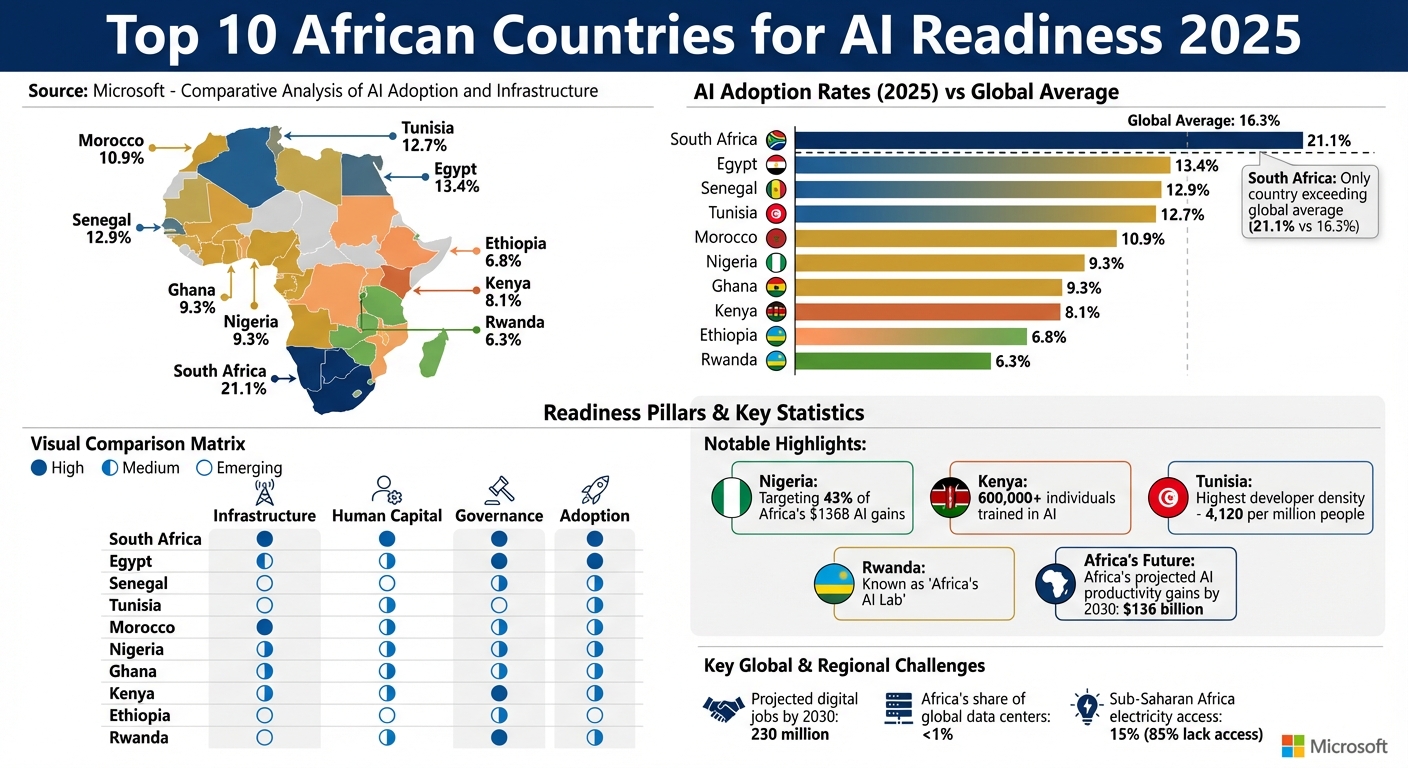
Top 10 African Countries by AI Readiness 2025: Adoption Rates and Key Strengths
THE NEXT DECADE OF AI IN AFRICA
sbb-itb-dd089af
1. South Africa
South Africa is setting the pace for AI adoption in Africa, with a diffusion rate of 21.1% by late 2025, up from 19.3% earlier in the year.
Digital and AI Skills Pipeline
To address a growing need for digital expertise, Microsoft South Africa teamed up with Afrika Tikkun Services and the Youth Employment Service (YES) in January 2025. Together, they launched the AI Skills Navigator portal, aiming to train 1,000,000 people by 2026. This free platform offers customized learning paths and certifications, tackling a skills gap that over 60% of companies have identified.
In a related development, SPAR, a major retailer, began using Microsoft 365 Copilot across its operations in Africa and Europe in March 2025. The results? A remarkable 67% of employees adopted the tool, collectively saving 715 hours (equivalent to 89 workdays). Post-implementation, 93% of users reported improved productivity, while 88% said tasks were completed faster.
Cloud and AI Infrastructure
South Africa boasts Microsoft’s hyperscale Azure data centers in Johannesburg and Cape Town. These facilities empower a range of businesses – from startups to financial institutions – to create secure, scalable AI-driven solutions.
Some standout applications include:
- SARS (South African Revenue Service): Leveraged Azure to pre-fill tax returns for 5,000,000 individuals and deployed an Azure OpenAI-powered chatbot that handled 300,000 queries during the 2024/2025 fiscal year.
- Standard Bank: Migrated critical workloads to Azure, enhancing its operational flexibility.
- Lelapa AI: A local startup developed InkubaLM, Africa’s first multilingual small language model, supporting languages like isiXhosa and isiZulu.
Policy and Regulation
South Africa is also making strides on the policy front. In April 2024, the Department of Communications and Digital Technologies unveiled the Draft National AI Plan, which lays out a roadmap for AI integration and regulatory development. Meanwhile, the Presidential Commission on the Fourth Industrial Revolution (PC4IR), active since 2019, continues to provide strategic direction to bolster the country’s position in the global digital economy. These initiatives underscore South Africa’s role as a leader in AI readiness across the continent.
2. Nigeria
As Africa’s AI momentum continues to grow, Nigeria is positioning itself as a key player in the region. The country aims to claim 43% of the continent’s projected $136 billion in AI-driven productivity gains by 2030. By late 2025, Nigeria’s AI diffusion rate had risen to 9.3%, up from 8.7% earlier.
Digital and AI Skills Pipeline
The Federal Ministry of Communications, Innovation and Digital Economy launched the 3 Million Technical Talent (3MTT) Initiative, which aims to generate 2 million digital jobs. By early 2024, the platform had already engaged 4 million Nigerians.
In December 2025, Microsoft partnered with VISA, UNICEF, and Data Science Nigeria to host Microsoft AI Skills Week in Lagos. This event drew an impressive 235,000 participants and resulted in 1,700 certifications in AI skills. Spearheaded by Abideen Yusuf (General Manager, Microsoft Nigeria and Ghana) and Olayinka David-West (Dean of Lagos Business School), the event also included an Agentic AI hackathon. Participants developed solutions for document verification and fraud detection in the fintech sector.
"Nigeria cannot afford to wait. AI is reshaping every sector, and the countries that move fastest on skills will lead." – Abideen Yusuf, General Manager, Microsoft Nigeria and Ghana
The AI National Skills Initiative (AINSI), a collaboration between Microsoft, the Federal Government, Data Science Nigeria, and Lagos Business School, has trained 350,000 Nigerians. This includes 99 public sector leaders and 645 developers in ethical AI and analytics. Since 2021, Microsoft has provided digital training to over 4 million Nigerians.
Cloud and AI Infrastructure
Nigeria’s growing AI ecosystem is backed by strong infrastructure. The country hosts 16 data centers, placing it among Africa’s top four infrastructure hubs. It also benefits from direct cloud services provided by Microsoft Azure, Amazon AWS, and Google Cloud. Microsoft has further invested in Edge Nodes to improve network speeds and cloud accessibility for local businesses. Additionally, Nigeria boasts over 230 AI-specific startups and more than 7,000 general tech startups.
Microsoft’s cloud investments have supported the establishment of the National Centre for Artificial Intelligence and Robotics (NCAIR) and the launch of the Nigeria AI Scaling Hub, both designed to accelerate innovation. A workforce survey revealed that 70% of Nigerian respondents believe generative AI will enhance their efficiency, while 88% think it will help them acquire new skills and improve work quality.
Policy and Regulation
The Federal Ministry of Communications, Innovation and Digital Economy introduced the National Artificial Intelligence Strategy (NAIS) to harness AI for economic growth, job creation, and social inclusion. The Nigeria Data Protection Act of 2023 ensures a secure legal framework for data-intensive AI businesses.
To support research, the government established the Nigeria Artificial Intelligence Research Scheme (NAIRS), providing funding for AI-focused projects. Meanwhile, the Developers in Government (DevsInGov) initiative is equipping public sector developers with data analytics and AI integration skills, aiming to reduce brain drain among skilled professionals.
3. Kenya
Kenya ranks as Africa’s 5th most AI-ready nation, with an adoption rate projected to reach 8.1% by late 2025. The country is transitioning from being a consumer of technology to becoming a hub for AI innovation in East Africa. This transformation is fueled by a strong focus on developing digital skills across various sectors.
Digital and AI Skills Pipeline
In 2025, the Kenya Private Sector Alliance (KEPSA) and Microsoft joined forces to launch the Kenya Artificial Intelligence Skilling Alliance (KAISA). This national initiative coordinates AI skills development across government, industry, and civil society. With a 24-month roadmap in place, KAISA focuses on sector-specific working groups targeting agriculture, health, and finance, alongside a national AI repository designed to highlight local innovations.
Kenya’s AI Skilling Initiative has already trained over 600,000 individuals. KEPSA alone has educated 70,000 leaders, professionals, and small businesses. Additionally, the Regional Centre of Competence for Digital and AI Skilling has provided training for around 1,500 public servants through bootcamps and online programs, with another 6,500 officials registered for future courses.
"Kenya’s ambition to become Africa’s AI talent hub will only be realized through deliberate investment in skills development, from basic digital literacy to advanced expertise."
– Phyllis Migwi, Country General Manager, Microsoft Kenya
The MESH Network plays a key role by offering bite-sized AI learning to over one million microentrepreneurs each month, supporting the informal economy that employs 85% of Africa’s workforce. Collaborating with the Kenya Union of Gig Workers, the initiative has also trained more than 1,300 gig and platform workers in high-demand digital skills, helping them thrive in the gig economy. These efforts underscore Kenya’s strategic push to lead AI development in the region.
Cloud and AI Infrastructure
In May 2024, Microsoft and G42 unveiled a $1 billion digital ecosystem initiative, marking the largest private-sector investment in Kenya to date. This includes a state-of-the-art geothermal-powered data center in Olkaria, which hosts an East Africa Cloud Region for Azure.
"This represents the single largest and broadest digital investment in Kenya’s history and reflects our confidence in the country, the government, its people, and the future of East Africa."
– Brad Smith, Vice Chair and President, Microsoft
The initiative also focuses on expanding both marine and terrestrial fiber cable networks, aiming to provide last-mile wireless internet access to 20 million Kenyans by the end of 2025. Complementing this, the Kenyan government has adopted a "cloud-first" policy, encouraging state agencies to migrate their data and computing services to the cloud. A trusted data zone has also been established, allowing data from other countries to be stored in compliance with local laws.
Policy and Regulation
Kenya launched its National Artificial Intelligence Strategy (2025–2030) on March 27, 2025, at the Kenyatta International Convention Center. Supported by the EU and GIZ, the strategy emphasizes AI infrastructure, data management, and innovation. To encourage AI growth while maintaining safeguards, the government has opted for a "soft" regulatory approach, utilizing sandboxes to refine governance frameworks.
"We must build our own knowledge and science in AI; otherwise, we risk remaining users rather than creators in the next chapter of human progress."
– Ambassador Phillip Thigo, Special Envoy on Technology, Government of Kenya
Although a dedicated AI law is still under development, Kenya currently relies on the Data Protection Act and the Computer Misuse and Cybercrimes Act as its primary governance frameworks. Proposed legislation, like the Kenya Robotics and AI Society Bill and the Draft IT Artificial Intelligence Code of Practice, seeks to establish comprehensive legal and ethical standards for AI. These measures aim to foster innovation while ensuring responsible use of AI technologies.
Innovation and Startup Ecosystem
The East Africa Innovation Lab in Nairobi serves as a collaborative space for startups, offering design sessions, rapid prototyping, and mentorship. Additionally, Microsoft’s Africa Development Center in Nairobi employs 500 people and acts as a regional hub for AI research and development.
To address the growing need for cybersecurity, a specialized skilling program trains over 2,000 individuals annually. Partnerships with universities have integrated AI into the curriculum at 10 institutions, while more than 78,000 students in Technical and Vocational Education and Training (TVET) programs have gained AI knowledge through tailored modules and bootcamps. These initiatives are laying the groundwork for a thriving AI-driven startup ecosystem in Kenya.
4. Egypt
Egypt is making significant strides in the AI space, building on the momentum seen in South Africa, Nigeria, and Kenya. The country is at the forefront of AI readiness in Africa, boasting a 13.4% diffusion rate by late 2025, surpassing countries like Nigeria, Ghana, and Kenya. Additionally, Egypt saw a 0.9 percentage point increase in AI adoption between the first and second halves of 2025, signaling steady progress in its digital transformation efforts.
Cloud and AI Infrastructure
Egypt is one of Africa’s major data center hubs, sharing this distinction with South Africa, Kenya, and Nigeria. Together, these four countries host nearly half of the continent’s 121 operational and 49 planned data centers. A notable milestone came in October 2022 when G42 partnered with Benya Technologies to bolster Egypt’s digital transformation by providing localized computing power for AI workloads. However, despite these advancements, Africa as a whole still accounts for less than 1% of global data center capacity.
Policy and Regulation
Egypt has unveiled its Second Edition National AI Strategy (2025–2030), which focuses on governance, talent development, economic applications, and international collaboration. This strategy introduces legal frameworks to address data access, safety, and ethical AI use. A proposed National AI Council aims to oversee its implementation across various government ministries, while regulatory sandboxes allow for testing AI technologies in controlled environments before scaling.
The government is also emphasizing Arabic language technologies and interdisciplinary AI applications in areas like law, linguistics, and biology. Large-scale projects are already underway, including initiatives in smart irrigation, traffic management, medical imaging, and Arabic language processing. Additionally, the strategy outlines plans for national computing infrastructure, including GPU access and shared open datasets for healthcare and agriculture.
Digital and AI Skills Pipeline
To ensure a robust AI ecosystem, Egypt is heavily investing in digital literacy and AI education to boost productivity in work, education, and entrepreneurship. Efforts include expanding postgraduate programs, vocational training, and grants to address the AI skills gap. Open-source platforms like DeepSeek are also playing a pivotal role by lowering financial and technical barriers, making advanced AI tools more accessible.
Strategic collaborations, such as those with Huawei and Chinese AI developers, are further driving AI adoption and accessibility in Egypt. This comprehensive approach – combining infrastructure development, skills training, and language-focused initiatives – not only helps bridge the AI adoption gap but also supports small and medium enterprises (SMEs) and startups by improving access to funding and computing resources.
5. Morocco
Morocco is steadily positioning itself as a Tier 2 AI market, thanks to its growing talent pool and evolving infrastructure. By the second half of 2025, the country reported a 10.9% AI diffusion rate, a slight increase from 10.5%. While the growth is modest, Morocco’s focus on education and infrastructure is setting the stage for broader AI adoption. Let’s take a closer look at the factors driving Morocco’s progress in AI, including its talent pipeline, infrastructure, policies, and startup ecosystem.
Digital and AI Skills Pipeline
Morocco’s dedication to STEM education is clear, with 27% of 2022 graduates coming from science-related fields. The country also stands out for its high percentage of female engineering graduates. To further boost AI expertise, Morocco has established specialized institutions for AI training and launched the Al-Khawarizmi Program, aimed at advancing research and development in artificial intelligence. However, with research and development spending at just 0.75% of GDP, there’s significant potential for increased investment.
Cloud and AI Infrastructure
As of 2025, Morocco operates 8 data centers, providing essential support for AI and digital services. The country boasts 100% electricity access and 88.1% internet penetration, creating a solid foundation for connectivity. However, large-scale technological infrastructure still has room to grow to fully support AI deployment. Current investments are focusing on IT infrastructure, healthcare, and biotechnology sectors.
Policy and Regulation
While Morocco has yet to implement a dedicated national AI strategy, it follows a broader digital strategy that includes a defined plan for AI ecosystem development. The country has completed UNESCO‘s Readiness Assessment Methodology, which highlighted:
"Morocco has a favorable ecosystem for the development of a holistic and responsible vision of AI. It has many assets to showcase in terms of research, training, regulation, data governance, and e-inclusion".
Morocco ranks 35th globally in the Open Data Index 2022 and 50th in the ITU Global Cybersecurity Index, reflecting its commitment to data transparency and digital security. These efforts are strengthening its innovation landscape and regulatory framework.
Innovation and Startup Ecosystem
Morocco’s startup scene further demonstrates its readiness for AI growth. The country is home to around 160 AI startups. Between 2020 and 2023, AI investments saw a notable rise, particularly in sectors like healthcare, biotechnology, media, and marketing. Additionally, Morocco’s e-Government Development Index improved from 0.5729 in 2020 to 0.5915 in 2022, signaling advancements in digital governance. This combination of innovation, investment, and governance underscores Morocco’s potential as an emerging player in the AI space.
6. Rwanda
Rwanda is positioning itself as "Africa’s AI Lab", with its AI adoption rate projected to climb to 6.3% by the second half of 2025, up from 6.0% earlier. The country introduced a National AI Policy in 2023, focusing on six critical sectors: agriculture, public administration, health, education, energy, and financial services. Alongside this, Rwanda is making strides in strengthening both its talent pool and infrastructure to support its ambitions.
Digital and AI Skills Pipeline
Rwanda is taking a comprehensive approach to AI education, integrating fields like machine learning, natural language processing, social sciences, ethics, and law into its curriculum. Through its "Local AI Leadership" initiative, the country is preparing its workforce to evaluate AI outputs and address risks such as fabricated AI-generated content. A National Skills Building Program has been launched to train professionals in data and AI, and a specialized visa program has been introduced to attract highly skilled international talent.
Cloud and AI Infrastructure
To complement its focus on skills development, Rwanda is advancing its infrastructure to establish itself as a key AI hub in Africa. The government has adopted a cloud-first strategy, rolling out a hybrid multi-cloud service for public sector use. Plans are also underway to create a blueprint for a hyperscale data center, which could significantly expand Africa’s share of global data center capacity, currently less than 1%. The Rwanda Utilities Regulatory Authority (RURA) is working to improve internet throughput to support real-time AI applications. Additionally, the policy prioritizes building an "Open, Secure, Trusted Data Ecosystem" by digitizing public data. As stated in the National AI Policy:
"Data is the energy that will fuel Rwanda as Africa’s AI Hub, but today there is a lack of digitized data and most data from the public and private sector remain inaccessible".
Policy and Regulation
Strong governance frameworks are central to Rwanda’s AI ambitions. The Ministry of ICT and Innovation’s Responsible AI Office (RAIO) oversees global AI initiatives, while the Data Protection and Privacy Law (Law No 058/2021) enforces penalties of up to 1% of global turnover for significant breaches. Additional support comes from AI Ethical Guidelines issued by RURA and the Ministry of ICT and Innovation (MINICT), along with updated procurement rules that encourage local providers.
Innovation and Startup Ecosystem
Rwanda’s AI Program connects startups, industries, and researchers to create homegrown AI solutions. To foster this ecosystem, the government has established a Seed Investment Fund and is exploring a shared risk fund. Employers benefit from tax incentives and grants to upskill and reskill workers in AI and data-related fields. Moreover, Rwanda collaborates with global organizations like GIZ, the World Economic Forum‘s Centre for the 4th Industrial Revolution, and The Future Society to align its regulatory framework with international standards. This cohesive strategy underscores Rwanda’s commitment to becoming a leader in AI development while contributing to Africa’s broader AI readiness efforts.
7. Ghana
Building on the momentum seen in countries like South Africa and Rwanda, Ghana is making strides toward becoming AI-ready through focused initiatives and strategic planning.
By the end of 2025, AI adoption in Ghana reached 9.3%, which is below the global average of 16.3%. To address this gap, Ghana introduced its National Artificial Intelligence Strategy (2023–2033), a decade-long plan designed to strengthen the country’s AI capabilities.
Developing Digital and AI Skills
The “AI Ready Ghana” program is central to the nation’s efforts to build a skilled workforce. This initiative includes fellowship programs and remote internships aimed at engaging young talent. Institutions like AITI-KACE, SADA, and GTL are playing a key role in equipping both students and professionals with essential AI skills. Additionally, civil and public servants will undergo specialized training to ensure they can design, lead, and implement AI-driven projects effectively.
Strengthening Cloud and AI Infrastructure
Ghana’s strategy places a strong emphasis on expanding its digital infrastructure. Collaborations with leading cloud service providers and the establishment of national data centers are key components of this plan. Efforts such as the Ghana Open Data Initiative (GODI) and the Ghana Data Exchange Hub aim to improve data accessibility and governance. Furthermore, the creation of a Natural Language Processing Centre of Excellence will integrate Ghanaian local languages into AI models, making technology more inclusive.
Policies and Ethical AI Development
To ensure AI is developed responsibly, Ghana is establishing a Responsible AI Office to oversee ethical practices and coordinate efforts across sectors. Updates to intellectual property laws are also underway to protect AI-driven innovations. The National AI Strategy envisions a transformative future for the country, stating:
"By 2033, people living in Ghana will experience a transformed society where AI advances the potential of people, government, businesses and systems to achieve inclusive social and economic transformation".
Supporting Innovation and Startups
To encourage innovation, Ghana is offering tax incentives for research and development as well as startup employment. The government is also improving access to government procurement opportunities for AI-focused businesses. Plans are in place to expand both physical and virtual AI innovation hubs, creating spaces for collaboration and knowledge exchange. Special attention is being given to “Deep Science” and AI applications in areas like climate-smart agriculture, forestry, and healthcare to address pressing national challenges.
8. Tunisia
Tunisia has positioned itself as a leading force in North Africa’s AI landscape, securing the 2nd spot in Africa on the 2025 AI Talent Readiness Index with a score of 51.80. This success stems from a combination of a skilled technical workforce and a solid digital infrastructure.
Digital and AI Skills Pipeline
Tunisia stands out with the highest developer density in Africa, boasting 4,120 developers per million people – far ahead of Morocco (1,345) and Egypt (1,224). This achievement is tied to the country’s emphasis on integrating technical education into its national curriculum. With 85 higher education institutions offering specialized programs in AI and machine learning, Tunisia has built a strong talent pipeline. Additionally, 71.37% of its population possesses ICT skills, the highest rate in North Africa. This robust foundation has fueled an increase in AI adoption, rising to 12.7% in the latter half of 2025 from 12.3% earlier in the year. Such a skilled workforce is key to Tunisia’s growing digital innovation landscape.
Cloud and AI Infrastructure
Tunisia leads Africa in the "data and infrastructure" category of AI readiness, demonstrating its commitment to advancing cloud computing and AI technologies. Companies like NobleProg are actively providing onsite and remote training to support the development of advanced AI frameworks. However, the region faces a significant hurdle: it accounts for less than 1% of global data center capacity. This limitation results in higher latency and increased costs. Despite these challenges, Tunisia benefits from reliable electricity and internet connectivity, forming a strong base for future AI growth. These infrastructural strengths are helping foster an innovative environment for AI adoption.
Policy and Innovation Ecosystem
Tunisia is emerging as a tech hub, achieving notable progress in AI development even without a finalized national AI strategy. It has been highlighted as a "country to watch" for potential AI advancements in 2026. With an AI diffusion rate of 12.7%, Tunisia outpaces several larger African economies, including Nigeria (9.3%), Kenya (8.1%), and Ghana (9.3%). This demonstrates the country’s effective utilization of its technical talent and infrastructure to drive AI adoption and innovation.
9. Senegal
Senegal ranks 75th globally in the Global AI Index and 10th among African nations, but its progress in AI adoption stands out. The country achieved an AI diffusion rate of 12.9% in the latter half of 2025, up from 12.4% earlier in the year. This puts Senegal ahead of some larger economies in adopting AI technologies. Such advancements highlight the country’s readiness to implement targeted policies and improve its infrastructure.
Policy and Regulation
The Ministry of Communication, Telecommunications and the Digital Economy (MCTEN) leads Senegal’s AI initiatives through the National Strategy for the Development of Artificial Intelligence (SNDIA), launched in September 2023. Instead of focusing on intricate policy frameworks, the government emphasizes foundational connectivity. One major initiative planned for 2026 is the nationwide deployment of satellite antennas to provide free internet access, aiming to bridge the digital divide that hinders AI accessibility. This focus on infrastructure reflects past successes – such as the expansion of 3G coverage, which contributed to a 10% reduction in extreme poverty.
Cloud and AI Infrastructure
Senegal is upgrading its digital framework with new data centers, expanded fiber optic networks, and the rollout of 5G technology. By March 2023, 99% of mobile users had access to 3G or 4G networks. The country has also introduced supercomputing capabilities to support advanced research and data processing. However, Senegal operates within a region that accounts for less than 1% of global data center capacity, leading to higher latency and costs. Even so, Senegal’s Online Services Index score of 0.49 in 2022 surpassed the West African sub-regional average of 0.38.
Digital and AI Skills Pipeline
Building on its infrastructure improvements, the "Senegal Digital 2025" strategy tackles workforce challenges by addressing gender and rural-urban disparities in the digital space. Currently, fewer than 30% of higher education STEM students and only 25% of the STEM workforce are women, while the gender gap in internet usage remains stark, with a female-to-male usage ratio of just 0.7. Geographic disparities are also evident – only 52.5% of rural households had electricity access in 2018, compared to nearly 90% of urban households. To address these challenges, the government is implementing the National Data Strategy and National Cybersecurity Strategy. Meanwhile, private sector efforts, such as digital startup incubators and FabLabs, are helping to cultivate a thriving innovation ecosystem.
10. Ethiopia
Ethiopia holds the 10th spot among African nations in AI adoption, with a 6.8% diffusion rate recorded in the latter half of 2025. This marks a small but steady rise from 6.4% earlier in the year, signaling gradual progress despite ongoing challenges. This upward trend provides a glimpse into how Ethiopia’s infrastructure and policy initiatives are shaping its AI landscape.
Cloud and AI Infrastructure
Ethiopia has teamed up with Chinese companies like Huawei to roll out AI solutions, aligning itself with China’s broader regional ambitions. However, limited access to electricity and a lack of regional data centers create hurdles for AI users and startups, leading to higher costs and slower performance. These constraints have pushed the nation to prioritize practical improvements in infrastructure rather than focusing on advanced AI technologies.
Policy and Regulation
The Ethiopian government has chosen a pragmatic route, concentrating on strengthening basic infrastructure while leveraging open-source platforms like DeepSeek to address financial limitations. Instead of diving into cutting-edge AI development, Ethiopia is focusing on applying existing technologies to address immediate needs. DeepSeek, a free-to-use platform, has gained significant traction across Africa, with adoption rates 2 to 4 times higher than in other regions, helping to bypass the financial obstacles often tied to Western AI providers. This approach reflects Ethiopia’s focus on building a solid foundation before advancing to more complex AI innovations.
Digital and AI Skills Pipeline
To cultivate local expertise, Ethiopia is leveraging programs like Microsoft’s AI Skills Navigator and LinkedIn Learning, which emphasize "Local AI Leadership" to tackle technical, ethical, legal, and language-related challenges. Special attention is being given to developing AI solutions tailored to Ethiopia’s unique languages and contexts. However, language barriers remain a significant issue, as countries with low-resource languages often experience slower AI adoption, even when internet access is available. Bridging this digital divide will require both infrastructure upgrades and the creation of AI tools designed to operate in areas with limited connectivity.
AI Readiness Comparison Table
The table below highlights the AI readiness of the top 10 African countries, focusing on four key areas: Infrastructure (power, computing capabilities, and connectivity), Human Capital (digital skills and AI expertise), Governance (policy frameworks and national strategies), and Adoption (user engagement and innovation ecosystems). Ratings are categorized as High, Medium, or Emerging, based on Microsoft’s AI Diffusion Report and global indices.
| Country | Infrastructure (Power/Compute) | Human Capital (Skills/Talent) | Governance (Policy/Strategy) | Adoption (User Share/Innovation) |
|---|---|---|---|---|
| South Africa | High | High | High | High |
| Nigeria | Medium | Medium | Medium | Medium |
| Kenya | Medium | Medium | High | Medium |
| Egypt | Medium | Medium | High | High |
| Morocco | High | Medium | Medium | Medium |
| Rwanda | Emerging | Medium | High | Medium |
| Ghana | Medium | Medium | Medium | Medium |
| Tunisia | Emerging | Medium | Emerging | Medium |
| Senegal | Emerging | Emerging | Medium | Medium |
| Ethiopia | Emerging | Emerging | Medium | Emerging |
South Africa leads the continent with "High" ratings across all categories, surpassing the global AI adoption average of 15%. Egypt and Kenya excel in governance, compensating for infrastructure gaps, while Morocco stands out with strong physical infrastructure but shows room for improvement in policy execution. Rwanda, despite its "Emerging" status in infrastructure, has gained attention for its forward-thinking AI strategies. Meanwhile, Tunisia, Senegal, and Ethiopia face infrastructure challenges, such as limited electricity access and insufficient data center capacity, which hinder their ability to scale AI initiatives.
These ratings provide a snapshot of current AI adoption while also pointing to areas where investments could drive rapid progress. With less than 1% of global data centers located in Africa, countries with strong governance but weaker infrastructure represent significant opportunities for growth, particularly for investors and entrepreneurs looking to make an impact.
Conclusion
Africa stands at a pivotal moment in its journey toward AI readiness. While only South Africa has exceeded the global average adoption rate of 15%, the potential for growth is immense. By 2030, AI is expected to create 230 million digital jobs across the continent. The challenge lies in ensuring this progress extends beyond the key infrastructure hubs – South Africa, Kenya, Nigeria, and Egypt – so that opportunities reach all corners of the region. This report highlights where targeted investments can deliver the greatest impact.
For startups and investors, the gaps in the current landscape present clear opportunities. With Africa contributing less than 1% to global data center capacity, the need for infrastructure development is pressing. Open-source platforms like DeepSeek showcase how affordable solutions can drive adoption in areas with limited resources. Entrepreneurs have a chance to tap into the 44 million micro, small, and medium enterprises (MSMEs) across sub-Saharan Africa, creating AI tools that help these businesses grow while addressing local languages and cultural nuances.
The report also underscores the importance of building capacity alongside technology. Companies like Microsoft are not just introducing tools but actively fostering local expertise. For example, the Kenya AI Skilling Initiative (AINSI) has trained over 600,000 people, including 70,000 organizational leaders through the Kenya Private Sector Alliance, and has reached 1 million microentrepreneurs via the MESH network. Microsoft Research Africa’s development of IrokoBench – a benchmark tailored for African languages – is helping to break down language barriers that limit AI accessibility.
"By 2030, AI is projected to unlock 230 million digital jobs across Africa – a transformation comparable to South Korea’s post-war rise or India’s IT boom in the 1990s." – Winnie Karanu, Microsoft AI Skills Director
The urgency to bridge the adoption gap between regions cannot be overstated. Nations that prioritize foundational systems – such as electricity, internet connectivity, and computing infrastructure – while simultaneously investing in localized training programs will position themselves to capture a significant share of global AI opportunities. The next 12 to 24 months will be critical in shaping Africa’s role in the global AI economy.
FAQs
What makes South Africa a leader in AI readiness among African countries?
South Africa is making waves in the AI landscape, thanks to its young, tech-savvy population. With a median age of just 19 and nearly 60% of its people under 35, the country boasts a vibrant talent pool ready to embrace AI-related skills. Programs like Microsoft’s ambitious AI-skilling initiative, which aims to train one million South Africans in digital skills by 2026, are set to further enhance this workforce.
The government is also playing a pivotal role. For example, the South African Revenue Service (SARS) has adopted AI to modernize tax filing processes, boosting efficiency and streamlining operations. On top of that, the private sector is stepping up, with significant investments and a thriving startup ecosystem driving innovation in key industries such as finance, healthcare, and mining.
With its youthful talent, growing focus on skill development, government initiatives, and private-sector momentum, South Africa is emerging as a leader in AI across the continent.
How is Nigeria planning to achieve 43% of Africa’s AI productivity gains by 2030?
Nigeria is setting its sights on securing 43% of Africa’s AI-driven productivity gains by 2030, laying out a robust plan that focuses on talent development, practical AI applications, and solid infrastructure.
To build a skilled workforce, the government has teamed up with Microsoft to roll out the AI-Nation program, which aims to train 350,000 Nigerians in AI, data science, and cloud technologies. The goal? Equip individuals with the expertise needed to seamlessly integrate AI into local businesses and public services.
Beyond workforce development, Nigeria is zeroing in on using AI to transform critical sectors like agriculture, healthcare, finance, and public services. By investing in cloud infrastructure, establishing regulatory frameworks, and fostering public-private collaborations, the country is charting a clear path toward achieving its ambitious AI objectives.
What are the main challenges Africa faces in building data centers to support AI development?
Africa is grappling with several hurdles as it works to expand its data center capacity to support AI development. A key obstacle is the unreliable infrastructure across the continent. Issues like inconsistent power availability, steep energy costs, and insufficient fiber-optic networks pose significant challenges for running large-scale facilities. These shortcomings make it tough to meet the heavy computational requirements of AI systems.
Another pressing issue is regulatory uncertainty. Many African governments are still in the process of crafting clear policies around AI, which include addressing critical concerns like data privacy, transparency, and ethical standards. Without clear guidelines, foreign investors and cloud service providers may be reluctant to commit their resources to new projects, slowing progress.
On top of that, limited public-sector readiness in many countries adds another layer of difficulty. Only a handful of nations are equipped to offer the necessary funding, incentives, and strategic planning to attract and sustain data center investments. Together, these barriers are slowing Africa’s efforts to build the infrastructure needed to compete on a global scale in the AI arena.
Related Blog Posts
- AI Startups in Africa: Role of Infrastructure Policies
- The Rise of AI Startups in Africa: Tools, Trends & Talent
- AfDB Report: AI Could Add $1 Trillion to Africa’s GDP by 2035
- AI Adoption in Africa 2025: South Africa Leads, Others Catch Up