Kevin Mwangi
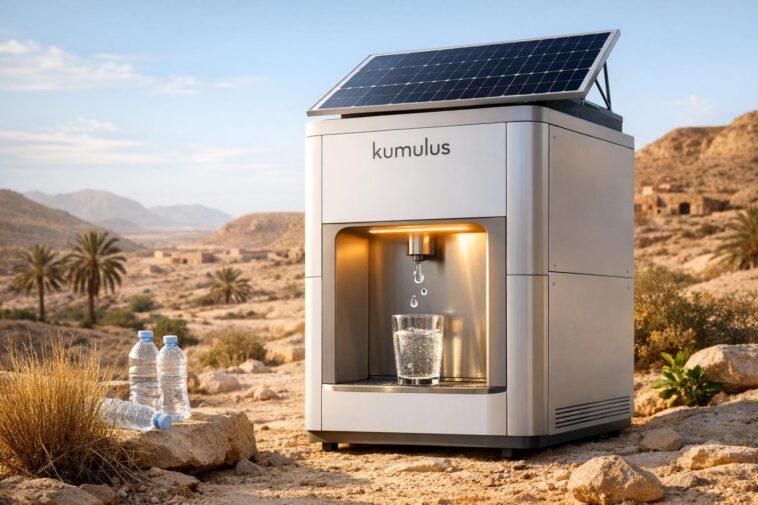
Kumulus is tackling water scarcity by creating drinkable water from air using Atmospheric Water Generation (AWG) technology. This startup, based in Tunisia, has introduced solar-powered machines that condense moisture from the atmosphere into clean, mineralized water. Each unit produces up to 30 liters daily, even in arid conditions, offering a reliable alternative to bottled water and reducing plastic waste.
Key Highlights:
- How It Works: Air is cooled below the dew point, moisture condenses, and the water is purified through a four-step filtration process. It’s then mineralized with calcium and magnesium.
- Cost and Sustainability: Machines cost $5,900, with water production costing about $0.10 per liter. Each unit prevents 500 kg of plastic waste and cuts 2,000 kg of CO₂ emissions annually.
- Deployment: Over 140 units are operational in Tunisia, France, Spain, and Saudi Arabia, producing 1.5 million liters of water to date.
- Impact: Supports schools, villages, and businesses, reducing reliance on bottled water while providing cleaner, local water solutions.
Kumulus aims to scale globally, with plans for larger machines capable of producing up to 2,000 liters daily, targeting industrial and agricultural needs. By 2030, the company envisions becoming a key player in water independence solutions worldwide.


What is Atmospheric Water Generation (AWG)?
sbb-itb-dd089af
How Kumulus Extracts Water from Air
How Kumulus Atmospheric Water Generator Converts Air into Drinking Water
The Science of Atmospheric Water Generation
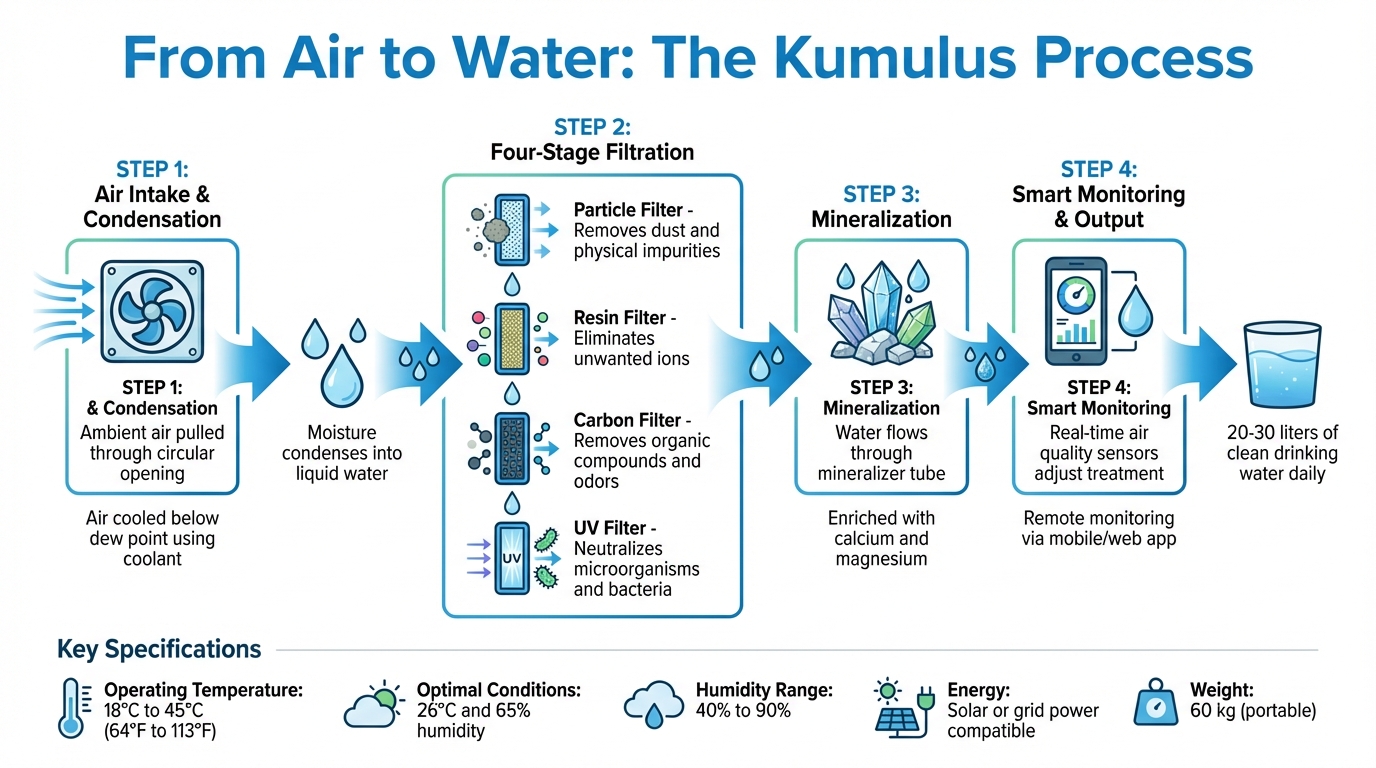
The Amphore machine works by mimicking the natural process of dew formation. It starts by pulling in ambient air through a circular opening at its top using fans. Once inside, the air is cooled with a coolant to bring it below the dew point, causing moisture to condense into liquid. This collected liquid is stored in a reservoir, effectively replicating nature’s dew-forming mechanism with precision.
After gathering the water, the system subjects it to a four-step purification process. First, a particle filter removes dust and other physical impurities. Next, a resin filter eliminates unwanted ions that could alter the water’s taste and safety. Then, a carbon filter tackles organic compounds and odors. Finally, a UV filter, positioned right before the tap, neutralizes microorganisms and kills bacteria.
To ensure the water is not only clean but also nutritionally balanced, it flows through a mineralizer tube filled with calcium and magnesium rocks. Mohamed Ali Abid, Kumulus’s Co-founder and CTO, explains this meticulous process:
"In addition to capturing moisture from the air, we treat the collected water with multiple filters, add mineral salts to make it safe for consumption".
The machine is also equipped with sensors that monitor air quality and adjust the water treatment process in real time. "We have placed sensors throughout the machine to receive data and adjust the water treatment based on the air quality", Abid notes. Additionally, users can track water production and even tweak settings remotely via a mobile or web app, allowing the system to adapt seamlessly to local weather conditions.
Key Features of the Amphore Machine
The Amphore machine is designed to be both practical and versatile, making it suitable for a variety of environments. Weighing about 60 kg (132 lb), it’s portable enough to be transported in a standard pick-up truck. Each unit can produce between 20 and 30 liters (approximately 5 to 8 gallons) of fresh drinking water daily, with peak output achieved at 26°C (79°F) and 65% relative humidity.
The system can operate on solar panels or standard grid power, making it adaptable to different energy sources. It performs best in temperatures ranging from 18°C to 45°C (64°F to 113°F) and relative humidity levels of 40% to 90%. While it excels in humid coastal areas, it’s also effective in Tunisia’s arid desert climate.
On top of producing water, the Amphore contributes to environmental sustainability. Each unit prevents about 500 kg (1,100 lb) of plastic waste and reduces CO₂ emissions by 2,000 kg (4,400 lb) annually. Plus, it ensures the water produced is free from microplastics and harmful PFAS chemicals.
Kumulus’s Journey: From Concept to Implementation
Kumulus transformed from a bold idea into a practical solution aimed at addressing Tunisia’s water challenges, leveraging cutting-edge water technology along the way.
Inspiration from the Tunisian Desert
The idea for Kumulus took shape during a 2020 camping trip in the Tunisian desert. Co-founders Iheb Triki and Mohamed Ali Abid woke up to find their tents and car windows covered in thick dew – a surprising abundance of moisture in such a dry environment. This moment sparked a realization: atmospheric water could be tapped as a decentralized resource.
Both Triki and Abid brought relevant expertise to the table. With backgrounds in renewable energy finance and thermal power, they saw an opportunity to address Tunisia’s pressing water issues. The country’s high reliance on bottled water – ranked 11th globally – and the struggles of rural communities to access clean water underscored the need for a new approach.
This insight set the stage for the duo to secure funding and begin turning their vision into reality.
Funding and Development Milestones
In 2021, Triki and Abid officially launched Kumulus with less than $20,000 in initial capital. They spent months designing and testing prototypes, overcoming early setbacks before finally producing their first drops of water.
"My biggest achievement was the first water drops that came out of the prototype. This breakthrough moment was pivotal", Abid recalls.
That same year, the startup raised $1 million in pre-seed funding, which allowed them to further refine their technology. By 2023, they had launched the Amphore machine and began rolling out commercial deployments. Then, in June 2025, Kumulus secured $3.5 million in seed funding, bringing their total funding to $4.5 million. This round included backing from key investors like Bpifrance, PlusVC, Flat6Labs, and Spadel.
These milestones not only advanced their technology but also brought recognition from the broader industry.
Industry Awards and Recognition
Kumulus’s innovative approach quickly earned acclaim. In 2022, the company won first prize at Vivatech for water innovation. The following year, their Amphore machine received the Grand Award at the Seoul Design Award 2023 for its distinctive design and functionality. Additionally, Kumulus was selected for support through the France 2030 competition and identified as one of the top fifteen GreenTech startups in Africa.
To date, Kumulus has received ten industry awards and successfully deployed over 140 machines in Tunisia, France, Spain, and Saudi Arabia.
Deployment and Impact Across Communities
Kumulus has moved from initial prototypes to global operations, with its water-producing machines now active in countries like Tunisia, France, Spain, and Saudi Arabia. These machines are making a difference in diverse settings, from small rural villages to bustling transit hubs, highlighting their broad applicability.
Supporting Schools and Villages in Tunisia
The first Kumulus unit was installed at Bayadha Elementary School, located in a rural area of western Tunisia. With backing from the Orange Foundation, this initiative provided clean drinking water to schoolchildren who previously lacked easy access. Maya Jerbi, President of the Orange Foundation, described the impact:
"Having water available directly on site means that residents no longer need to travel miles from the village to fetch water".
By June 2023, Kumulus expanded its efforts in Tunisia by installing four solar-powered Amphore machines at Bazma Elementary School in Kebili. These machines produce up to 120 liters of clean water daily, allowing the school to operate independently from the local water grid. Often, such projects are part of corporate social responsibility efforts, with businesses funding these units to support underserved schools.
While schools benefit from these localized solutions, Kumulus’s reach extends to commercial and international markets, showcasing its scalability.
Corporate and Global Applications
In addition to its humanitarian work, Kumulus has attracted commercial clients focused on cutting plastic waste and achieving water independence. For instance, TAV Airports in Tunisia installed 12 Kumulus machines to provide fresh water for employees. This move not only reduced plastic bottle usage but also allowed the company to recover its investment within a year. Meriem Ben Abdeljelil, Director of Engineering & Assets at TAV Airports Tunisia, shared:
"Installing Kumulus’ solutions at the TAV airports has been a complete game changer… we can easily produce high-quality water locally without relying on plastic bottled water".
In France, Paris Est Marne et Bois deployed 17 Kumulus units at bathing sites, offering visitors fresh water while preventing 936 kg of CO₂ emissions. Kumulus also entered the Saudi Arabian market in January 2025, appointing a general manager and announcing plans to expand its decentralized water solutions in the Gulf region.
Measuring the Impact
By late 2025, Kumulus had installed over 120 machines across its markets, producing around 3,000 liters of water daily. This output supports approximately 2,000 people, with total water production reaching 1.5 million liters. In doing so, the company has avoided the use of more than 3.06 million PET bottles. Across all deployments, these machines have significantly reduced plastic waste and CO₂ emissions. Equipped with sensors, the units also provide real-time ESG data, allowing Kumulus to monitor water production, track environmental savings, and adapt to air quality changes.
Economic and Environmental Benefits
Kumulus is making waves not just with its technology but also with the economic and environmental advantages it brings to the table. The system can produce water at around $0.10 per liter, a price that undercuts both bottled water and desalination methods. CEO Iheb Triki summed up the approach:
"In our case, we are cheaper than bottled water to convince people that, yes, they would be better for the environment".
Cost Advantage Over Traditional Methods
One of the standout features of Kumulus is its ability to deliver quick returns on investment while reducing dependence on conventional water delivery systems.
By cutting out expenses tied to water logistics, transportation, and plastic bottle storage, the machines offer a more streamlined and cost-effective solution. Starting at $5,900, with annual maintenance costs ranging from $500 to $1,500, the system is designed to be accessible. Flexible leasing and subscription options further lower the barrier to entry, enabling users to achieve water independence without hefty upfront costs.
Lowering Waste and Energy Consumption
Beyond the financial perks, Kumulus significantly cuts down on waste and energy use. The machines require only 0.4 to 0.8 kWh of energy per liter of water produced and are optimized to run on solar power, making them ideal for off-grid areas. Maya Jerbi, President of the Orange Foundation, highlighted the tangible impact:
"The changes are visible in terms of costs and the environment, since we no longer buy plastic bottles".
This combination of efficient energy use and reduced waste underscores Kumulus’s contribution to sustainable water solutions.
Future Plans and Vision for Scaling
Scaling Production and Global Reach
Kumulus is taking bold steps to expand its reach on a global scale. After securing a substantial seed funding round in June 2025, the company is set to extend its operations beyond Tunisia and France, targeting Spain and the high-demand Saudi Arabian market. Mohamed Ali Abid, Co-founder and CTO, highlighted the importance of this moment:
"This funding allows us to scale not just production, but impact. We have spent the past few years refining a technology that can operate reliably in some of the harshest and most water-stressed environments. Now, we are ready to deploy it at scale".
The company has set its sights on achieving break-even by 2026, supported by the establishment of four country offices to manage its growing international footprint. In January 2025, Kumulus officially launched operations in Saudi Arabia, appointing a General Manager to address the increasing industrial and commercial demand in the region.
This momentum positions Kumulus to deliver next-generation solutions on a global stage.
Advanced Machines for Broader Needs
Kumulus is transitioning from its office-scale Amphore model to the industrial-grade Kumulus Boks, an atmospheric water generator tailored for work camps, industrial facilities, and community centers. Their research and development efforts are now focused on creating next-generation machines capable of producing 1,000 to 2,000 liters of water daily – enough to meet the needs of up to 1,000 people in a single location. These machines are being designed to function off-grid with solar power integration, making them ideal for areas lacking infrastructure.
CEO Iheb Triki shared his ambitious vision for the future, emphasizing Kumulus’ role in ensuring water independence:
"For me, in 10 years, Kumulus will become the water utility of the future, with high tech that allows any institution, factory, offices, homes, to have the full independence when it comes to drinking water".
In addition to drinking water, the company is exploring new applications for its technology in agriculture and industry, harnessing the moisture in the air to address a range of water needs.
These developments signal an exciting leap toward broader possibilities across multiple sectors.
Conclusion
Kumulus has demonstrated that turning air into water isn’t just a concept – it’s a practical solution to a pressing global need. With over 140 machines operating in Tunisia, France, Spain, and Saudi Arabia, the company has already produced 1.5 million liters of water, prevented the use of 3.06 million plastic bottles, and cut 800 tons of CO₂ emissions. These numbers represent real change for families, schools, and communities, providing them with steady access to clean water without relying on outdated infrastructure.
From its humble beginnings as a $20,000 startup in the Tunisian desert to securing $4.5 million in funding, Kumulus has proven that atmospheric water generation can be a game-changer for climate resilience. Projects like the collaboration with the Orange Foundation in Bayadha and the installation at TAV Airports – which achieved a full return on investment within a year – highlight the environmental and financial benefits of this technology.
Kumulus’s vision for the future is just as ambitious. CEO Iheb Triki sees the company evolving into a next-generation water utility, empowering institutions to achieve drinking water independence. With plans to expand further into Saudi Arabia, roll out industrial-scale machines capable of producing up to 2,000 liters of water daily, and hit break-even by 2026, Kumulus is transitioning from a promising idea to a global solution.
Innovations like Kumulus are reshaping water access for the billions of people facing scarcity. With one in four Africans lacking access to safe drinking water and droughts worsening due to climate change, decentralized water production offers a critical path forward. Atmospheric water – holding six times more water than all the rivers on Earth combined – has the potential to redefine how we approach water security. By harnessing this resource, Kumulus is delivering sustainable solutions, reducing environmental impact, and creating water independence for communities that need it most.
FAQs
How does Kumulus create drinkable water from air in dry climates?
Kumulus employs an atmospheric water generator to draw moisture from the air, even in areas with extremely dry conditions. Here’s how it works: air is pulled into a solar-powered unit, cooled through a highly efficient heat exchange process, and the water vapor is condensed into liquid form. Once collected, the water undergoes filtration, disinfection, and mineral enrichment to ensure it’s safe for drinking.
Even in challenging environments like Tunisia, where average temperatures hover around 78°F with about 65% humidity, a single Kumulus unit can generate 5–8 gallons of clean water daily. This output is sufficient to meet the needs of small schools or community centers. Powered by solar energy and adapting to real-time conditions, the system delivers a reliable, local water source while cutting down on the need for bottled water and the logistics that come with it.
What are the cost advantages of using Kumulus machines compared to traditional water sources?
Kumulus machines bring a fresh approach to water sourcing by offering substantial savings compared to traditional methods. Each unit runs on solar power or can connect to the grid, significantly lowering energy expenses that are usually tied to large-scale water treatment plants or high-powered pumps. Plus, their compact and portable design – small enough to fit in the back of a pickup truck – removes the need for costly infrastructure like pipelines or boreholes.
With the ability to produce 20–30 liters (5–8 gallons) of mineralized drinking water daily, a single Kumulus machine can replace dozens of bottled water cases. This not only reduces the cost of purchasing and transporting bottled water but also offers a practical solution in areas with high bottled water consumption, such as Tunisia. The modular design of these units allows for quick setup of multiple machines, ensuring a steady, on-site water supply without relying on imported or trucked water, which often comes with unpredictable price changes. These advantages position Kumulus machines as an economical and practical answer to water scarcity challenges.
How is Kumulus planning to expand its operations worldwide?
Kumulus is gearing up for global expansion, fueled by $3.5 million in recent funding. With this boost, the company plans to roll out new products and ramp up production capacity. A key focus is the Kumulus Boks series, along with increasing the availability of its water-from-air units to cater to larger businesses and off-grid locations.
The company is honing in on markets like Saudi Arabia, France, Spain, and North Africa, leveraging direct sales and local partnerships to make inroads. By the close of 2025, Kumulus intends to have more than 200 machines in operation, including new models such as the Boks and Water-Cooler. These will complement the existing Amphore units, which can produce approximately 800 gallons of water daily.
What sets Kumulus apart is its flexible technology, capable of generating 5–8 gallons of drinking water per day using either grid electricity or solar power. This versatility makes it a practical solution for remote areas, schools, factories, and corporate campuses. Looking ahead, Kumulus plans to focus on developing new products, securing additional funding, and tackling water scarcity in regions where it’s needed most.
Related Blog Posts
- 5 African Startups Advancing Battery Recycling
- 10 Startups to Watch in 2025 in North Africa
- 5 African Startups Innovating Water-Saving Tech
- Cleantech Rising: Investors Eye Africa’s Green Economy in 2025