Kevin Mwangi

Nigeria and South Africa introduced major data laws in 2025, reshaping how businesses handle personal information. Nigeria’s NDPA 2023, effective September 19, enforces strict rules like mandatory registration for high-risk data processors, 72-hour breach reporting, and penalties up to ₦10 million or 2% of annual revenue. Meanwhile, South Africa’s POPIA focuses on privacy rights with updated consumer protections, including digital deletion requests via SMS or WhatsApp starting April 2025.
Key Highlights:
- Nigeria (NDPA):
- Applies to foreign companies targeting Nigerian users.
- Data Controllers/Processors of Major Importance (DCPMIs) must register and appoint a Data Protection Officer.
- Breach notifications required within 72 hours.
- Fines: Up to ₦10 million or 2% of annual revenue.
- South Africa (POPIA):
- Protects data of individuals and companies.
- New digital consumer rights (e.g., SMS/WhatsApp requests for data deletion).
- Fines: Up to ZAR 10 million, with possible imprisonment for violations.
Quick Comparison:
| Feature | Nigeria (NDPA) | South Africa (POPIA) |
|---|---|---|
| Scope | Extraterritorial | Within South Africa |
| Registration | Mandatory for high-risk processors | Not required |
| Breach Notification | 72 hours | Required (via portal by April 2025) |
| Maximum Fine | ₦10 million or 2% of revenue | ZAR 10 million |
Both frameworks demand businesses prioritize data security and user privacy. Startups operating in these regions must tailor compliance strategies accordingly, as the rules differ significantly.


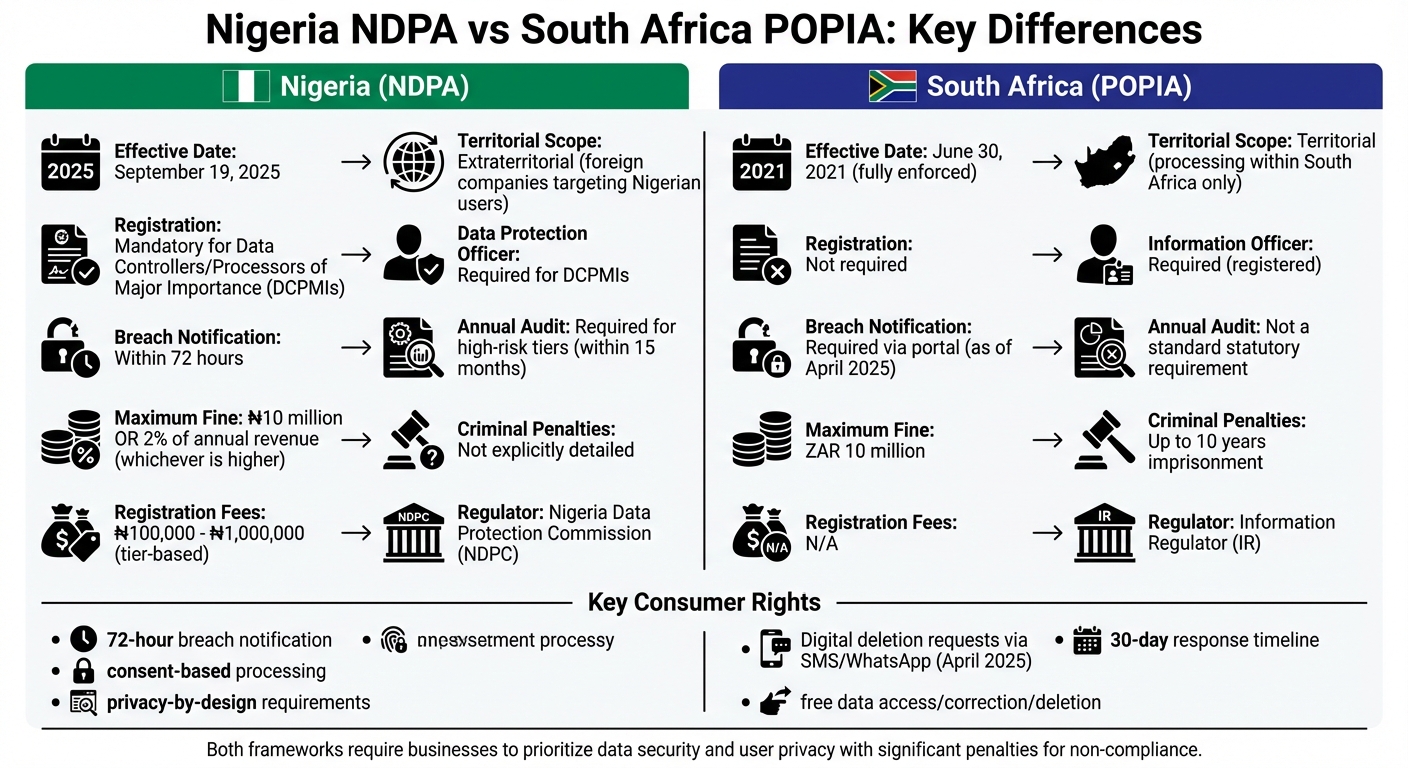
Nigeria NDPA vs South Africa POPIA: Key Differences for Tech Startups
Nigeria Data Protection Act (NDPA) 2023: Key Provisions
What the NDPA Covers and Its Goals
The Nigeria Data Protection Act (NDPA) has brought significant changes by establishing the Nigeria Data Protection Commission (NDPC) as an independent regulatory authority. Its primary aim is to protect privacy rights as outlined in Section 37 of the 1999 Constitution. But the Act doesn’t stop at privacy – it also promotes strong data security practices, supports the growth of Nigeria’s digital economy, and ensures the country remains competitive in global trade through trusted data management.
"By having a stronger protective regime for data privacy, in tune with global best practices, Nigeria hopes to help boost international trade and commerce".
The NDPA applies to both local and foreign organizations that process the personal data of individuals located in Nigeria. Personal data includes any information that can identify an individual, such as names, identification numbers, or location details. This broad scope sets the stage for the compliance measures businesses must follow.
What Businesses Must Do to Comply
To meet the NDPA’s requirements, businesses need a lawful reason for processing personal data. This could be based on consent, a contract, legal obligations, vital interests, public interest, or legitimate interests. The Act mandates that data processing must be fair, transparent, and limited to specific purposes. Data must also be accurate, kept only as long as necessary, and handled securely.
When transferring data across borders, businesses must ensure the receiving country has adequate data protection laws or use safeguards like binding corporate rules or specific contractual clauses.
The NDPA also introduces a special category for Data Controllers or Processors of Major Importance (DCPMIs). These are organizations handling large volumes of sensitive data. DCPMIs must register with the NDPC and appoint a Data Protection Officer with specialized expertise. Non-compliance comes with steep penalties: a Standard Maximum penalty (₦2 million or 2% of annual gross revenue, whichever is higher) and a Higher Maximum penalty for DCPMIs (₦10 million or 2% of annual gross revenue, whichever is higher). These rules are particularly impactful for tech startups.
How the NDPA Affects Tech Startups
For tech startups in Nigeria, the NDPA introduces new operational challenges – starting with the requirement to adopt Privacy-by-Design. This approach integrates data protection measures directly into the development of products and services from the very beginning. Startups leveraging technologies like AI must prioritize Privacy-by-Design to ensure compliance.
The Act’s enforcement has already led to significant fines for organizations failing to meet its standards. Investigations into digital lending practices highlight the NDPA’s strict oversight. To align with the law, startups should implement technical safeguards like encryption and pseudonymization, improve consent mechanisms to offer clear acceptance or rejection options, and establish Data Processing Agreements with third-party vendors.
"Strong data protection laws are needed for responsible AI development and deployment".
South Africa Protection of Personal Information Act (POPIA): Key Provisions
Main Principles of POPIA
South Africa’s Protection of Personal Information Act (POPIA) lays out eight essential conditions for processing personal data lawfully. These principles include:
- Accountability: Data controllers are responsible for ensuring compliance throughout the data lifecycle.
- Processing Limitation: Data must be processed lawfully, only as necessary, and typically with consent.
- Purpose Specification: Personal data should be collected solely for specific, clearly defined, and lawful purposes.
- Further Processing Limitation: Any subsequent use of the data must align with its original purpose.
- Information Quality: Data must be accurate, complete, and kept up to date.
- Openness: Organizations must be transparent about their data collection practices, including identifying the responsible parties.
- Security Safeguards: Proper technical and organizational measures must be in place to prevent unauthorized access.
- Data Subject Participation: Individuals have the right to access, correct, or delete their personal data.
A unique aspect of POPIA is that it protects the personal information of both individuals and juristic persons, such as companies or entities. This dual focus aims to balance the constitutional right to privacy with the need for access to information and the free flow of data. Notably, amendments taking effect on April 17, 2025, will allow individuals to submit digital objections and deletion requests through platforms like SMS and WhatsApp.
These principles form the backbone of the responsibilities businesses and startups must adhere to under POPIA.
What Companies and Startups Must Do
South African businesses, particularly startups, have specific obligations under POPIA. One of the primary requirements is appointing a registered Information Officer. By 2025, these officers will be responsible for creating and updating compliance frameworks and conducting personal information impact assessments. Maintaining a comprehensive Data Asset Register is also recommended to streamline compliance efforts.
When it comes to direct marketing, companies must secure explicit consent – using methods like Form 4 or a similar approach – before sending unsolicited electronic communications. Importantly, an "opt-out" mechanism does not meet the consent requirements. For cross-border data transfers, businesses must ensure the destination country has adequate data protection standards.
Non-compliance carries serious consequences, including administrative fines ranging from ZAR 1,000,000 to ZAR 10,000,000. In more severe cases, violations can lead to imprisonment for 1 to 10 years. Startups should also begin preparing their systems to accommodate digital responses, as outlined in the updated consumer rights provisions.
Consumer Rights Under POPIA
POPIA also prioritizes consumer rights, granting individuals significant control over their personal data. Consumers can object to data processing at any time. Beyond basic rights like accessing, correcting, and deleting personal information, individuals can request the destruction of data that is inaccurate, irrelevant, excessive, or processed unlawfully. Additionally, the Act protects consumers from decisions made solely through automated processing that profiles them.
If a company violates these rights, consumers can file complaints with the Information Regulator using Form 5. Complaints can be submitted online, by post, or via email, and the Regulator is required to acknowledge receipt and provide a reference number within 14 days. Companies must respond to correction or deletion requests within 30 days. Crucially, all requests – whether for objections, corrections, or deletions – must be processed free of charge, ensuring financial barriers don’t limit individuals’ ability to exercise their privacy rights.
NDPA vs. POPIA: Side-by-Side Comparison
Comparison Table: Main Differences
Nigeria and South Africa have established distinct frameworks for data protection, each with its own set of rules and requirements.
| Feature | Nigeria (NDPA + GAID 2025) | South Africa (POPIA) |
|---|---|---|
| Primary Regulator | Nigeria Data Protection Commission (NDPC) | Information Regulator (IR) |
| Registration | Mandatory for "Major Importance" tiers | Generally not mandatory |
| Annual Audit | Required for high-risk tiers (within 15 months) | Not a standard statutory requirement |
| Breach Notification | Within 72 hours of awareness | Required (via portal as of April 2025) |
| Response Timeline | Defined in GAID templates | 30 days for rights requests |
| Territorial Scope | Extraterritorial (applies to anyone processing Nigerian data) | Territorial (processing within South Africa only) |
| Maximum Administrative Fine | Greater of ₦10,000,000 or 2% of annual gross revenue | ZAR 10,000,000 |
| Criminal Penalties | Not explicitly detailed | Up to 10 years imprisonment |
Nigeria’s NDPA applies to any entity processing data from Nigerian residents, regardless of its location, while POPIA is limited to activities within South Africa.
Under NDPA, high-risk startups must register with the NDPC and pay yearly fees ranging from ₦100,000 to ₦1,000,000, depending on their tier and the number of data subjects. In contrast, South African companies are not required to register under POPIA.
POPIA, which became effective in 2021, is often seen as aligned with GDPR. Nigeria’s NDPA, however, began active enforcement in 2025, with notable fines like Fidelity Bank‘s $358,580 and Multichoice Nigeria‘s ₦766 million. As VinciWorks highlighted:
"The African landscape of data protection has shifted from peripheral concern to core business risk".
What These Differences Mean for Tech Startups
For tech startups, these differences create distinct compliance challenges. Operating in both countries requires separate strategies, as there’s no uniform "African GDPR." Businesses must treat NDPA and POPIA as entirely different frameworks due to their unique definitions, registration triggers, and enforcement practices.
Startups serving Nigerian customers must comply with NDPA’s registration and audit requirements, even if they are based outside Nigeria.
The NDPA’s audit rules add another layer of complexity. High-tier controllers in Nigeria must conduct annual data protection audits through licensed third-party Data Protection Compliance Organizations (DPCOs) within 15 months of starting operations. On the other hand, South Africa emphasizes lawful processing and privacy notices but doesn’t require annual audit filings. Startups should plan for these costs – compliance audit filing fees in Nigeria can reach ₦1,000,000 for ultra-high-level entities managing data for over 50,000 subjects.
Enforcement timelines also vary. Nigeria has moved aggressively toward stricter enforcement, with regulatory inspections beginning in September 2025 under the General Application and Implementation Directive (GAID). In contrast, South Africa’s Information Regulator has been steadily issuing enforcement notices, particularly targeting direct marketers who fail to establish lawful processing grounds.
To handle cross-border compliance, startups can localize sensitive data (such as financial data in Nigeria) on local servers while using anonymized data for global analytics. This approach enables companies to meet regulatory standards in both countries without overhauling their entire infrastructure.
sbb-itb-dd089af
Emerging Trends in Data Privacy in Nigeria and Other Select Jurisdictions
How African Tech Startups Can Meet Compliance Requirements
To keep up with the changing NDPA and POPIA mandates, African tech startups need to adopt smart, efficient strategies for compliance.
Creating a Compliance Plan
Start by conducting a thorough data audit to identify and classify all personal data based on its sensitivity. Assign a compliance leader – such as an Information Officer under POPIA or a Data Protection Officer (DPO) if classified as a DCPMI in Nigeria – to oversee and report on data protection efforts. As Mary Ajibola from Lexworth Legal Partners explains:
"The DPO is required to compile a semi-annual report, submit it to management, and ensure it is delivered to the officer of the data controller/processor authorized to receive records of processing activities".
Update your privacy policies to ensure clear user consent. For example, in Nigeria, cookie notices must be prominent and partially block the screen to encourage active user acceptance or rejection. Strengthen your safeguards with measures like encryption, multi-factor authentication, and a robust data breach response plan that adheres to Nigeria’s 72-hour reporting rule.
If your startup is considered high-risk in Nigeria, you’ll also need to register with the NDPC and prepare for compliance audits, as non-compliance can result in hefty penalties.
Once a solid compliance framework is in place, technology can help streamline these efforts even further.
Using Technology to Simplify Compliance
Leverage automation tools to manage consent and handle data subject requests, reducing the manual workload. Licensed DPCOs can assist in streamlining compliance audits, while automated security monitoring tools ensure ongoing system checks. Under the GAID 2025, startups are required to process access, correction, and portability requests "seamlessly". Automated workflows can help meet these obligations within POPIA’s 30-day response window.
Ensure all vendor relationships are backed by updated Data Processing Agreements that include NDPA and POPIA compliance terms. Automated security tools can also continuously test and certify your data protection systems, reducing risks and simplifying audits.
Turning Compliance into Business Opportunities
Strong compliance practices, combined with automation, can become a competitive advantage. By embedding privacy-by-design principles into your products, you can enhance customer trust and use compliance as a selling point to attract global investors. As Captain Compliance puts it:
"Compliance with POPIA is not just about avoiding fines – it’s about building a sustainable, customer-centric business that respects privacy and earns trust".
Adopt Interoperable Data Privacy Measures (IDPMs) to align with international standards, making cross-border data flows smoother and boosting credibility with global partners. Additionally, use the Standard Notice to Address Grievance (SNAG) mechanism to resolve privacy issues internally before they escalate to regulatory authorities. Shifting the focus from basic legal compliance to "data ethics" – which emphasizes transparency, fairness, and respect for user rights – not only minimizes reputational risks but also fosters long-term customer loyalty.
Conclusion
Nigeria’s NDPA and South Africa’s POPIA represent a significant shift in how data is managed, bringing stricter accountability and enforcement to the forefront. As of September 19, 2025, Nigeria has officially transitioned from the NDPR to the NDPA and GAID 2025. Meanwhile, South Africa’s POPIA, fully in effect since its grace period ended on June 30, 2021, continues to set the standard for GDPR-aligned data protection across the continent. This evolving regulatory environment requires startups to not only comply but also rethink their approach to data management.
For startups operating in these markets, compliance isn’t just a box to check – it’s a cornerstone for long-term success. Regulatory enforcement highlights the steep financial and reputational costs of non-compliance. Mary Ajibola of Lexworth Legal Partners puts it well:
"Early alignment will not only mitigate regulatory risks but also demonstrate accountability and good corporate governance".
Startups can stay ahead by embedding privacy-by-design principles from the outset, automating consent management, and leveraging tools like the SNAG system to handle disputes internally. These proactive measures can turn regulatory hurdles into opportunities for differentiation and growth.
Adapting to these laws is about more than just avoiding penalties – it’s about building businesses that are both sustainable and trustworthy in Africa’s fast-changing digital economy. As the Nigeria Data Protection Commission has stated:
"We are committed towards making data privacy a cornerstone of sustainable digital economy in Nigeria".
Startups that align with this vision today will be better positioned to scale tomorrow, both within Africa and beyond. By embracing these regulatory frameworks, businesses can lay the foundation for growth and establish themselves as leaders in trusted digital innovation.
FAQs
How do Nigeria’s NDPA and South Africa’s POPIA differ?
Nigeria’s Nigeria Data Protection Act (NDPA) and South Africa’s Protection of Personal Information Act (POPIA) aim to regulate data privacy, but they approach this goal with different priorities. The NDPA, which will be fully implemented by 2025, focuses on setting clear compliance standards for businesses while encouraging growth in Nigeria’s expanding tech sector. In contrast, POPIA, enforced since 2021, places a strong emphasis on safeguarding personal data and ensuring that processing practices are handled responsibly.
A closer look at specific aspects of these laws – like consent rules, timelines for reporting data breaches, and penalties for violations – can highlight the distinctions between them. If you can provide more details about POPIA, we can dive deeper into how these differences impact businesses operating in both countries.
What impact will Nigeria and South Africa’s new data laws have on tech startups?
Nigeria’s data landscape is set to change in 2025 with the introduction of the Nigeria Data Protection Act (NDPA) and the General Application and Implementation Directive (GAID). These laws will impose stricter data privacy regulations on tech startups. Companies managing personal data will need to register with the Nigeria Data Protection Commission (NDPC) as either a "data controller" or "data processor." They’ll also have to appoint a qualified Data Protection Officer (DPO) to handle critical responsibilities like conducting privacy assessments, keeping accurate processing records, and ensuring data is collected on lawful grounds, such as consent or contractual necessity. Failure to comply could lead to fines or other enforcement actions.
Although these changes might increase operational expenses, startups can use compliance as a way to build trust with their customers by demonstrating strong privacy practices. Meeting these standards could also make startups more appealing to investors and partners who value data security.
As for South Africa, details about its 2025 data law reforms remain sparse. However, businesses operating there should stay alert for updates to ensure they’re ready for any similar compliance measures.
What do businesses need to do to comply with Nigeria’s NDPA and South Africa’s POPIA?
To align with Nigeria’s NDPA and South Africa’s POPIA, businesses need to focus on several critical areas to ensure compliance:
- Register with relevant authorities: Businesses must register with Nigeria’s Data Protection Commission (NDPC) and South Africa’s Information Regulator to operate within the legal framework.
- Appoint a compliance officer: A qualified data protection or information officer should be designated to manage and oversee compliance activities effectively.
- Perform risk assessments: Conduct thorough Data Protection Impact Assessments (DPIAs) to identify potential risks and establish measures to address them.
- Strengthen data security: Put in place strong security protocols to safeguard sensitive data from breaches or unauthorized access.
- Obtain proper consent: Collect and document clear, lawful consent from individuals before processing their personal information.
- Uphold data rights: Respond promptly to requests from individuals to access, correct, or delete their personal data as required by law.
- Maintain reporting and auditing practices: Regularly submit compliance audits and immediately report any data breaches to the appropriate authorities.
Taking these steps not only helps businesses stay compliant with legal requirements but also enhances customer trust and positions them as responsible stewards of personal data.
Related Blog Posts
- Best Practices for SME Cybersecurity in Africa
- Nigeria Labor Laws: Key Rules for Startups
- Ethical AI: Navigating Governance and Compliance in Africa
- Healthtech Regulation 2025: What Founders Need to Know