Kevin Mwangi

OpenAI‘s new Agent Tools – launched in October 2025 – offer a faster, simpler way for businesses to automate tasks, improve customer support, and streamline operations. These tools include AgentKit, Agent Builder, ChatKit, and Agents SDK, which handle everything from browsing and coding to file searches. For African startups and SMEs, this means:
- Faster Development: Build apps 4x quicker and cut iteration cycles by 70%.
- Cost Savings: Affordable pricing avoids high licensing fees, starting at $25 per 1,000 queries for web search.
- Efficiency Gains: Automate repetitive tasks like data entry and customer support, reducing manual workloads.
- Scalability: Tools like the Responses API and Agents SDK help small teams manage growing demands without hiring more staff.
With limited resources and high manual workloads, African businesses can now adopt these tools to save time, reduce costs, and handle tasks more efficiently. Start small with prototypes, track results, and scale up gradually to maximize impact.

How To Use OpenAI Agent Builder For Beginners
Problems Facing African Startups, SMEs, and Customer Support Teams
African startups are facing a tough road to growth, especially as venture capital funding shrinks and resources remain tight. In 2024, venture capital for African startups plunged by 46%, leaving many businesses scrambling to stretch their limited resources. Meanwhile, small, medium, and micro enterprises (SMMEs) play a vital role in South Africa’s economy, contributing 34% to the GDP and employing over 60% of the workforce. These challenges highlight the urgent need for tools that can simplify operations and improve efficiency.
Limited Resources and Manual Work
African startups and SMEs often operate with small teams and tight budgets. In South Africa, SMMEs make up 91% of formal businesses, yet many are bogged down by manual processes that eat into their time and resources. With only 3% of global AI talent based in Africa, these businesses are forced to rely on outdated workflows. For instance, banking teams frequently draft credit memos manually, while healthcare workers spend hours on tedious paperwork.
Infrastructure issues only add to the strain. South Africa has some of the highest mobile data costs in the world, and African data centers account for less than 1% of the global total as of 2024. These barriers make it even harder for startups and SMEs to adopt modern, scalable solutions.
Customer Support Delays and Overload
Customer support teams are often overwhelmed by the sheer volume of inquiries they receive. Traditional rule-based systems struggle to handle complex or nuanced situations, leaving businesses with slow and inefficient processes. Without automation, companies can face weeks of development time and iteration cycles that stretch across two quarters just to set up a functional support system.
The stakes are high. Impersonation fraud in South Africa surged by 356% between April 2022 and April 2023, but many businesses lack the tools to respond quickly. Manual workflows for handling unstructured data and natural language interactions are not only cumbersome but also expensive, making it nearly impossible for small teams to scale their operations effectively.
Workflow Problems in Fintech and E-commerce
Fintech and e-commerce companies face their own set of operational challenges. Many still rely on manual invoicing and financial reconciliation, while outdated sales systems fail to reflect real-time inventory. This can lead to overselling or delays in procurement, frustrating both businesses and their customers.
Take OpenAI’s Go-to-Market Innovation team as an example. In September 2025, they were receiving thousands of leads each month but could only engage with a small fraction. Their static lead management system provided generic responses, missing the chance to address customer-specific needs and ultimately losing revenue opportunities.
"We were getting thousands of leads a month and only had capacity to talk to a small fraction. Some leads needed a couple of questions answered to really make a great buying experience, but we weren’t able to provide that personalized experience."
- Harsha Chilakamarri, Go-to-Market Innovation, OpenAI
These inefficiencies highlight the need for scalable tools that don’t require proportional increases in staff. For SMEs operating on razor-thin margins, relying on incremental hiring isn’t a sustainable solution. Instead, businesses need smarter systems that can handle growing demands without breaking the bank.
How OpenAI’s Agent Tools Solve These Problems
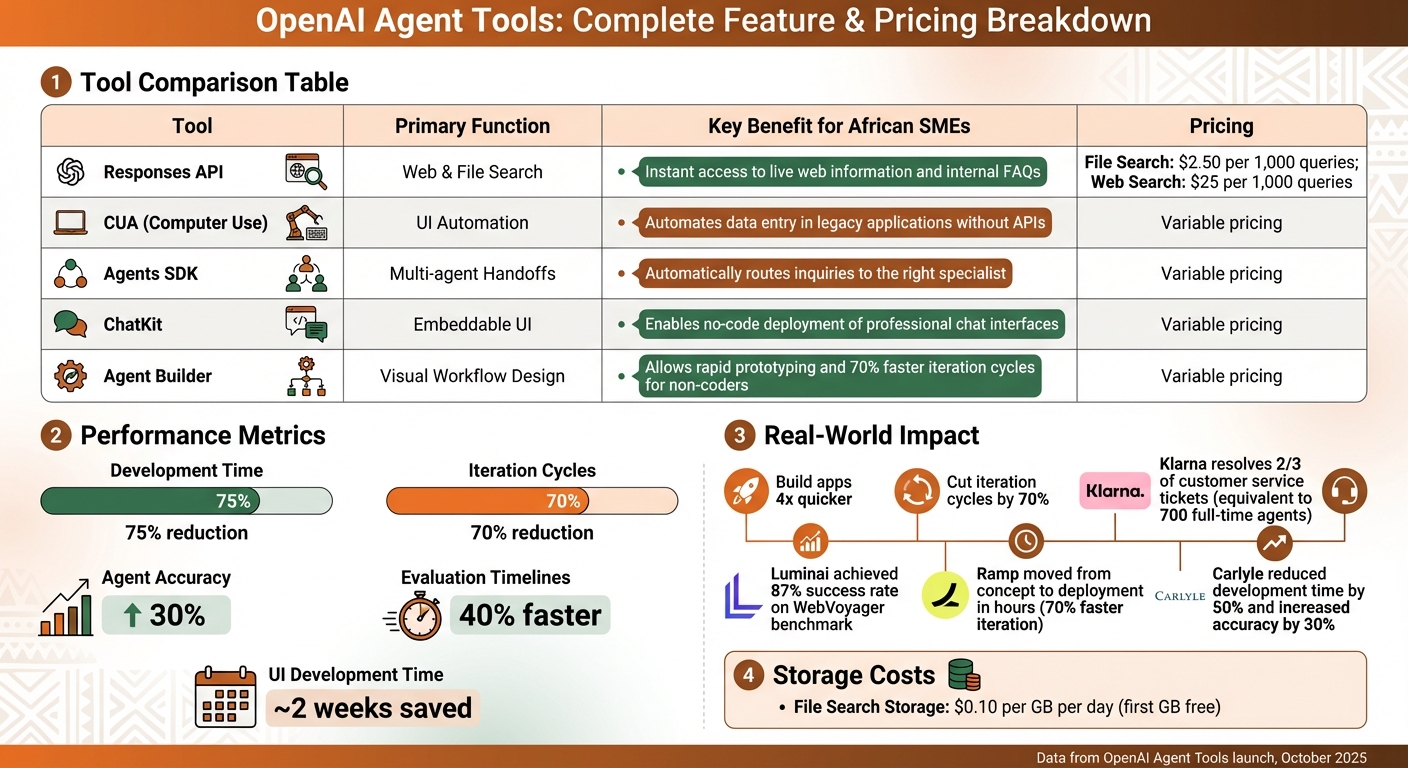
OpenAI Agent Tools: Features, Benefits and Cost Comparison for African SMEs
OpenAI’s agent tools are designed to tackle inefficiencies by automating tasks, speeding up support processes, and streamlining operations, making them especially beneficial for African startups and SMEs. Here’s how these tools address specific challenges.
Automating Customer Support with Responses API and CUA
For businesses struggling with slow customer support, the Responses API offers a solution by combining live web search and file retrieval in a single call. This allows agents to provide accurate answers using both real-time web data and internal resources. For example, in early 2025, Navan (formerly TripActions) used the File Search tool to create an AI-powered travel agent. This tool efficiently answered questions based on internal travel policies and knowledge-base articles, all at a cost of $2.50 per 1,000 queries, with storage priced at $0.10 per GB per day (the first GB is free).
The Computer-Using Agent (CUA) takes automation further by handling repetitive tasks like data entry and form processing in legacy systems. In March 2025, Luminai implemented a CUA-powered agent for a community service organization, automating application processing and user enrollment. This deployment achieved an 87% success rate on the WebVoyager benchmark and significantly cut processing times. Similarly, Klarna‘s support agent – built with these tools – now resolves two-thirds of its customer service tickets.
Improving Business Workflows with Agents SDK
Workflow inefficiencies can slow down business operations, but the Agents SDK simplifies this by enabling specialized agents to collaborate seamlessly. Its "Handoffs" feature ensures inquiries are routed to the appropriate specialist, making the process up to four times faster than manual methods. In October 2025, Ramp used the Agent Builder – part of the toolkit – to create a buyer agent. This tool allowed them to move from concept to deployment within hours, reducing iteration cycles by 70%, a game-changer for resource-limited businesses.
"Agent Builder transformed what once took months of complex orchestration, custom code, and manual optimizations into just a couple of hours." – Ramp
For industries like fintech and e-commerce, where manual invoicing and outdated sales systems are common hurdles, the Agents SDK automates tasks such as transaction reconciliation, recurring financial reporting, and procurement workflows. Built-in safeguards also protect sensitive data by masking personally identifiable information (PII), ensuring security in high-risk environments.
Scaling Operations with AgentKit
AgentKit goes beyond workflow automation by enabling fast, visual prototyping, making it ideal for small and medium-sized businesses with limited technical resources. The Agent Builder’s drag-and-drop interface allows non-technical teams to design and modify workflows quickly. This rapid deployment capability is crucial for SMEs aiming to stay competitive. Additionally, the Connector Registry centralizes access to data sources like Google Drive, SharePoint, and CRMs, ensuring agents can securely retrieve proprietary information.
In March 2025, Coinbase utilized the Agents SDK to prototype and deploy "AgentKit", a toolkit that empowers AI agents to interact with crypto wallets and perform on-chain activities. This entire process was completed in just a few hours.
| Tool | Primary Function | Key Benefit for African SMEs |
|---|---|---|
| Responses API | Web & File Search | Instant access to live web information and internal FAQs |
| CUA (Computer Use) | UI Automation | Automates data entry in legacy applications without APIs |
| Agents SDK | Multi-agent Handoffs | Automatically routes inquiries to the right specialist |
| ChatKit | Embeddable UI | Enables no-code deployment of professional chat interfaces |
| Agent Builder | Visual Workflow Design | Allows rapid prototyping and 70% faster iteration cycles for non-coders |
sbb-itb-dd089af
How to Implement OpenAI’s Agent Tools in Your Business
If you’re looking to integrate OpenAI’s agent tools into your business, here’s how you can get started effectively:
Start Small with Prototypes and Scale Up
Begin with a simple prototype using high-performing models and aim to refine the solution as you go. Focus on automating a single, high-value workflow – like routing customer support tickets or processing invoices – where automation can make an immediate impact. This approach allows you to optimize costs while testing the waters.
For instance, in October 2025, LY Corporation, a technology firm based in Japan, leveraged Agent Builder to create a multi-agent work assistant. By combining the expertise of engineers and subject matter experts within a visual interface, they successfully built and executed their first complex workflow in under two hours. This example highlights how multi-agent systems can accelerate workflow creation compared to traditional single-agent methods.
You can also repurpose existing documentation – such as operating procedures, support scripts, or policies – into actionable agent instructions. Agent Builder’s drag-and-drop interface simplifies rapid prototyping. Once your prototype is ready, incorporate human-in-the-loop mechanisms and set failure thresholds to ensure safety when handling high-risk tasks.
After deploying your prototype, monitor its performance closely and make adjustments to fine-tune the system for better outcomes.
Track Results and Efficiency Improvements
To validate your investment, measure the results. OpenAI offers built-in evaluation tools that can help you track key performance metrics before and after deployment. Carlyle, for example, used these tools to streamline their due diligence framework, reducing development time by over 50% and improving agent accuracy by 30%.
"The evaluation platform cut development time on our multi-agent due diligence framework by over 50%, and increased agent accuracy 30%." – Carlyle
Define custom metrics that align with your business goals, such as resolution rates, processing speeds, or cost per transaction. OpenAI’s Trace Grading feature can assess thousands of past executions, pinpointing areas where your agents might need improvement. For businesses in Africa, tracking metrics like the number of tickets resolved autonomously, development hours saved, and accuracy improvements can clearly demonstrate the value of these tools.
Here’s a snapshot of the potential improvements you can achieve:
| Metric | Potential Improvement |
|---|---|
| Development Time | 75% reduction |
| Iteration Cycles | 70% reduction |
| Agent Accuracy | 30% increase |
| Evaluation Timelines | 40% faster |
| UI Development Time | ~2 weeks saved |
Conclusion: What OpenAI’s Agent Tools Mean for African Business Growth
OpenAI’s agent tools are reshaping how African startups, small businesses, and customer support teams operate on a global scale. By automating repetitive tasks and simplifying complex workflows, these tools empower small teams to accomplish what previously required large departments. Take Klarna’s support agent as an example – it now manages two-thirds of customer service tickets, a workload that would have needed 700 full-time agents. This kind of efficiency is no longer limited to enterprises with massive budgets.
For African businesses working with limited resources, these tools significantly shorten development timelines. What used to take six months can now be done in just four weeks. With a 70% reduction in iteration cycles and a 75% decrease in development time, entrepreneurs can adapt quickly, validate ideas faster, and enter markets with minimal upfront investment.
The affordability of these tools makes them especially valuable in the African market. For instance, web search starts at $25 per 1,000 queries, while file search costs $2.50 per 1,000 queries. This pricing structure breaks down traditional barriers to AI adoption, making automation accessible to even the most budget-conscious startups.
Another game-changer is how these tools address the engineering talent gap faced by many African businesses. Platforms like Agent Builder allow subject matter experts to collaborate directly with developers through user-friendly visual interfaces, reducing the need for advanced technical skills. Whether it’s automating customer support or speeding up workflow design, these tools help tackle resource limitations and reduce manual workloads.
For African companies looking to scale, OpenAI’s agent tools provide a practical roadmap: start with small, manageable projects, measure their impact, and expand gradually. By combining affordability and efficiency, these tools streamline operations while fueling innovation. With lower costs, faster rollouts, and improved accuracy, businesses of any size or location can achieve sustainable growth and compete on a global stage.
FAQs
How can African startups use OpenAI’s Agent Tools to maximize efficiency with limited resources?
African startups have a powerful ally in OpenAI’s Agent Tools, which can streamline operations by automating essential tasks. This means businesses can operate efficiently without needing large teams or extensive infrastructure. These AI-powered agents are capable of managing tasks like customer support, data handling, and workflow automation – freeing up time for startups to focus on scaling and innovation.
With tools like Agent Builder and AgentKit, businesses can design and implement solutions tailored to their specific needs in no time. These tools are user-friendly, integrate seamlessly with existing systems, and require only basic technical know-how, making them a great fit for resource-conscious startups. By automating repetitive tasks and enabling smarter decision-making, startups can improve customer satisfaction and expand their reach in sectors such as fintech, e-commerce, and technology.
How can OpenAI’s Agent Tools improve customer support for African SMEs?
OpenAI’s Agent Tools offer a game-changing solution for African SMEs by automating repetitive tasks like handling common customer inquiries. This not only cuts down response times but also trims operational costs, freeing up teams to concentrate on addressing more complex customer needs. The result? Better service quality overall.
Another key advantage is the 24/7 availability these tools provide. Businesses can assist customers even outside normal working hours, ensuring no query goes unanswered. By simplifying workflows and boosting efficiency, SMEs can deliver a smoother, more reliable customer experience – building loyalty and paving the way for sustained growth.
How can OpenAI’s Agent Tools help African businesses overcome the shortage of engineering talent?
OpenAI’s Agent Tools are helping to bridge the engineering talent gap in Africa by streamlining complex workflows and minimizing the need for advanced coding expertise. Tools like the Agent Builder allow businesses to design and manage AI-driven agents through intuitive interfaces, enabling quicker implementation without requiring deep technical knowledge.
These tools also take care of tasks like system orchestration and front-end development, saving time and resources while speeding up development timelines. By making AI technology more approachable, African startups and small businesses can tap into advanced solutions to grow and innovate, even with limited access to engineering talent. This creates fresh opportunities for expansion in industries like fintech, e-commerce, and healthcare.
Related Blog Posts
- How AI Improves Coding Education in Africa
- Solving Africa’s Tech Talent Gap with AI Training
- How AI Improves Logistics for African Startups
- Zoho Insights: Why “Augmented Teams” Are Africa’s AI Future