Grace Ashiru
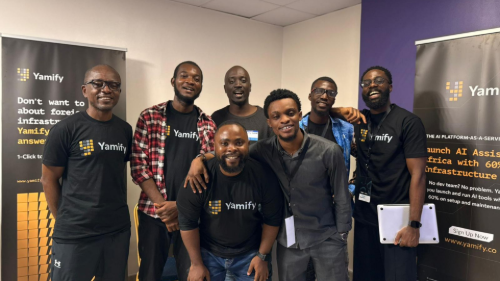
Africa’s AI boom has a supply problem. Developers and small agencies across the continent want to build and deploy artificial intelligence tools, but they routinely run into the same wall: high cloud costs, unreliable GPU access, latency issues connecting to overseas servers, and infrastructure complexity that demands in-house cloud engineering talent most startups simply do not have. Yamify, a young startup born out of the Democratic Republic of Congo, is building directly at that bottleneck — and it has just closed new funding to push forward.
Yamify, a developer-first AI infrastructure platform often described as the “Heroku for AI tools in Africa,” has secured pre-seed funding from Launch Africa Ventures as part of an ongoing round. Founded by Congolese entrepreneur Luc Okalobé, the startup enables freelancers and web agencies to spin up GPU-powered AI stacks and deploy AI tools in under a minute using African data centres. The startup had already gained early traction with fintechs and web agencies in Lagos, Kinshasa, Brazzaville, Johannesburg, and San Francisco, and was initially launched with a $100,000 investment from Felix Anane, an early backer of Paystack.


Okalobé, a former cloud engineer at TikTok and Salesforce, built Yamify around GPU-powered clusters — known as “YAMs” — hosted in Nigeria, Congo, and South Africa, with global cloud providers available as backup. Rather than charging the typical $20-a-month SaaS licence fees, users can run unrestricted open-source AI models and pay through local payment systems including naira, M-Pesa, or MTN MoMo. The product is designed not for large enterprise clients but for the freelancers, small agencies, and early-stage startups that make up the majority of Africa’s developer community.
The new funding from Launch Africa Ventures will help de-risk early distribution through partnerships with OADC and Cassava AI as Yamify continues raising its pre-seed round. The investment reflects rising confidence among African venture investors in startups building the critical AI and cloud infrastructure layer that will underpin the continent’s broader digital economy. As Okalobé put it: “Africa should not wait to be included in the AI wave — we should build it.”