Kevin Mwangi

Africa’s AI landscape has transformed dramatically by 2026. With 44 countries adopting data protection laws and 38 establishing enforcement authorities, the continent is moving toward stricter AI governance. Nigeria, for example, introduced its National Digital Economy and E-Governance Bill, requiring high-risk AI systems to obtain licenses and submit annual impact assessments. Other nations like Kenya, South Africa, Ethiopia, and Côte d’Ivoire have also tailored policies to address local challenges and priorities.
Startups face growing compliance risks, such as fines, mandatory data localization, and stricter oversight in sectors like finance and healthcare. However, these regulations also create opportunities for companies that align with local needs and regulatory frameworks. Tools like regulatory sandboxes and government-backed funding programs are helping startups navigate these challenges while fostering growth.

Key takeaways:
- Nigeria’s AI Bill: High-risk systems require licenses, impact assessments, and transparency measures.
- Data Protection Laws: 44 countries enforce privacy rules; 25 mandate safeguards against automated decisions.
- Compliance Risks: Fines, personal liability for executives, and stricter reporting obligations.
- Opportunities: Regulatory sandboxes, localized AI solutions, and government funding programs.
Africa’s regulatory frameworks are reshaping the AI ecosystem, balancing oversight with economic growth. Startups that prioritize compliance and local relevance are well-positioned for success.
Africa fights for a seat at the global AI table
sbb-itb-dd089af
Major AI Laws Introduced in Africa by 2026
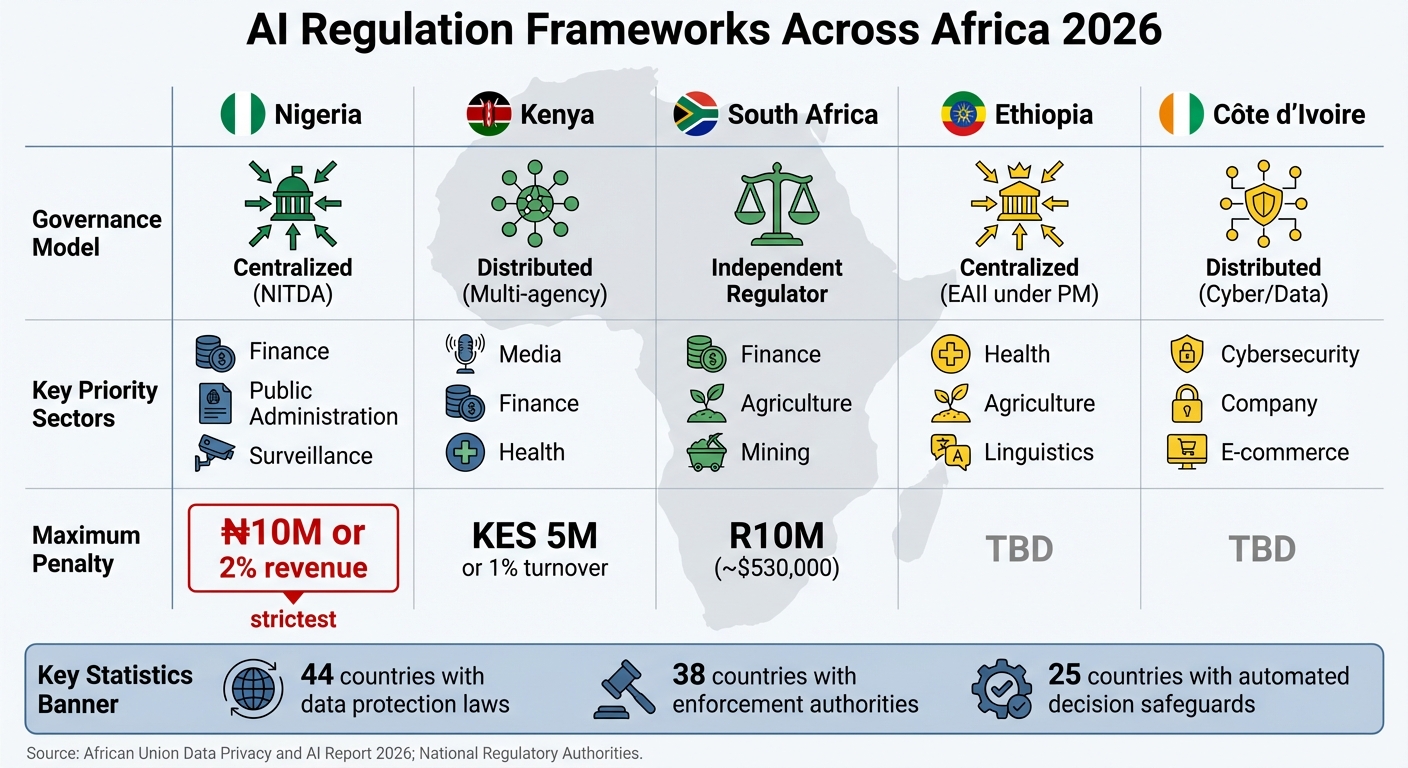
AI Regulation Framework Comparison Across 5 African Countries 2026
By 2026, African nations have transitioned from aspirational guidelines to enforceable laws, reshaping the continent’s regulatory landscape for AI. Nigeria has taken the lead with its National Digital Economy and E-Governance Bill, while countries like Kenya, South Africa, Ethiopia, and Côte d’Ivoire have crafted approaches tailored to their unique economic goals. This marks a significant shift in AI governance across Africa.
Nigeria’s National Digital Economy and E-Governance Bill
Nigeria’s upcoming legislation, expected to pass by March 2026, gives the National Information Technology Development Agency (NITDA) the authority to enforce a risk-based framework. High-risk AI systems – those used in finance, public administration, surveillance, and automated decision-making – will need licenses and must submit annual impact assessments. These assessments will detail risks, mitigation strategies, and system performance. Regulators will have the power to demand information, issue directives, and block unsafe systems. Companies failing to comply face fines of up to ₦10 million (about $7,000) or 2% of their annual gross revenue in Nigeria, whichever is higher.
With a population exceeding 220 million, Nigeria’s market is too large for tech companies to ignore. Kashifu Abdullahi, NITDA’s Director General, emphasized the importance of this framework:
Effective AI governance requires clear protections to ensure systems are developed within defined boundaries, making it easier for authorities to identify and curb misuse by bad actors.
The Bill’s risk-based classification aligns with international standards, such as the EU AI Act, making Nigerian AI products more competitive globally while easing compliance for international providers.
AI Policies in Kenya, Côte d’Ivoire, Ethiopia, and South Africa
Other African nations are implementing distinct AI strategies that balance local challenges with economic priorities.
Kenya introduced its National AI Strategy (2025–2030) in March 2025, allocating KES 152 billion (around $1.14 billion) over five years. The strategy blends horizontal policies with sector-specific guidelines, focusing on media and finance. The Media Council of Kenya proposed rules requiring media outlets to maintain audit trails for AI training datasets to ensure they are unbiased and respect intellectual property.
South Africa has adopted a rights-based approach rooted in its Protection of Personal Information Act (POPIA). This framework emphasizes "inclusive innovation" to address socio-economic disparities. The Artificial Intelligence Institute of South Africa (AIISA), launched in partnership with the University of Johannesburg and Tshwane University of Technology, is tasked with setting technical standards and guiding public-sector AI initiatives.
Ethiopia has opted for a centralized model, with its Ethiopian Artificial Intelligence Institute reporting directly to the Prime Minister. Its strategy prioritizes "AI for Social Good", focusing on food security, public health, and linguistic preservation through natural language processing for local languages.
Côte d’Ivoire has integrated AI into its National Digital Development Strategy, emphasizing cybersecurity and data protection. This approach supports e-commerce and digital trade while maintaining strict oversight of data practices.
| Country | Governance Model | Key Priority Sectors | Maximum Penalty |
|---|---|---|---|
| Nigeria | Centralized (NITDA) | Finance, Public Administration, Surveillance | ₦10M or 2% revenue |
| Kenya | Distributed (Multi-agency) | Media, Finance, Health | KES 5M or 1% turnover |
| South Africa | Independent Regulator | Finance, Agriculture, Mining | R10M (~$530,000) |
| Ethiopia | Centralized (EAII under PM) | Health, Agriculture, Linguistics | TBD |
| Côte d’Ivoire | Distributed (Cyber/Data) | Cybersecurity, E-commerce | TBD |
These diverse frameworks offer opportunities for startups while presenting challenges for compliance. Together, they set the stage for the African Union’s broader AI strategy.
The African Union‘s AI Strategy
In July 2024, the African Union Executive Council approved the AU Continental AI Strategy to guide all 55 member states. The strategy focuses on five key areas: leveraging AI benefits, building capacities, minimizing risks, boosting investment, and fostering collaboration. It outlines a governance model that involves updating existing laws, addressing regulatory gaps, and formulating national AI strategies.
Implementation is divided into two phases. Phase 1 (2025–2026) establishes governance structures and secures resources, while Phase 2 (starting in 2028) launches large-scale AI initiatives. A key focus is on digital sovereignty, promoting AI solutions and datasets that reflect African languages and contexts.
Dr. Amani Abou-Zeid, African Union Commissioner for Infrastructure and Energy, highlighted the importance of this approach:
AI systems should be able to reflect our diversity, languages, culture, history, and geographical contexts.
The strategy aligns with the Malabo Convention on Cyber Security and Personal Data Protection, which became effective on June 8, 2023, after its 15th ratification. This alignment facilitates cross-border data sharing while maintaining consistent standards. With over 2,400 organizations focused on AI across Africa, the AU’s framework aims to channel these efforts toward long-term development.
Compliance Risks for African Startups
With the introduction of stricter AI regulations, startups in Africa now face a more challenging compliance environment. As one regulatory expert put it, "The ‘grace period’ is officially over". The consequences of failing to meet these standards include hefty fines, disruptions to operations, and even personal liability for executives.
Data Sovereignty and Privacy Requirements
By early 2026, 44 African countries had implemented data protection laws, and 38 of them had established fully functional Data Protection Authorities (DPAs) to enforce these regulations. Startups in countries like Kenya, Nigeria, Eswatini, and Malawi are now required to register as data controllers or processors with their respective DPAs.
Data localization laws have also become more rigid. Nations such as Kenya, Ghana, Nigeria, and Algeria now demand that certain types of data be stored or processed within their borders to maintain digital sovereignty. For startups operating across multiple countries, this creates new challenges, including the need for localized infrastructure and partnerships.
In September 2025, Nigeria’s Data Protection Commission (NDPC) introduced the General Application and Implementation Directive, which set the enforcement framework for the 2023 Data Protection Act. High-risk activities like biometric data collection and automated decision-making now require Data Protection Impact Assessments (DPIAs) and certified Data Protection Officers (DPOs). A notable example occurred in Kenya, where a High Court halted the operations of Worldcoin, a global biometric identity platform, ruling that its mass collection of iris scans violated constitutional rights due to a lack of a proper DPIA.
Additionally, 25 African countries now have specific safeguards for data subjects against automated processing, emphasizing transparency and the right to human intervention. Breach notification rules are also stringent – Egypt, for instance, mandates reporting within 72 hours, while Malawi has introduced new notification requirements.
Regulations for High-Risk Sectors
Startups in industries like finance and healthcare face the toughest compliance requirements. High-risk AI systems – used in areas such as credit scoring, public service allocation, law enforcement, and healthcare diagnostics – must undergo mandatory annual impact assessments to evaluate issues like algorithmic bias, safety, and transparency.
In January 2026, Nigeria’s Communications Commission (NCC) and Central Bank introduced a joint framework requiring banks and telecom companies to issue automatic refunds for failed airtime and data transactions within 30 seconds, with full compliance expected by March 1, 2026. This has pushed fintech startups to adopt advanced real-time monitoring systems.
Fintech startups must also align with regulators like South Africa’s Financial Sector Conduct Authority (FSCA) and Nigeria’s Securities and Exchange Commission (SEC), while healthcare startups must comply with both data protection laws and national health acts. In late 2025, Kenya’s Office of the Data Protection Commissioner (ODPC) imposed fines on an employer for withholding reference letters and on an individual for unauthorized disclosure of personal data.
Regulators are increasingly applying the concept of "piercing the corporate veil," holding executives personally accountable for organizational privacy failures, including potential criminal charges.
Compliance Requirements Across African Countries
The regulatory frameworks across African nations vary widely, complicating compliance for startups operating in multiple regions. Here’s a snapshot of key requirements:
| Requirement | Nigeria | Kenya | South Africa | African Union Framework |
|---|---|---|---|---|
| Primary Law/Policy | National AI Strategy / Data Protection Act 2023 | Data Protection Act / Proposed AI Bill | POPIA / National AI Policy Framework | AU AI Strategy / Africa Declaration on AI |
| High-Risk Sectors | Finance, Digital Trade, Biometrics, Public Admin | Biometrics, Media, Finance | Credit Scoring, Healthcare, Law Enforcement | Critical Infrastructure, Public Services |
| Max Financial Penalty | ₦10M (~$7,000) or 2% of annual revenue | KES 5M (~$38,500) or 1% of turnover | R10M (~$530,000) | Varies by member state |
| Reporting Obligations | Annual AI Impact Assessments; 72-hour breach notification | Mandatory DPA registration; compliance audits | 30-day processing timelines for data requests | Cross-border interoperability standards |
| Key Enforcement Body | NDPC / NITDA | ODPC | Information Regulator | NADPA (Regional Network) |
These variations highlight the importance of tailored, region-specific compliance strategies for startups.
Penalties for non-compliance are becoming increasingly severe. For instance, in November 2025, Nigeria’s NDPC settled a high-profile case with a global social media company after initially levying a $32.8 million fine for data violations earlier that year. Similarly, Egypt’s Alexandria Economic Court fined a telecom company EGP 10 million (around $200,853) in 2025 for failing to prevent fraud through unauthorized SIM swaps.
Kenya’s ODPC also ramped up enforcement in 2025, issuing compliance notices to over 1,300 organizations across various sectors to ensure adherence to privacy and data rights. One digital lender was fined KES 700,000 (approximately $5,400) for unlawful data processing and lack of cooperation during investigations.
As one regulatory report aptly put it: "The ‘Year of the Teeth’ proved that African data protection is no longer a theoretical exercise. The ecosystem is evolving into a muscular, complex regulatory environment where cross-border collaboration is the norm".
Opportunities for Startups Under AI Regulations
While compliance demands may seem daunting, startups that adapt quickly to new AI regulations can find themselves in a position to thrive. The shift from general policy guidance to enforceable laws is creating room for innovation, new funding opportunities, and a chance to stand out in the market. Startups that engage early with regulators and focus on practical, locally impactful solutions can gain a significant edge. One promising avenue for this is the use of regulatory sandboxes, which provide a structured environment for testing and innovation.
Using Regulatory Sandboxes for Innovation
Regulatory sandboxes are becoming key resources for AI startups in Africa. As of October 2024, 25 national sandboxes are active across 15 African countries, offering startups a safe space to test new technologies while collaborating directly with regulators. Interestingly, 99% of these sandboxes are centered around fintech. For instance, Kenya’s fintech sandbox operates on 12-month cycles that include stakeholder feedback, helping startups accelerate product launches and shape future regulations. Rwanda offers another success story: between 2020 and 2023, its participatory AI policy development process attracted over $76.5 million in investments for its AI ecosystem.
The sandbox model isn’t limited to national initiatives. Cross-border programs are also gaining traction. One example is Ecobank‘s Pan-African Banking Sandbox, which operates in 33 countries and allows fintech startups to test and scale their solutions across the continent.
"Sandboxes are emerging as useful tools for testing regulatory and technical innovations in Africa amid complex challenges presented by data and artificial intelligence."
– Paula Gilbert, Editor, Connecting Africa
Funding and Support Programs for AI Startups
Governments are stepping up with initiatives to support AI startups that comply with regulations. In July 2024, the African Union launched its Startup Model Law Framework to streamline startup governance across the continent. This effort has already had a big impact. For example, Tunisia saw a 72% jump in startup funding and a 75% increase in officially recognized startups after implementing its Startup Act in 2018. Similarly, Senegal raised about $353 million in startup funding following its 2019 legislation.
Nigeria is another standout. In January 2026, the National Information Technology Development Agency (NITDA) teamed up with the Korean International Cooperation Agency (KOICA) to create the Start-Up Digital Innovation Academy. This initiative combines education with investment support and coincides with Nigeria’s rise to 72nd globally in the 2025 Government AI Readiness Index, a leap of 31 places.
International partnerships are also fueling growth. Under the UK–Nigeria Enhanced Trade and Investment Partnership, UK investors contributed 65% of Nigeria’s new foreign capital, including $40.5 million for Johnvent Industries and $7.5 million for agritech firm Babban Gona. Beyond Nigeria, countries like South Africa, Kenya, and Egypt collectively attract over 70% of Africa’s startup funding annually.
Building Localized AI Solutions
Startups that design AI solutions tailored to local needs are setting themselves apart. By addressing regional challenges, these companies meet digital sovereignty requirements and gain a competitive edge. National AI institutes in Ethiopia and Nigeria are taking the lead by developing indigenous AI models and datasets that reflect local languages and cultural nuances. For example, the Ethiopian Artificial Intelligence Institute (EAII), which operates under the Prime Minister’s office, focuses on "AI for Social Good." One of its key initiatives is creating Natural Language Processing systems for local languages, helping preserve linguistic diversity.
Sector-specific AI tools are also making waves. From precision agriculture to healthcare diagnostics, these tools not only meet regulatory standards but also address pressing local issues. Platforms like the Digital Earth Africa Analysis Sandbox give startups access to remote-sensing data and development tools for tackling environmental and developmental challenges. These efforts align with the African Union’s focus on digital sovereignty and provide startups with a roadmap for long-term success.
"The region is moving from a consultative, policy-driven environment to one with concrete, enforceable duties and dedicated oversight bodies for AI."
– Regulations.ai
Compliance Strategies and Startup Success Stories
Creating Risk Mitigation Plans
The first step in managing compliance is to classify your AI system based on its risk level. High-risk applications – like biometric identification, credit scoring, or healthcare diagnostics – have stricter requirements. These include annual impact assessments, human oversight, and, in some cases, licensing. Medium-risk tools, such as enterprise automation software, must adhere to transparency rules and data privacy standards, while low-risk systems, like spam filters, only need to meet basic data protection requirements.
If your system processes personal data, conducting a Data Protection Impact Assessment (DPIA) is critical. This process identifies potential algorithmic biases and ensures robust data security throughout the training pipeline. For instance, Nigeria’s proposed National Digital Economy and E-Governance Bill requires high-risk AI developers to submit annual assessments outlining risks and mitigation strategies, with non-compliance leading to strict financial penalties.
Transparency is another key area. Documenting human oversight and dispute resolution mechanisms is essential. In Nigeria, startups can work with licensed Data Protection Compliance Organizations (DPCOs), while in Egypt, certified Data Protection Officers (DPOs) are available for auditing and compliance support. Notably, Egyptian startups must report any data breaches within 72 hours.
"Regulation is meant to guide innovation rather than outrun it, shaping market practices and social outcomes in a way that encourages responsible and beneficial use of AI."
– Kashifu Abdullahi, Director General, NITDA
Let’s take a closer look at how startups in Africa have successfully navigated these compliance challenges.
Case Study: Nigerian Fintech Startup
A Nigerian fintech startup developed an AI-driven credit scoring platform, placing it squarely in the high-risk category. This meant they had to meet stringent documentation and oversight requirements. To address these challenges, the company joined Nigeria’s regulatory sandbox, run by the National Centre for Artificial Intelligence and Robotics (NCAIR). This gave them a controlled environment to test their algorithm while demonstrating ethical compliance to regulators.
The team conducted a detailed DPIA to identify and address potential biases. They also created localized datasets that incorporated alternative credit indicators, such as mobile money transactions and community lending patterns. This not only reduced bias but also aligned with Nigeria’s goals for digital sovereignty.
To meet transparency standards, the startup introduced a Standard Notice to Address Grievance (SNAG) system, allowing users to challenge algorithmic decisions. Additionally, they partnered with a licensed DPCO to perform quarterly audits and prepare an annual impact report for regulatory submission. These proactive measures positioned them well for obtaining a license when Nigeria’s National AI Commission begins regulating high-risk systems in late 2026.
Case Study: Kenyan Healthtech Startup
A Kenyan healthtech startup faced similar hurdles while developing an AI diagnostic tool for malaria detection. Since their system processes sensitive medical data, it was categorized as high-risk. A recent legal case in Kenya, where a global biometric platform was halted for failing to conduct a proper DPIA, served as a cautionary tale for the startup.
In response, the team conducted a rigorous DPIA and built a model using localized data to enhance clinical accuracy. They also mandated that all AI-generated diagnoses undergo licensed medical supervision. This attention to detail helped them secure a government contract, as authorities prioritized solutions that used indigenous data.
The startup further strengthened its compliance by participating in a regulatory sandbox. This allowed them to test their tool in real clinical environments while working closely with regulators. By treating compliance as a strategic advantage, they gained significant market traction and credibility.
Conclusion: The Future of AI Regulation in Africa
By 2026, AI regulation in Africa has transitioned from being a goal to a tangible reality. Countries like Nigeria, Kenya, and Ethiopia are no longer relying on voluntary guidelines but are implementing enforceable legal frameworks. Nigeria’s Digital Economy Bill is a prime example, offering clear compliance standards while boosting investor confidence. This clarity is laying the groundwork for growth in key areas like fintech, healthcare, and e-commerce.
These regulatory frameworks are becoming powerful tools for economic development. Take Nigeria, for instance: the country jumped 31 places in the Government AI Readiness Index in 2025, now ranking 72nd out of 195 countries. This progress has caught the attention of international investors. In 2025, UK-based investors contributed about 65% of Nigeria’s new foreign investment inflows, totaling over $48 million in commitments. By reducing risks through well-defined regulations, countries are creating an environment where investment thrives.
Success stories highlight how strict compliance with mandates – such as prioritizing privacy by design, ensuring transparency, and localizing data – builds market credibility. These efforts not only attract investors but also secure government contracts. Regulatory sandboxes are playing a key role, allowing companies to refine their strategies while meeting these stringent requirements.
"You cannot be ahead of innovation, but regulation is not just about giving commands. It’s about influencing market, economic, and societal behavior so people can build AI for good."
– Kashifu Abdullahi, Director General, NITDA
Looking forward, the focus shifts to how startups and tech ecosystems will adapt. With nearly 60% of Africa’s population under 25, the potential for training and deploying AI solutions is immense. Companies that prioritize digital sovereignty, ensure their AI systems are explainable, and actively engage with regulators have the opportunity to not just adapt but lead. By doing so, they can shape both their own futures and Africa’s role in the global AI landscape.
FAQs
How do I know if my AI product is “high-risk” in my country?
Your AI product might fall into the high-risk category if it functions in key sectors such as finance, healthcare, or infrastructure and aligns with the criteria outlined by regional laws. For instance, in Africa, developing guidelines emphasize ethics, transparency, and respect for human rights. These frameworks evaluate risks by examining factors like safety, the protection of fundamental rights, and the level of decision-making power the system holds. Be sure to review local regulations to confirm whether your AI system is classified as high-risk.
What’s the fastest way to comply with data localization rules across multiple countries?
To navigate data localization rules in Africa efficiently, it’s crucial to grasp the specific laws of each country. These regulations often require personal data to be stored or processed within local borders. To stay on top of compliance:
- Conduct thorough legal reviews to understand the nuances of each jurisdiction.
- Implement localized data storage solutions tailored to meet regional requirements.
- Use centralized compliance tools to streamline the process and ensure consistency.
Partnering with local experts can help you stay informed about changing regulations and align your infrastructure with legal standards. This approach makes managing compliance across multiple countries more straightforward.
Should a startup join a regulatory sandbox, and how do you apply?
Startups across Africa have a unique opportunity to test AI technologies in regulatory sandboxes – controlled environments designed to align with evolving laws and guidelines. These sandboxes create a space for collaboration, encourage transparency, and ensure compliance with regulations.
To get started, you’ll need to identify the regulatory sandboxes relevant to your country or industry. Once you’ve found the right fit, prepare a proposal that details your technology, outlines potential risks, and explains your plans for maintaining compliance. Engaging directly with regulators during this process can help you fine-tune your solutions to meet regulatory requirements while staying innovative.
Related Blog Posts
- AI Startups in Africa: Role of Infrastructure Policies
- The Rise of AI Startups in Africa: Tools, Trends & Talent
- Ethical AI: Navigating Governance and Compliance in Africa
- Healthtech Regulation 2025: What Founders Need to Know