Kevin Mwangi
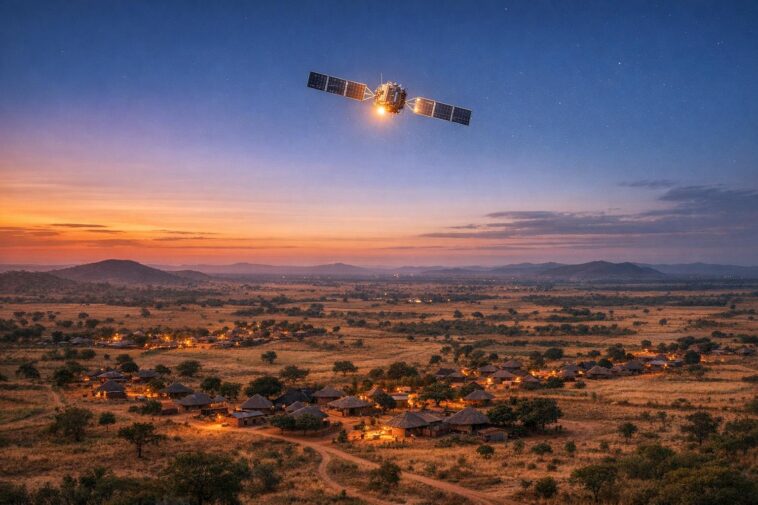
Airtel Africa, in partnership with SpaceX, is set to introduce a satellite-based mobile service in 2026. This service will connect standard LTE smartphones directly to SpaceX‘s Starlink satellites, eliminating the need for traditional cell towers in remote areas. Covering 14 African countries and 174 million customers, Airtel aims to address connectivity challenges in underserved regions.
Key Highlights:
- Coverage Expansion: Direct-to-cell technology will provide connectivity in areas without cell towers.
- Affordable Access: No extra hardware needed – works with existing LTE/4G smartphones.
- Phased Rollout: Starting with SMS and basic data in 2026, with broadband speeds to follow.
- Rural Focus: Targets regions where building towers is too costly (up to $150,000 per tower).
- Economic Impact: Boosts access to mobile money, telemedicine, and education.
This initiative addresses Africa’s connectivity gap, where 64% of the population lacks mobile internet access. It also positions Airtel as a leader in bridging digital divides while leveraging hybrid satellite-cellular networks for broader reach.


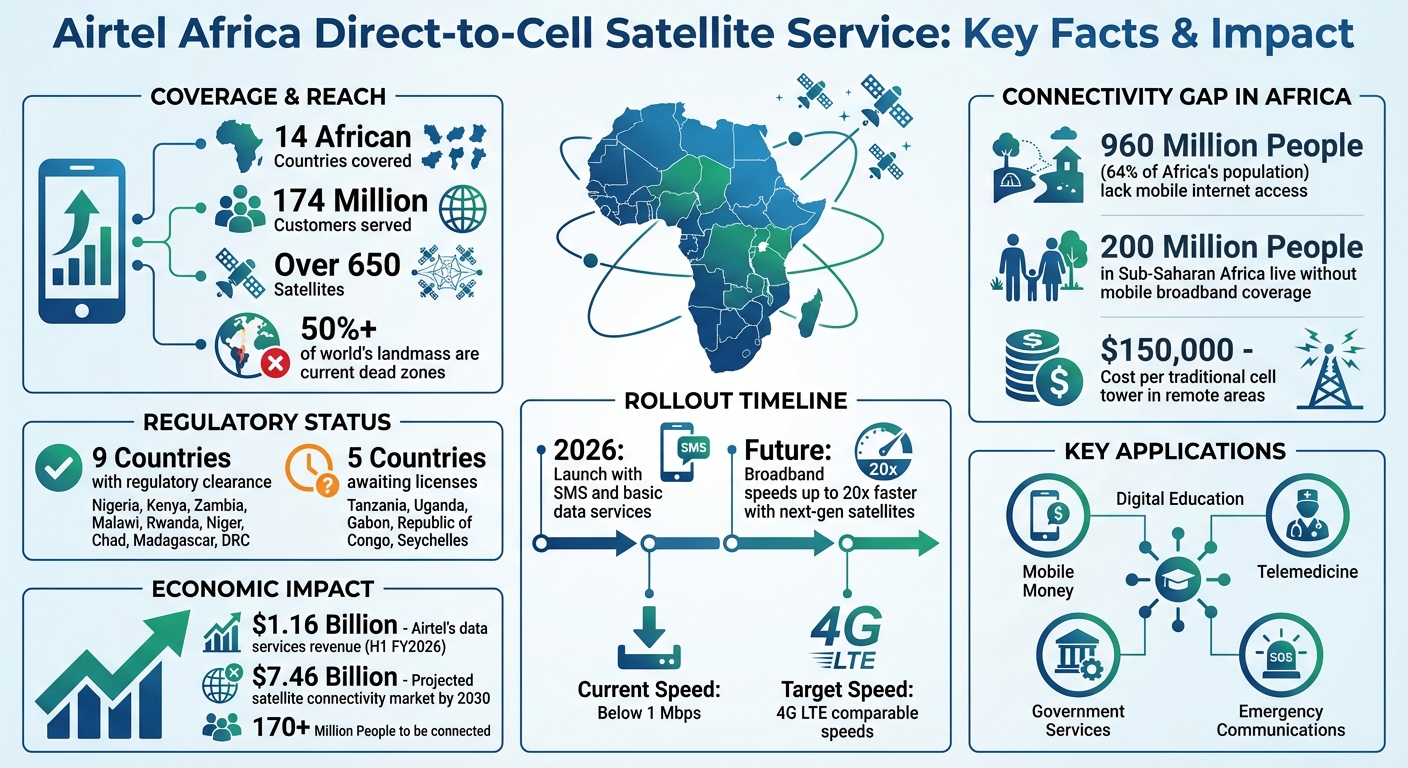
Airtel Africa Direct-to-Cell Satellite Service: Key Statistics and Impact 2026
What Is Direct-to-Cell Satellite Technology?
Direct-to-Cell Connectivity Basics
Direct-to-Cell (D2C) technology lets your regular smartphone connect directly to satellites orbiting Earth – no extra gear required. Unlike traditional satellite phones that rely on bulky hardware or satellite internet services needing dedicated dishes, D2C works seamlessly with the LTE-compatible phone you already have. These satellites operate in Low Earth Orbit (LEO), between 310 and 1,240 miles above Earth, which helps reduce signal delays compared to older systems. The real game-changer? Your phone’s existing hardware, firmware, and apps function just as they do now. The satellites act as cell towers in space, equipped with advanced eNodeB modems that communicate using the same cellular protocols your phone already understands. This means no upgrades or special modifications are necessary, making the technology incredibly user-friendly.
How the System Works
Starlink’s Direct-to-Cell network includes over 650 satellites, each functioning like a cell tower in space. These satellites use phased array antennas to pick up signals from smartphones on the ground and rely on laser backhaul technology to transfer data across the satellite network. Ground stations then connect the satellite system to Airtel Africa’s core network, integrating it as if it were standard cellular roaming.
Currently, download speeds are below 1 Mbps, but next-generation satellites are expected to boost performance by 20 times, bringing speeds closer to what you’d expect from 4G LTE. However, the system does have its limitations. It needs a clear view of the sky, so coverage inside buildings or in dense urban areas with tall structures can be restricted. Even with these challenges, the seamless integration with existing networks opens up new possibilities for tackling connectivity gaps.
Working with Existing Networks
D2C technology doesn’t aim to replace traditional cell towers – it’s designed to work alongside them. Think of it as an added layer of coverage that steps in when building physical infrastructure isn’t feasible or economical. As Sunil Taldar, CEO of Airtel Africa, put it, the technology "complements the terrestrial infrastructure and even reaches areas where deploying terrestrial network solutions are challenging".
"D2D strengthens network reach and resilience, but remains a complement, not a substitute, for terrestrial towers and small cells." – Wireless Infrastructure Association (WIA)
This hybrid approach makes financial and practical sense. Satellite coverage eliminates the need for costly ground infrastructure in remote areas, effectively addressing the "dead zones" that cover more than 50% of the world’s landmass – areas where traditional cellular service simply doesn’t reach.
Airtel Africa‘s Rollout Plan and Market Approach
Launch Timeline and Service Phases
Airtel Africa is set to roll out its Direct-to-Cell service in 2026, starting with basic SMS and select data services. Over time, the service will evolve to deliver speeds up to 20 times faster. With upgraded satellites, the service aims to provide broadband connectivity comparable to 4G LTE. This gradual enhancement allows Airtel Africa to test and refine the technology while expanding its network capabilities as the satellite constellation grows. This step-by-step strategy lays the groundwork for a well-planned market expansion.
Target Markets and Coverage Areas
Airtel Africa is focusing its efforts on underserved regions, operating across 14 African countries and serving approximately 174 million customers. The rollout schedule will differ by country, as it hinges on obtaining local regulatory approvals. So far, nine countries – Nigeria, Kenya, Zambia, Malawi, Rwanda, Niger, Chad, Madagascar, and the Democratic Republic of the Congo – have already secured regulatory clearance for Starlink operations, putting them in line for earlier deployment. Meanwhile, five other countries – Tanzania, Uganda, Gabon, Republic of the Congo, and Seychelles – are still awaiting the necessary licenses. The primary focus will be on rural areas, where building traditional cell towers, which can cost up to $150,000 each, is not a viable option.
"The rollout will proceed in line with country-specific regulatory approvals" – Atul Sachdeva, Group CTO at Airtel Africa.
Device Compatibility Requirements
Airtel Africa’s Direct-to-Cell service is designed for seamless integration with existing devices. No additional equipment or new devices are needed. If a user’s 4G or 5G smartphone operates on supported frequencies, it will automatically switch to satellite coverage when moving out of terrestrial network range. This feature ensures the service is readily accessible to Airtel Africa’s current customer base, making the transition to satellite connectivity effortless.
Impact on Connectivity and Digital Access in Africa
Closing Coverage Gaps
In Sub-Saharan Africa, nearly 200 million people – accounting for about half of the global population without mobile broadband coverage – live in areas where expanding traditional networks is simply too costly. On top of that, around 960 million people in Africa (64% of the population) don’t use mobile internet, often due to barriers like affordability and literacy.
Building traditional cell towers in remote regions comes with immense costs, making it unfeasible in many areas. Airtel Africa’s Direct-to-Cell service addresses this challenge by utilizing satellites as "cell towers in the sky." This approach makes connectivity more affordable and accessible, even in the most remote locations where conventional infrastructure just isn’t an option.
Practical Applications in Rural and Emergency Situations
This satellite-based technology is enabling mobile money, telemedicine, digital education, and government services in areas that were previously disconnected. For instance, rural health workers can now access up-to-date patient records, while farmers can check current commodity prices and connect with potential buyers.
"For a rural health worker accessing patient records or a farmer checking real-time commodity prices, the difference between no connectivity and reliable connectivity is not incremental. It’s transformative." – Techloy
The system also proves invaluable during emergencies. When terrestrial networks fail due to fiber cuts, vandalism, or natural disasters, Direct-to-Cell technology ensures that emergency services remain operational. A powerful example comes from Ukraine, where Kyivstar, the country’s largest mobile operator, launched Starlink’s direct-to-cell technology in November 2025. It kept 24 million subscribers connected during wartime blackouts and major infrastructure failures, showcasing the system’s potential. Airtel Africa is set to replicate this model in 2026, offering a lifeline for critical situations.
This leap in connectivity is paving the way for broader economic and social advancements.
Economic and Social Effects
With improved connectivity, underserved regions are witnessing new opportunities in sectors like fintech, agri-tech, and e-learning. Airtel Africa’s data services have become a major revenue driver, generating $1.16 billion in the first half of fiscal year 2026. This shift toward data-driven services is reshaping the economic landscape across the continent.
The rollout across 14 nations is also encouraging governments to update regulatory frameworks and simplify licensing processes. The partnership between Airtel Africa and SpaceX aims to connect over 170 million people across these markets, potentially sparking economic growth in areas that have long been left behind.
"Starlink’s Direct-to-Cell technology complements the terrestrial infrastructure and even reaches areas where deploying terrestrial network solutions are challenging." – Sunil Taldar, Managing Director and CEO, Airtel Africa
sbb-itb-dd089af
Starlink Direct to Cell: How it works, common misconceptions, and answers to your questions
Effects on the African Telecom Industry
The growing influence of enhanced connectivity is reshaping the telecom industry in Africa, pushing operators to rethink their traditional business strategies.
Changes in Telecom Business Models
Airtel Africa’s partnership with satellite providers is redefining how telecom companies approach infrastructure investment. In remote areas, the high costs of building and maintaining traditional cell towers make conventional network expansion economically impractical.
To address this, the industry is turning to hybrid connectivity models. These models combine high-speed, low-latency satellite constellations with existing terrestrial networks and spectrum rights. Instead of relying heavily on ground infrastructure, telecom operators are teaming up with satellite companies to quickly bridge coverage gaps. This shift is also driving a change in revenue streams, with data services surpassing voice as the primary growth driver. For instance, Airtel reported $1.16 billion in data revenue during the first half of fiscal year 2026.
Airtel is also leveraging its established licenses to block SpaceX from directly entering its 14 markets. This strategic positioning puts pressure on competitors like MTN, Orange, and Vodacom to secure similar satellite partnerships or risk losing market share in underserved areas. These changes are setting the stage for new tech-driven opportunities across the continent.
New Opportunities for African Startups and Tech Sectors
The adoption of hybrid networks is opening doors for startups in regions that were previously disconnected. For example, agri-tech companies can now provide real-time commodity pricing and supply chain solutions to farmers in areas where traditional networks were not feasible. Similarly, health-tech startups can expand digital healthcare services to rural communities.
With the satellite connectivity market projected to reach $7.46 billion by 2030 and satellites delivering data speeds 20 times faster than before, startups have the chance to scale data-heavy applications like AI tools and advanced education platforms without shouldering the financial burden of traditional infrastructure. Additionally, the rise of hybrid networks is promoting the adoption of Network-as-a-Service (NaaS) models, enabling tech companies to expand their reach with lower capital risks.
Airtel Africa’s Position as a Connectivity Leader
Airtel Africa is solidifying its leadership role in this evolving industry. By becoming the first mobile operator on the continent to partner with SpaceX for Direct-to-Cell technology, Airtel has gained a significant competitive advantage. With a customer base of 174 million across 14 markets, the company is using its existing licenses to navigate regulatory challenges that would take new satellite entrants years to overcome. This positions Airtel as a key player in shaping the future of connectivity in Africa.
Conclusion
Airtel Africa’s partnership to introduce its Direct-to-Cell satellite service, powered by Starlink’s technology, represents a major step forward in connecting underserved communities across Africa. By integrating Low Earth Orbit satellites with existing mobile networks, this initiative addresses a pressing issue: nearly 400 million people globally lack access to mobile broadband, with nearly half of that gap concentrated in Sub-Saharan Africa. The next hurdle lies in achieving smooth regulatory approval across all the regions involved.
The rollout’s success depends heavily on regulatory alignment across Airtel’s 14 markets. Each country must adapt its licensing frameworks to accommodate this cutting-edge technology, which blends satellite and terrestrial networks. This highlights the satellite service’s role as a complement to traditional infrastructure.
This initiative goes beyond just providing connectivity – it has the potential to fuel economic growth. Starting with basic SMS in 2026 and gradually scaling to broadband speeds up to 20 times faster, the phased rollout aims to unlock opportunities in rural areas through services like mobile money, telehealth, and online education. These advancements could be a game-changer for Africa’s digital economy.
As this hybrid connectivity expands, its broader impact will depend on modernized regulations and the seamless integration of satellite and terrestrial networks. With the satellite connectivity market projected to reach $7.46 billion by 2030, this initiative is paving the way for a significant transformation in how Africa connects and thrives in the digital age.
FAQs
How will Airtel Africa’s Direct-to-Cell satellite service improve connectivity in rural areas?
Airtel Africa’s Direct-to-Cell satellite service is poised to deliver dependable mobile connectivity to rural and underserved areas, even in places where conventional infrastructure, like cell towers, doesn’t exist. With this service, users equipped with compatible smartphones will be able to access crucial features such as data, voice calls, and text messaging.
Offering speeds up to 20 times faster than what’s currently available in some regions, this technology has the potential to reshape connectivity across Airtel’s 14 African markets. By bridging the digital divide, it will grant more people access to essential communication tools, opening doors to economic opportunities and growth in remote areas.
What advantages does Direct-to-Cell technology offer compared to traditional cell towers?
Direct-to-Cell technology enables satellites to act as mobile towers, providing 4G-level voice, data, and messaging services without relying on physical infrastructure. This makes it a practical solution for connecting remote or underserved areas where building traditional cell towers is either too expensive or simply not feasible.
With this technology, users experience wider coverage, uninterrupted connectivity, and data speeds that can be up to 20 times faster – all without needing any extra devices or hardware. It’s a transformative step toward closing connectivity gaps and making communication more accessible in areas with limited infrastructure.
What obstacles might Airtel Africa face when launching its Direct-to-Cell satellite service across multiple countries?
Airtel Africa is navigating a series of hurdles as it works to introduce its Direct-to-Cell satellite service across 14 countries. Each market presents its own set of regulatory requirements, including licensing, spectrum allocation, and rules surrounding foreign investments. For instance, in South Africa, the company must adhere to Black Economic Empowerment (BEE) regulations, which mandate at least 30% local ownership – an expectation that could clash with Airtel’s current corporate structure.
Beyond regulatory complexities, infrastructure challenges in remote and underserved regions of Africa add another layer of difficulty. In many sparsely populated areas, building traditional cell towers is simply too expensive to justify, making satellite connectivity a more practical option. That said, deploying satellite technology comes with its own high costs, extended timelines, and the challenge of integrating it with existing networks. Airtel faces the tough task of managing these obstacles while ensuring dependable service delivery across a variety of demanding environments.
Related Blog Posts
- Top 7 African Countries Using Partnerships for Rural Internet
- Starlink Partners with Airtel & Vodacom: From Rival to Ally
- Starlink Faces Import Restrictions in Uganda Ahead of Elections
- South Africa’s DA Pushes for Starlink Entry to Boost Connectivity