Grace Ashiru
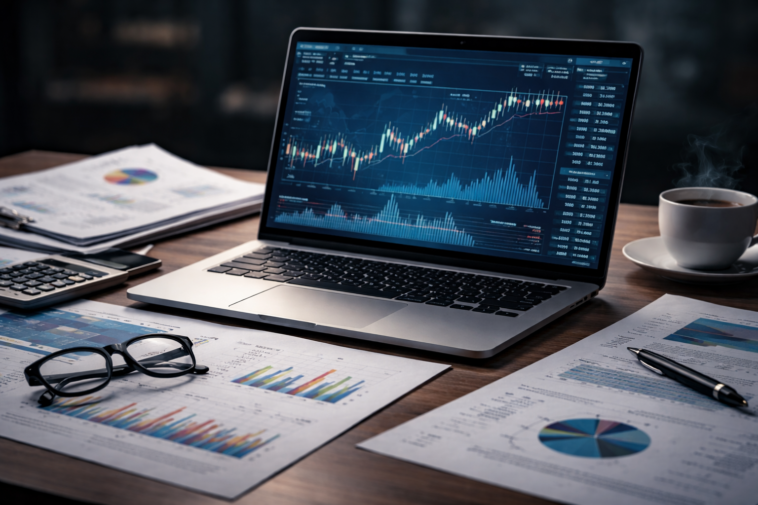
Financial decision-making was somewhat like walking in the dark a very long time ago. Investors were guided by hunch, newspaper headlines or by the friend who had a hunch. Sometimes it worked. Often it didn’t. The fog is not fully cleared today, although we have now potent headlights: algorithms and data analytics.
Numbers speak in the contemporary financial world. Actually, they shout. Markets spew forth vast volumes of data each second in the form of prices, trades, news, social sentiment, and economic indicators. All of it cannot be digested by humans. Algorithms are the solution to this, silently computing millions of data points when most of us are still trying to make a decision on what to have for breakfast.


When Data Is a Financial Compass
Financial analytics fundamentally is the process of making sense out of chaos. Suppose that you are looking at a giant spreadsheet consisting of millions of rows. Without help, it’s just noise. Algorithms intervene and begin to identify patterns – trends in the stock price, correlations among commodities, or indications buried in the depths of historical market data.
Complex models are used to assess risk and predict the possibility of outcomes by banks, hedge funds, and investment firms. Some of the variables that these systems consider include interest rates, inflation data, company earnings, and even geopolitical developments. It is not to foretell the future exactly the way you want it to be (no one can do this), but to shift the odds a little in your favor.
Consider it as weather forecasting. Meteorologists are not able to be confident that it will be sunny on Tuesday, but with sufficient data they can place a bet as to whether it will rain or not. Markets are no exception and are done the same by financial algorithms. They construct probability maps of realistic financial events.
The Emergence of Algorithmic Decision-Making
One of the most understandable illustrations of how the data-driven decision-making process operates nowadays is algorithmic trading. Computer programs also are used instead of traders manually purchasing and selling assets since the computer programs automatically execute orders according to preset rules.
As an illustration, an algorithm may be developed to purchase a stock when its price falls below any fixed parameter and the market volume is rising. There is another algorithm that can scan hundreds of markets at once seeking small price anomalies. These techniques work within milliseconds, which is quicker than a human trader who would have responded.
There are those who envision that Wall Street is about screaming brokers with papers in their hands. As a matter of fact, most trading floors in the modern world are as silent as a library. It is being done within servers and data centers where algorithms execute thousands of computations a second.
Speed and discipline is the advantage. Algorithms do not panic when the markets decline and do not get over-confident during the upsurge of prices. They are merely acting by the logic of their models.
Predictive Analytics: Headlines of Tomorrow
Predictive analytics is another effective financial instrument. In this case, machine learning models are used to analyze past data to determine indicators that may suggest future trends.
As an example, analysts could work with decades of stock market history, and program algorithms to identify patterns of stock market booms or crises. Such models then produce predictions that assist investors to make changes in portfolios ahead of significant changes.
Credit scoring and risk assessment are also manifested in predictive analytics. Banks assess the loans candidates basing on the data model that analyzes the payment history, payment stability, and other behavioral reports or indicators. Algorithms do not use a single factor, instead examining dozens (and in some cases, hundreds) of variables at once.
These systems are financial investigators in a number of ways. They take parts of the clues that lie in huge datasets, and construct a risk or opportunity picture.
Information is not Just Wall Street
Curiously enough, analytics is no longer restricted to large financial establishments. Data-driven insights are applied in everyday platforms to influence user experiences across the spectrum of applications such as budgeting applications and digital investment platforms.
Analytics have also been adopted even in the entertainment and betting industries. Smarter systems are made by platforms that analyze player behavior, probabilities, and event statistics. As an example, services like 22Bet integrate models with real-time analytics to optimize odds and enhance user interaction. In new markets such as Mozambique, where the online gaming communities are expanding at a pace, users who are seeking bets Moçambique are more and more exposed to a platform where algorithms make the odds and evaluate the trends work silently.
Data science is involved in nearly all interactions; the average user will never see the calculations under the hood, but data science is involved in the display of odds on the screen and personalized recommendations.
The Human Factor Is Not Dead Yet
Algorithms are not magic in spite of all this technology. They are man-made devices and just as any tool they are relying on the assumptions made.
A model trained on invalid or incomplete data can make invalid predictions. The 2008 financial crisis is a legendary lesson on the fact that excessive trust in models is flawed. Most of the systems had thought that the housing prices would hardly decrease in the entire country- and this was proven to be a spectacularly wrong assumption.
This is why machine intelligence and human judgment are the most effective in the best financial analysts. The data are processed by algorithms, whereas the results are interpreted by people, and the assumptions are questioned.
To put it in practice, the effective financial decision-making can be seen as the partnership between silicon and intuition.
From Guesswork to Insight
The most significant transformation caused by algorithms and analytics is psychological. The field of finance is gradually bidding adieu to guesswork and moving towards decisions made based on evidence.
Rather than posing the question, What do I feel about this investment?, professionals are starting to pose, What does the data suggest?
It is a not too strong but effective change. Statistics do not disprove something, but allow reducing the range of possibilities and emphasizing the dangers before they turn into catastrophes.
To investors, businesses and even ordinary consumers with their budgets, analytics offers something that is invaluable, namely perspective.
When used in the right way, numbers are stories. They demonstrate the concealed patterns, open the blind spots and sometimes speak warningly, even before something goes wrong.
Ultimately, algorithms do not take the place of human decision making, they enhance it. They are a kind of a pair of financial glasses and they focus the blurred information.
And in a world where billions of dollars circulate in markets in every minute, vision is half the battl