Kevin Mwangi
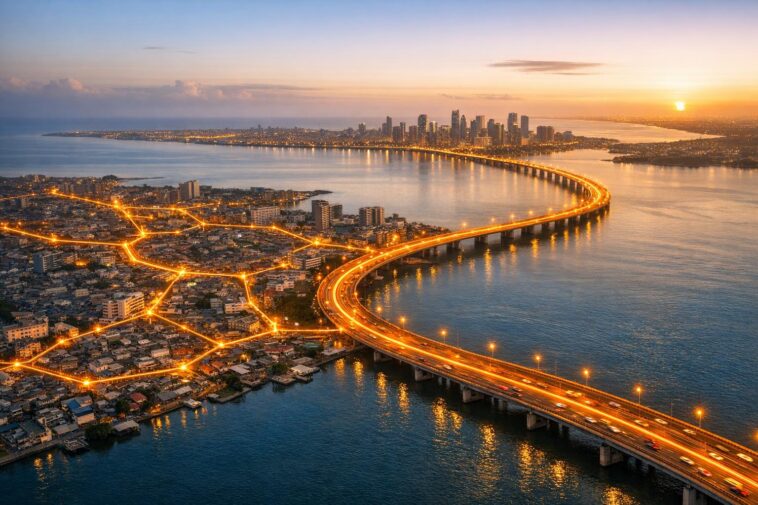
The Lagos Digital Highway is transforming Lagos into a smart city with a massive fiber-optic infrastructure. By 2027, the project will install 6,000 km of fiber cables, connecting schools, hospitals, businesses, and government facilities to high-speed internet. Key highlights include:
- Cost: $200 million for Lagos; part of a $2 billion national broadband plan.
- Completion: 90% of the network was done by 2025; full completion expected by 2027.
- Coverage: 85% of Lagos residents live within 5 km of the fiber network, compared to Nigeria’s 39% average.
- Impact: Internet speeds to increase 5x, costs to drop by 16-21%, and over 1 million new internet subscriptions since 2023.
- Funding: Public-Private Partnership with $845 million pledged by DFIs including the World Bank and African Development Bank.
- Smart City Tech: 450 cameras for traffic monitoring, IoT waste sensors, and automated traffic enforcement with fines.
This project is driving Lagos’s digital transformation and strengthening its position as a tech hub in Africa.

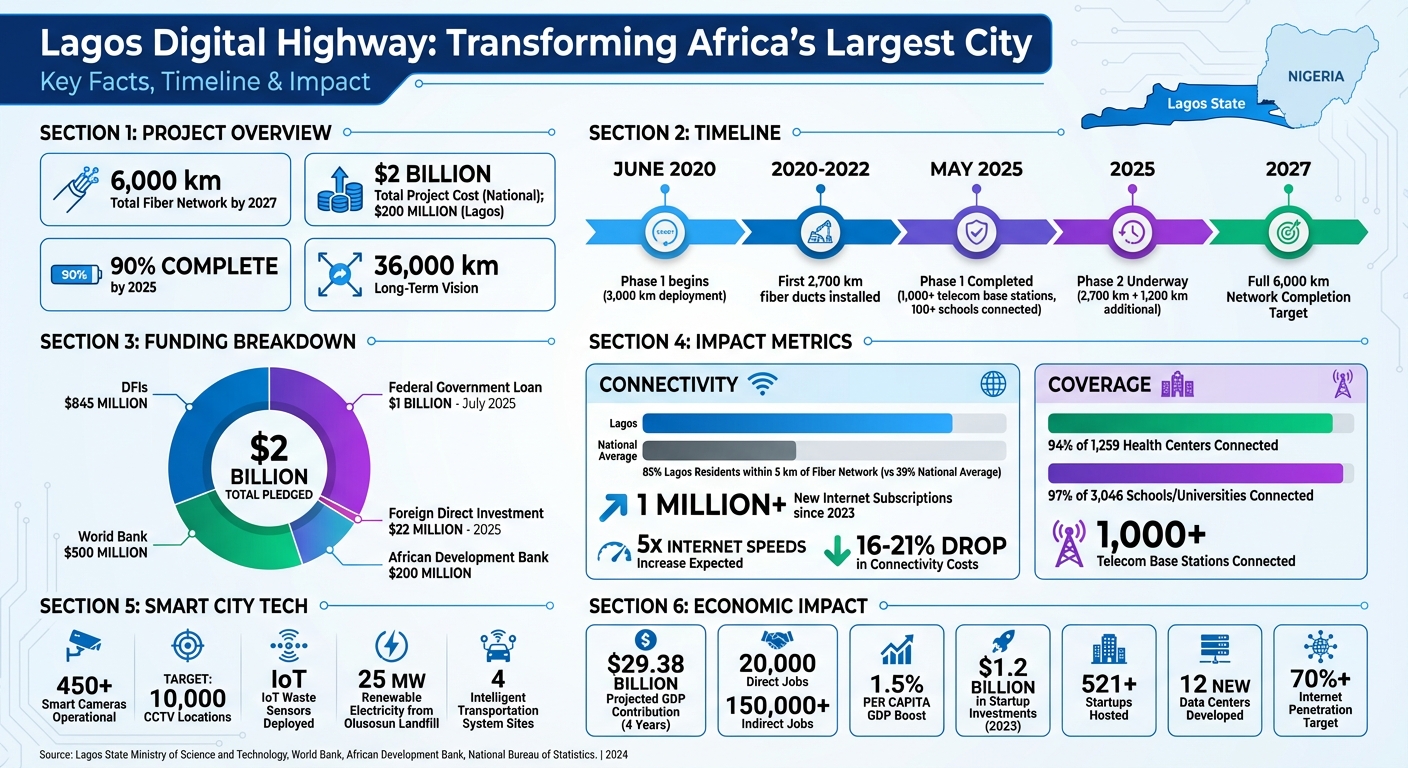
Lagos Digital Highway: Key Statistics, Timeline & Impact 2020-2027
Route, Map, and Deployment Plan
The Lagos Digital Highway Route and Coverage
The Lagos Digital Highway follows major corridors, including Ikorodu Road, the Apapa–Oshodi Expressway, and the Lekki–Epe Corridor. A standout feature is the ₦40 billion CCTV center and enforcement cameras on the Third Mainland Bridge. This network connects all Local Government Areas and Local Council Development Areas, reaching key locations such as Epe, Ikorodu, Badagry, Ikeja, and Lekki.
Strategically placed digital junctions – like those at Allen Avenue, Nurudeen-Oluwopopo Road, Alapere-Ogudu Road, and Nitel Junction – tap into the fiber-optic backbone. These sites provide 24/7 HD surveillance and real-time traffic analytics. The project’s phased development ensures it integrates efficiently into Lagos’s urban landscape.
Deployment Phases and Timeline
The project’s expansive route is being rolled out in two main phases, each covering 3,000 km (1,864 miles) of fiber ducts. Phase 1 began in June 2020 with a 24-month timeline, focusing on deploying the first 3,000 km in key metro areas. By May 2025, this phase was completed, connecting over 1,000 telecom base stations and linking more than 100 public schools and government hospitals.
Phase 2 builds on this foundation, supported by US$22 million in foreign direct investment. It adds 2,700 km of fiber ducts, with an additional 1,200 km planned for 2025, aiming to complete the 6,000 km network by 2027. The long-term vision includes expanding the network to approximately 36,000 km, laying the groundwork for Lagos’s digital future.
Connection with Existing Infrastructure
The project is designed to integrate seamlessly with existing telecom networks through the Unified Duct Infrastructure Project (LASG-UDIP). This shared model allows multiple telecom providers to use the network without repeated roadworks. Between 2020 and 2022, Western Telecoms and Engineering Services Limited installed the first 2,700 km of fiber ducts and secured partnerships with major providers like MTN, Airtel, Liquid Telecom, MainOne, Dolphin Telecoms, Swift, and Spectranet.
"The state is installing both fiber cables and the infrastructure (fiber ducts) that other companies can latch on in order to expand their network."
– Hakeem Fahm, Lagos State Commissioner for Science and Technology
The infrastructure also connects to international submarine cables like Google’s Equiano and Facebook’s 2Africa, linking them to local data centers such as Liquid Telecom, MainOne, and Rack Center. Additionally, it supports 14 state agencies that have digitized services for the public.
sbb-itb-dd089af
Project Costs and Funding Structure
Total Project Costs
The Lagos Digital Highway, part of Project Bridge, comes with a hefty price tag of $2 billion. This budget includes the deployment of 90,000 km (55,923 miles) of fiber optic cable, aligning with Nigeria’s National Broadband Plan 2020–2025 goal of achieving 120,000 km of nationwide coverage.
For Lagos specifically, the project cost stands at $200 million. In 2025, Lagos State secured an additional $22 million in foreign direct investment to extend the network by 2,700 km (1,678 miles). By mid-2025, international Development Finance Institutions (DFIs) had pledged $845 million, including $500 million from the World Bank and $200 million from the African Development Bank.
This project is expected to deliver transformative economic benefits. Over four years, it is projected to contribute $29.38 billion to Nigeria’s GDP, generate 20,000 direct jobs and over 150,000 indirect jobs, and boost per capita GDP by up to 1.5%. Additionally, it aims to elevate the country’s internet penetration rate to over 70%.
The funding for this ambitious initiative is organized through a Public-Private Partnership model.
Public-Private Partnership Funding Model
The project’s financing relies on a structured Public-Private Partnership (PPP) approach, a cornerstone of Lagos’s strategy for advancing smart city initiatives and fiber infrastructure.
The funding model is centered around a Special Purpose Vehicle (SPV) – an independent limited liability company created to manage the project. This hybrid framework blends sovereign loans from DFIs with equity investments from private firms. The Nigerian government holds a minority stake in the SPV, capped between 25% and 49%.
During public consultations, 30 private companies expressed interest in contributing to the project. The SPV operates under a professional Board of Directors and is led by experts from the telecommunications sector to ensure transparency and efficiency.
"Project Bridge is designed to serve both large and small ISPs through scalable access across core, metropolitan, and middle-mile network layers. By fostering competition and enabling infrastructure sharing, it will fast-track the expansion of fixed broadband nationwide."
– Bosun Tijani, Minister of Communication, Innovation, and Digital Economy
In July 2025, the federal government approved a $1 billion loan, covering half of the project’s total cost – a critical step in securing the required funding. The project’s open-access model aims to disrupt the dominance of major mobile network operators, enabling smaller Internet Service Providers to lease capacity and compete more effectively.
Impact on Fiber Infrastructure and Internet Access
Fiber-Optic Network Expansion
The Lagos Digital Highway introduces a six-way fiber-optic duct system, guided by a "Dig-Once" policy aimed at minimizing road disruptions and safeguarding infrastructure. This open-access model allows telecom providers like MTN, Airtel, MainOne, Liquid Telecom, and Spectranet to lease capacity rather than constructing their own networks.
By 2027, the network will stretch 6,000 km (3,728 miles), with nearly 4,000 km expected to be operational by early 2026. Acting as a backbone for terrestrial distribution, it connects to major international submarine cables such as Google’s Equiano and Facebook’s 2Africa.
The results? Internet speeds are anticipated to increase fivefold by 2025, while connectivity costs could drop by 16% to 21%. This infrastructure has already driven adoption, with over 1 million new subscriptions since 2023. Additionally, 85% of Lagos residents now live within 3.1 miles (5 km) of a fiber network, a stark contrast to the national average of just 39%.
"The unified duct project will serve as a natural distribution infrastructure for broadband capacity all over Lagos, thus becoming the technology backbone of the state government’s THEMES agenda."
– Darren Bedford, Chief Development Officer, WIOCC
This enhanced connectivity is paving the way for innovative business and technological solutions.
Benefits for Businesses and Tech Startups
Beyond improving internet access, this fiber network is a cornerstone of Lagos’s smart city ambitions. It has already catalyzed the development of 12 new data centers requiring high-speed connectivity. By April 2022, the project extended connections from submarine cable landing stations to major data hubs, including Liquid Telecom’s Africa Data Center, MainOne’s Data Center, and the Rack Center in Ikeja.
In 2023, this improved digital infrastructure attracted $1.2 billion in startup investments. Moreover, over 100 schools in Lagos State were connected to the fiber network by April 2022, offering free broadband access. The network also allows startups to host high-demand applications locally, cutting down on latency and operational costs by reducing reliance on international servers.
"It gives us the physical infrastructure to lay cables or buy capacity. The reality is we don’t have to build because they’ve built."
– Funke Opeke, CEO, MainOne Cable Company
Smart City Technology Implementation
Smart Systems and Sensors
The Lagos Digital Highway integrates advanced sensors and surveillance systems to improve urban management. Right now, Lagos operates over 450 smart cameras, with plans to expand this network to 10,000 CCTV locations in the near future.
In January 2026, a collaboration with Huawei Technologies introduced speed-enforcement cameras on the Third Mainland Bridge. These cameras use a combination of ANPR (Automatic Number Plate Recognition), radar, and LIDAR to enforce the 80 km/h (50 mph) speed limit. When drivers exceed this limit, the system automatically scans their license plates, matches them with a database, and sends SMS notifications with fines. This setup works alongside existing enforcement systems, boosting traffic monitoring and safety.
IoT sensors are also in play, tracking waste bin levels to optimize collection routes and cut down pollution. The Olusosun landfill project is another standout initiative – capturing methane gas from waste and converting it into 25 MW of renewable electricity.
"A truly digitised city requires seamless integration between physical and digital systems."
– Olatubosun Alake, Commissioner for Innovation, Science, and Technology
To address data security, Lagos has deployed 109 certified Data Protection Officers, successfully preventing two major data breaches in 2025. These innovations highlight how technology can reshape urban services.
Applications for Urban Services
The enhanced surveillance and monitoring systems are paving the way for a smarter approach to delivering urban services. In February 2025, the Ministry of Transportation launched four Intelligent Transportation System (ITS) sites at major intersections. These sites use high-definition cameras to stream real-time traffic data, detecting congestion and speeding violations. The data also supports predictive modeling, helping commuters and logistics companies plan better routes during peak hours.
Residents can access many of these services through the Lagos Digital Services Platform – a centralized hub offering government services like e-taxation, health insurance (LASHMA), and education programs (EKO EXCEL). The fiber-optic network has expanded broadband access to 94% of 1,259 health centers and 97% of 3,046 schools and universities.
"The goal is to alleviate traffic congestion and improve road safety. With the Intelligent Transportation System, drivers receive real-time traffic updates, allowing them to plan smarter routes and avoid delays."
– Oluwaseun Osiyemi, Lagos State Commissioner for Transportation
The Lagos State Science Research and Innovation Council (LASRIC) has played a significant role in fostering innovation, awarding over ₦800 million (approximately $530,000) to more than 60 tech startups and 50 research projects tackling urban challenges. Additionally, 14 state agencies have fully digitized their services, with AI-powered chatbots providing 24/7 support for documentation and updates.
Conclusion: Lagos’s Digital Infrastructure Development
The Lagos Digital Highway is reshaping Africa’s largest city into a hub of digital connectivity. By the end of 2025, over 90% of the planned 6,000 km (about 3,728 miles) fiber-optic network was completed, bringing in one million new internet subscribers and generating $293.35 million in startup funding. Advanced technologies like AI-driven traffic management, IoT-enabled waste sensors, and automated enforcement tools are transforming Lagos into a data-powered city. Meanwhile, the Lagos Digital Services Platform ensures 24/7 access to government services across 14 digitized agencies, and the Digital Leap Programme has equipped 50,000 young Lagosians with cutting-edge tech skills. These strides mark an exciting step toward a digitally empowered future.
What This Means for Lagos’s Digital Future
With these advancements, Lagos is on track to solidify its position as Africa’s leading tech hub. The city already hosts more than 521 startups and secured $1.2 billion in tech funding in 2023, accounting for 75% of Nigeria’s total. The digital highway is fueling growth across key industries like fintech, e-commerce, and logistics. Additionally, the public-private partnership model, which attracted $22 million in foreign direct investment for fiber expansion, is gaining attention as a scalable blueprint for other cities aiming for similar transformations.
"The Sanwo-Olu administration’s vision goes beyond digital efficiency – it is about safeguarding lives, enhancing governance, and unlocking opportunity for every Lagosian."
– Olatubosun Alake, Commissioner for Innovation, Science, and Technology
Looking ahead, Lagos aims to complete the project by 2027 and has an ambitious long-term goal of expanding its fiber infrastructure to 36,000 km. This combination of scalable infrastructure and innovative collaboration offers a model for other cities across Africa to follow in their digital transformation journeys.
FAQs
How will residents and businesses connect to the new fiber?
Lagos is making strides in digital connectivity with its growing fiber optic network. The city is installing thousands of kilometers of fiber ducts to support high-speed internet, smart city initiatives, and improved security systems. Internet service providers will offer customized packages for both residential and business users, ensuring reliable, high-speed internet access is available across the city. These efforts are a key part of Lagos’s push toward a more connected and technology-driven future.
Will internet prices actually drop for end users in Lagos?
The cost of internet services in Lagos is set to drop as the government wraps up the initial phase of a project involving the installation of 2,700 kilometers of fiber ducts throughout the state. This effort is designed to make internet access more affordable while enhancing connectivity for residents.
How will Lagos handle privacy with more CCTV and ANPR cameras?
Lagos plans to tackle privacy concerns by keeping CCTV and ANPR camera footage within a tightly secured system. Access to this surveillance data will be strictly regulated, ensuring that only authorized personnel can view it. This approach aims to safeguard both privacy and security effectively.
Related Blog Posts
- African Tech Hub Comparison: Lagos vs Nairobi vs Cape Town
- Top 7 African Countries Using Partnerships for Rural Internet
- Smart Cities in Africa: Economic Benefits Explained
- Lagos Digital Highway Explained: The Real Impact on Traffic, Data, Smart City Tech & Jobs