Kevin Mwangi

African startups face a tough challenge: scaling quickly while dealing with limited talent and tight budgets. The solution? Augmented teams – a blend of human expertise and AI tools. This approach allows AI to handle repetitive tasks, freeing humans to focus on strategy and innovation. By 2030, Africa will need 23 million more STEM graduates, yet AI is expected to add $16 trillion to the global economy. For startups, leveraging AI tools like Zoho’s Zia can bridge resource gaps, streamline operations, and boost productivity.
Key highlights:
- AI’s role: Predictive, generative, and agentic AI can improve efficiency by automating tasks like candidate screening and data analysis.
- Zoho’s tools: Integrated AI features like Zia, low-code platforms, and self-service analytics make advanced AI accessible to small businesses.
- Industry impact: Fintech, healthcare, and renewable energy are already seeing faster processes, better customer insights, and reduced costs through augmented teams.
- Localized AI: Tools tailored to Africa’s unique languages and systems ensure relevance and usability.
With AI amplifying human potential, African startups can overcome resource limitations and compete on a global scale. Zoho’s affordable, integrated AI solutions are key to this transformation.
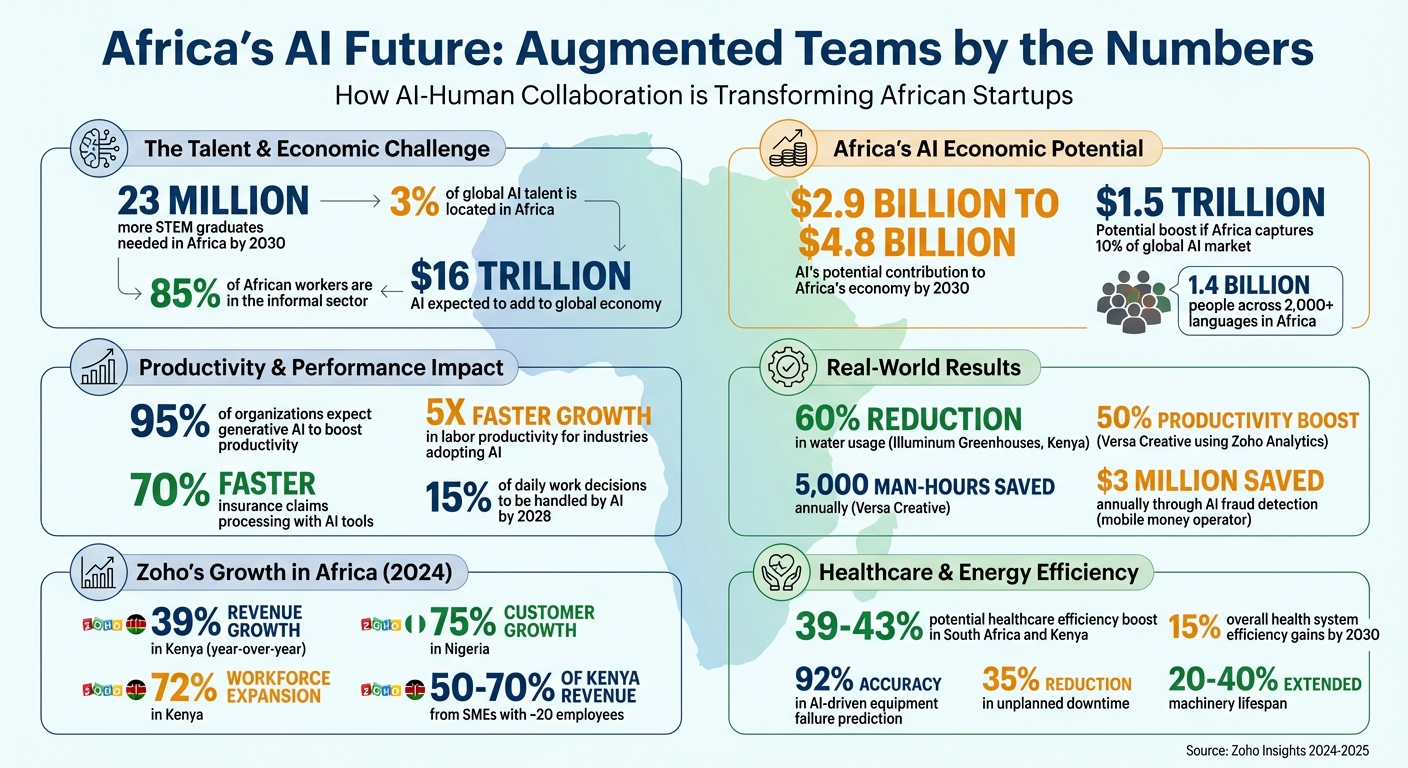
Africa’s AI Future: Key Statistics on Augmented Teams and Economic Impact
What Are Augmented Teams? Human-AI Collaboration Explained
An augmented team is all about humans and AI working side by side, not as tools and operators, but as teammates. It’s a blend of human creativity and empathy with AI’s unmatched speed and precision. The idea isn’t to replace humans but to relieve them of repetitive, time-consuming tasks, allowing them to focus on innovation and solving complex challenges.
AI operates on three primary levels: predictive (forecasting trends), generative (creating content), and agentic (handling multi-step tasks under human supervision). For African businesses that often face limited resources and talent, this collaboration model is proving to be transformative. In fact, 95% of organizations expect generative AI to boost productivity, and industries adopting AI report nearly 5 times faster growth in labor productivity.
The results are already evident. For example, AI tools enable insurance claims reviewers to process cases up to 70% faster by summarizing extensive documentation. By 2028, it’s predicted that 15% of daily work decisions will be handled autonomously by agentic AI. Zoho embodies this approach with "usable AI", integrating seamlessly into workflows through low-code tools and specialized agents like Deal Analyzers and Candidate Screeners. Next, let’s explore how augmented teams differ from traditional automation.
Augmented Teams vs. Automation: Key Differences
Traditional automation is designed to replace human effort in repetitive, high-volume tasks like data entry or invoice processing. It’s all about efficiency. Augmentation, on the other hand, is about enhancing human abilities in areas that require creativity, judgment, and complexity. Where automation increases output, augmentation improves quality.
The collaboration between humans and AI can take several forms:
- Autonomous collaboration: AI independently handles routine workflows with little human input.
- Structured oversight: Humans validate AI’s decisions for tasks requiring judgment.
- AI-led analysis: AI processes complex data while humans align findings with strategy.
- Strategic collaboration: Human creativity meets AI’s analytical power to drive innovation.
This model is particularly valuable for African businesses, which need to stretch limited resources while preserving the human connection critical for customer relationships and local market insights.
Organizations are also shifting how they measure AI’s impact. Instead of focusing on job replacement, many now use the "Human AI Augmentation Index" to track how AI enhances creativity and reduces mental strain.
"The value I see in AI is as an aid to humans, as opposed to replacement of humans." – George Hanson, Chief Digital Officer at Mattress Firm
Understanding this difference is key to identifying the tools that make augmented teams work.
Tools That Power Augmented Teams
For African startups navigating unique challenges, certain technologies are essential for building effective augmented teams. Here are three standout tools:
- AI copilots: Tools like Zoho’s Zia integrate directly into platforms like email, CRM, and HR systems, offering diagnostic insights and predictive analysis. With natural language querying (NLQ), even non-technical staff can extract insights from complex data.
- Self-service analytics: These tools democratize data access across organizations. With 97% of business leaders emphasizing data-driven decision-making, solutions like Zoho’s "Ask Zia" make it easy for teams to query business metrics in plain English. By 2026, two-thirds of B2B sales are expected to shift from intuition to data-backed decisions.
- Low-code platforms: These platforms empower small and medium-sized enterprises (SMEs) to build custom automations without the need for costly data science teams. For instance, Zoho’s Agent Studio enables users to create role-specific agents with simple prompts. This is especially important in Africa, where 85% of workers are in the informal sector. By offering advanced tools at no extra cost to existing users, Zoho removes financial barriers, making these technologies accessible to more businesses.
These tools are reshaping how businesses operate, making augmented teams not just a possibility, but a necessity for staying competitive.
Why Augmented Teams Work for Africa’s Tech Ecosystem
Africa is brimming with potential, even as resources remain limited. Take Kenya, for example: in 2022, it ranked fifth in Africa for government AI readiness. But when it came to the technology sector’s skills availability, the country scored just 28.76% – falling short of the global average of 35.17%. This gap highlights why many African startups are turning to augmented teams to maximize their impact.
The numbers tell a compelling story. In 2024, Zoho’s revenue in Kenya grew by 39% year-over-year, while its local workforce expanded by a staggering 72% during the same period. This approach isn’t about replacing human workers – it’s about empowering them. Small and medium-sized enterprises (SMEs) with around 20 employees now generate between 50% and 70% of Zoho’s revenue in Kenya. This demonstrates how smaller teams, when supported by AI, can achieve extraordinary results.
"We’re not trying to remove the human. We’re trying to make the AI helpful – a teammate, not a black box." – Veerakumar Natarajan, Country Head, Zoho Kenya
Zoho’s decision to provide advanced AI tools at no extra cost to its users makes enterprise-grade intelligence accessible. In a region where 85% of workers are in the informal sector, every dollar saved on tech translates into opportunities for growth.
Solving Talent Gaps and Resource Constraints
Augmented teams help tackle two of Africa’s biggest challenges: talent shortages and limited resources. The reality is simple – most startups in the region can’t afford to hire a data scientist for every department. Instead, AI becomes the ultimate multi-tasker, delivering results without requiring a six-figure salary. Low-code platforms, for instance, enable non-technical staff in cities like Kisumu or Eldoret to create custom automations without writing a single line of code. A sales manager can build a lead-scoring system, or an HR coordinator can design a candidate screener. The expertise is embedded in the tools themselves.
Look at Illuminum Greenhouses in Kenya. In October 2025, the company introduced AI-driven sensors to automate irrigation for smallholder farmers. The outcome? A 60% reduction in water usage while simultaneously boosting crop yields. Similarly, Safaricom‘s M-Pesa integrated machine-learning systems to improve credit scoring for its Fuliza and M-Shwari platforms. By analyzing mobile spending habits and payment histories, these systems assess loan eligibility for millions of users who lack traditional credit records. What once required a full analytics department is now achievable with AI-augmented teams, making advanced solutions accessible even to lean operations.
Zoho’s "contextual AI" approach further simplifies adoption. Instead of relying on massive, resource-intensive language models, the company uses smaller, task-specific models with parameters ranging from 1.3 billion to 7 billion. This approach delivers high accuracy at a fraction of the cost, which is crucial for startups operating on tight budgets.
Localization and Context-Aware AI
While Zoho’s tools work well globally, they’re also tailored to Africa’s unique needs. Generic AI models, often trained on Western datasets, struggle to perform effectively in African markets. Consider this: Africa is home to 1.4 billion people and over 2,000 languages, yet most AI tools are trained on data from English, Spanish, and Mandarin speakers. This creates a disconnect – AI that can’t recognize local names, understand regional business practices, or navigate mobile money systems isn’t very useful.
Context-aware AI changes the game. Zoho’s Zia, for example, uses Retrieval-Augmented Generation (RAG) to adapt its global capabilities to specific customer data, ensuring it understands regional nuances. This goes beyond simple translation; the AI learns to navigate systems like hawala in Nigerian fintech or M-Pesa in Kenyan healthcare.
The infrastructure supporting these advancements is also improving. In April 2025, Cassava Technologies announced a $720 million investment to partner with Nvidia on the "Africa AI Factory", which will provide critical AI infrastructure to countries like Egypt, Kenya, Morocco, Nigeria, and South Africa. At the same time, Nigeria’s government began developing a multilingual large language model trained in five local languages to promote digital inclusion.
Zoho has also addressed connectivity issues, reducing latency for African customers from around 7% to nearly zero. This improvement ensures real-time AI interactions are possible, even in regions with unreliable internet. Seamless collaboration is essential for augmented teams, and delays can disrupt productivity.
"Our customers don’t need to invest in third-party integrations or additional tools – the technology simply arrives and works. This approach makes AI adoption practical, affordable, and impactful for businesses across the continent." – Kehinde Ogundare, Country Head, Zoho Nigeria
AI has the potential to add between $2.9 billion and $4.8 billion to Africa’s economy by 2030. But for this growth to happen, AI must meet the specific needs of African businesses. Tools that understand local contexts, work within regional constraints, and amplify the capabilities of small teams are key to shaping the future of Africa’s tech ecosystem.
How to Build Augmented Teams With Zoho: Step-by-Step
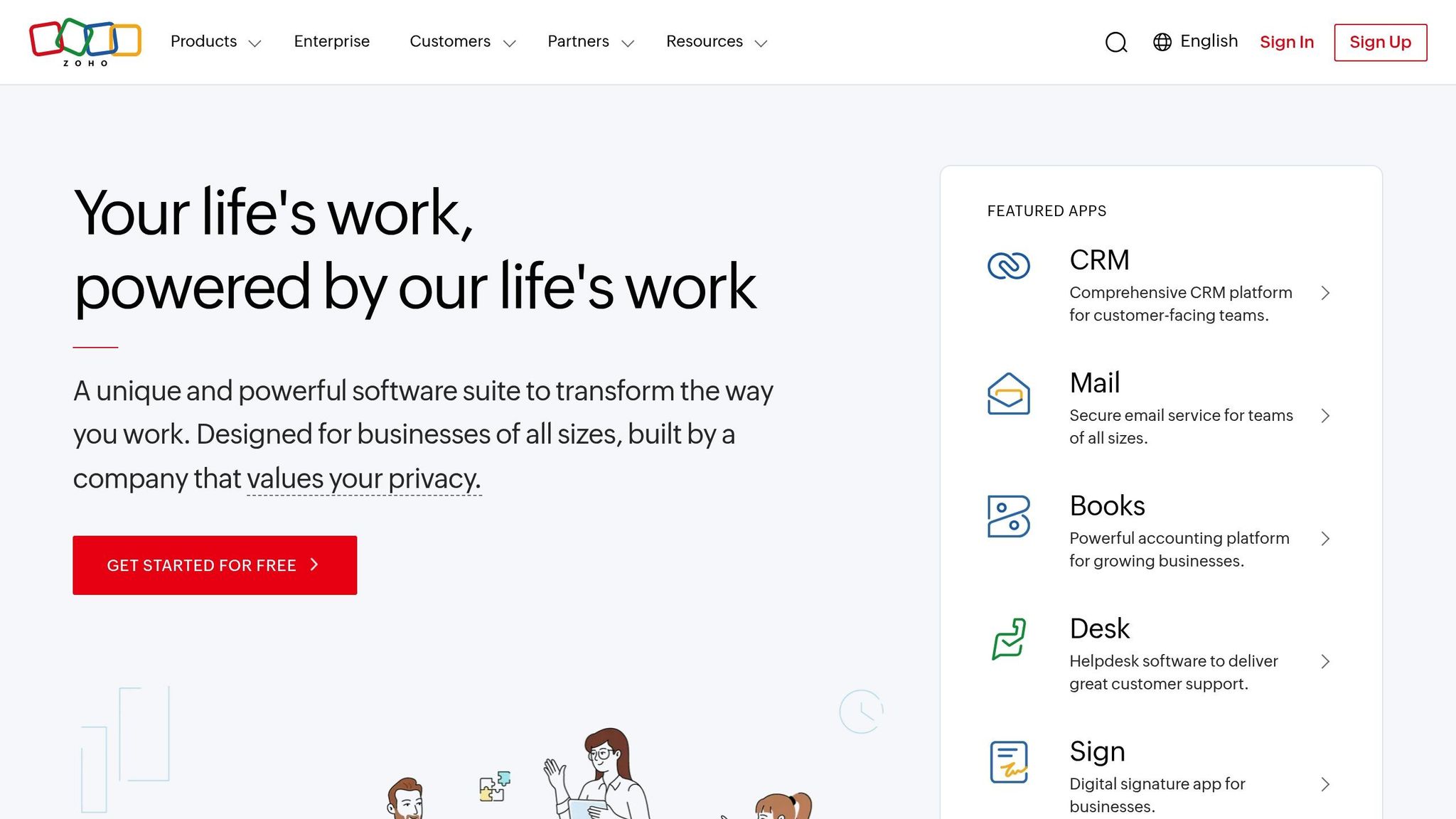
Building an augmented team doesn’t have to drain your budget or require a team of data scientists. Startups in Africa can begin with small, manageable steps and scale up as they grow. The trick is to establish a strong data foundation first, then introduce AI tools that align with your team’s needs. Zoho simplifies this process by including advanced AI features in all paid plans at no extra cost. This means a startup in Lagos or Nairobi has access to the same tools as a company based in Silicon Valley. By following this step-by-step process, data readiness and AI integration can work together seamlessly.
Setting Up Data Foundations for AI Integration
AI is only as effective as the data it processes. Research shows that business users spend 80% of their time preparing data rather than analyzing it. Zoho Analytics and DataPrep flip this trend by automating much of the tedious work. These tools offer over 250 transformations, automatically recognize data types, suggest ways to merge datasets, and flag invalid entries.
Start by integrating your existing data sources – whether it’s customer records in spreadsheets, sales data from mobile money platforms, or inventory logs from warehouse systems. Using Zoho’s visual pipeline builder, you can create a Unified Metrics Layer that standardizes business metrics across your team. This enables you to build full ETL (Extract, Transform, Load) processes without any coding. With everyone working from the same data – whether in sales, finance, or customer support – you’ll have a single source of truth for decision-making.
For example, in 2024, Versa Creative, led by CEO Eddie Shekari, used Zoho Analytics to consolidate data from multiple sources. The company saved 5,000 man-hours annually and boosted productivity by 50%. For startups with lean teams, this kind of efficiency can make a huge difference.
Once your data foundation is solid, you’re ready to bring AI copilots into your daily operations.
Adding AI Copilots to Daily Operations
After organizing your data, the next step is to deploy AI copilots to handle repetitive tasks. Zoho’s Zia Agent Marketplace offers pre-built agents like the Candidate Screener, Deal Analyzer, and Revenue Growth Specialist. These agents can be activated in minutes without requiring custom development. For instance, the Lead Qualifier Agent automatically syncs email conversations with your CRM and scores leads based on engagement patterns. This allows your sales team to focus on closing deals instead of updating records manually.
With Ask Zia, team members can query business data using plain language. Instead of building complex reports, a marketing manager can simply ask, “Which sales reps performed best on the coast last quarter?” and get instant visualizations. In 2024, Renu Energy Solutions used Ask Zia to compare sales rep performance across different regions. According to Business Intelligence Manager John Sheldon, they identified winning strategies in just minutes.
For field teams operating in areas with limited internet access, Zia Voice in the mobile CRM app allows updates via voice commands. For example, a healthcare worker in a rural clinic can quickly review patient histories or log notes without typing – an essential feature when connectivity is unreliable.
Using Low-Code Platforms for Custom Solutions
To tailor AI tools to specific needs, Zoho offers low-code platforms like Zoho Creator and Agent Studio. These platforms let non-technical users build custom workflows with visual interfaces or simple prompts. For example, a logistics coordinator could create a system to track shipments and send delay alerts, while an HR manager might design a candidate screener to evaluate resumes based on local qualifications.
For more advanced customization, developers can use Deluge, Zoho’s scripting language, to teach Zia specific business skills. This might involve integrating third-party software, like mobile money APIs, or automating unique processes for your industry. Additionally, Zoho’s Zia LLM offers models in three sizes – 1.3 billion, 2.6 billion, and 7 billion parameters – so you can balance performance and computing resources.
Zoho also supports BYOK (Bring Your Own Key), allowing startups to connect large language models like GPT-4, Gemini, or Claude to their workflows while maintaining control over data governance.
| Feature | Tool | Primary Benefit for Startups |
|---|---|---|
| Data Prep | Zoho Analytics / DataPrep | Automates cleaning with 250+ transformations |
| Custom Agents | Agent Studio | Build role-specific AI with simple prompts |
| Conversational BI | Ask Zia | Plain language querying for instant insights |
| Workflow Automation | Zia Agents | Automates tasks like lead qualification |
| Custom Skills | Deluge / Catalyst | Low-code platform for tailored AI functions |
sbb-itb-dd089af
Augmented Teams Across Industries: Fintech, Healthcare, and Energy
Augmented teams are reshaping African startups in fintech, healthcare, and renewable energy by blending human expertise with AI-powered tools. This combination helps businesses scale faster and reach underserved communities.
Fintech: Tackling Fraud and Enhancing Customer Insights
Fraud is a major challenge in Africa’s mobile money ecosystem. One leading operator managed to save over $3 million annually by implementing AI-driven fraud detection systems. These systems use graph analytics to map relationships between users, devices, and SIM cards, identifying fraud rings with precision. Augmented teams pair these AI tools with human investigators who interpret risk scores and apply measures like OTP prompts or transaction delays only to high-risk cases.
"AI in fraud detection is no longer optional. It’s a strategic necessity." – Subex
On the customer insights front, tools like Zoho’s Ask Zia allow teams to interact with financial data using plain language, generating instant visualizations and actionable insights, such as sending payment reminders. Additionally, Zoho’s Invoicing Agent flags high-risk customers and overdue amounts, enabling collections teams to focus on high-priority accounts. These innovations contributed to Zoho’s 39% revenue growth in Kenya in 2024.
While fintech is leveraging AI to enhance security and customer understanding, similar advancements are making waves in healthcare.
Healthcare: Expanding Telehealth and Diagnostics
In sub-Saharan Africa, over 20% of people live more than two hours away from essential health services. Augmented teams are addressing this gap with teleconsultations, remote monitoring, and AI-driven electronic triage systems that assess whether patients require emergency care or follow-ups. These digital solutions could boost healthcare efficiency by 39% to 43% in South Africa and Kenya, with overall system efficiency gains of up to 15% projected by 2030.
AI-powered virtual assistants integrated with Electronic Health Records (EHRs) are also reducing administrative errors, freeing up clinicians to focus on patient care. Localized AI models trained on regional data further enhance these systems by considering local regulations, languages like Amharic, and cultural nuances.
Beyond healthcare and financial services, augmented teams are driving change in Africa’s renewable energy sector.
Renewable Energy: Optimizing Distributed Systems
Africa’s renewable energy infrastructure relies heavily on distributed assets like solar panels, wind turbines, and microgrids in remote areas. Augmented teams utilize AI to monitor equipment health, predict energy production, and maintain grid stability. For example, in December 2025, Omdena partnered with Zimbabwe-based NeedEnergy to create AI-powered dashboards for solar management in Harare. These tools included a long-term PV sizing feature using 14 years of solar irradiance data to estimate 20-year ROI and an Energy Alert Tool that forecasts energy demand and generation for the next 36 hours with LightGBM.
AI-driven predictive maintenance has proven to be a game-changer, identifying equipment failures with 92% accuracy. This reduces unplanned downtime by 35%, extends machinery lifespan by 20% to 40%, and improves energy output by 8.5% through IoT sensor data analysis. Real-time monitoring systems cut system failures by 25%, while AI-powered drones equipped with computer vision streamline aerial surveys and land mapping, reducing installation times by 20% to 40%.
These examples highlight how augmented teams are driving progress and efficiency across Africa’s fintech, healthcare, and renewable energy sectors, empowering industries to overcome unique challenges and thrive.
Measuring Augmented Team Performance
Tracking the right metrics is essential to evaluate how well augmented teams are performing. These measurements not only highlight success but also ensure that the investment in these teams pays off. For African startups, having a clear system to assess whether AI tools are boosting productivity, revenue, and customer satisfaction – or merely complicating workflows – is crucial.
Key Metrics to Track
Start with the basics of productivity: monitor the planned-to-done ratio (how much work gets completed versus assigned) and cycle time (the time it takes to finish a project). Also, evaluate focus time versus interruptions – like unnecessary meetings or constant notifications – to understand whether AI tools are freeing up your team’s capacity or creating distractions.
When it comes to revenue and decision-making, look at how often decisions shift from gut instincts to being data-driven. By 2026, two-thirds of B2B sales organizations are expected to adopt data-driven decision-making. Keep an eye on forecasting accuracy and how frequently data insights guide strategic decisions. Additionally, track metrics like support tickets resolved and customer satisfaction scores, leveraging AI-powered "Resolution Experts" to analyze customer interactions and enhance future responses.
Human resources metrics are equally important. Measure recruitment speed, retention rates, and employee engagement using tools like communication and sentiment analysis. Research shows that new hires who integrate well with teams from day one are 65% more likely to remain long enough to become productive and profitable.
Consider using the IOB Model, which allocates performance focus as follows: 40% on Business Impact, 30% on Tangible Output, and 30% on Collaborative Behavior. This model ensures teams prioritize meaningful outcomes over mere activity. Companies that adopt comprehensive AI performance measurement frameworks report 3.2x higher ROI and 60% faster optimization cycles compared to those relying on basic usage metrics.
Next, let’s explore how Zoho’s tools simplify tracking these metrics and turn them into actionable insights.
Using Zoho’s Tools for Performance Tracking
Zoho offers a suite of tools designed to integrate performance metrics into daily workflows, making tracking seamless. Zoho Analytics provides a Unified Metrics Layer that consolidates all key business metrics into a single dashboard, eliminating the problem of fragmented data across departments. This is particularly beneficial for African startups juggling limited resources across various functions.
With Zia Insights, Zoho goes beyond surface-level analytics, offering diagnostic tools that explain the "why" behind performance trends instead of just showing the "what". For example, in 2025, Market Dojo used Zoho Analytics 6.0 and Zia Insights to pinpoint strategies that led to business success. Alun Rafique, CEO and Co-Founder of Market Dojo, shared:
"Zia Insights’ diagnostic capabilities have been a game-changer… it’s critical we understand what’s working before helping other businesses and professionals."
The platform also includes Key Driver Analysis, which identifies factors like advertising spend or team behavior that directly influence revenue and customer satisfaction.
To stay on top of changes, you can set up Data Alerts, which send instant notifications about KPI shifts, anomalies, or goal achievements. This feature allows teams to act quickly when performance trends change. For industries like fintech or energy, Stream Analytics processes real-time data from APIs, enabling up-to-the-minute performance tracking.
Zoho Analytics delivers measurable results: it boosts productivity by 50%, reduces project timelines by 30%, and increases revenue by 5%. Its ability to process 25% more data compared to manual methods helps startups make faster, smarter decisions. With a 4.4/5 rating across major platforms and recognition in the 2025 Gartner Magic Quadrant for Analytics and Business Intelligence Platforms, Zoho provides enterprise-level tools at prices accessible to startups.
Conclusion
The future of AI in Africa lies in empowering workers by combining human expertise with AI tools to tackle challenges like talent shortages and limited resources. With only 3% of the global AI talent located in Africa, this approach allows the current workforce to amplify its impact without relying on large-scale hiring efforts. This strategy lays a strong groundwork for economic growth across the continent.
By 2030, AI could contribute between $2.9 billion and $4.8 billion to Africa’s economy. Some projections even suggest a potential $1.5 trillion boost if Africa captures just 10% of the global AI market. Achieving this requires AI solutions tailored to African languages, business environments, and regulatory frameworks.
Zoho is emerging as a key player in this transformation. Its 2024 results – 39% revenue growth in Kenya and a 75% increase in customer growth in Nigeria – highlight the growing appetite for AI-driven business tools. By offering AI capabilities like its Zia LLM at no extra cost and hosting it on private servers, Zoho addresses critical concerns around affordability and data privacy for African businesses.
The guiding principle here is clear: AI should enhance human potential, not replace it.
The real question isn’t whether Africa will embrace AI, but whether the necessary investments will ensure its leadership in the field. By focusing on building strong data infrastructures, adopting low-code platforms, and prioritizing workforce upskilling, African businesses can create augmented teams that deliver a competitive edge across industries like fintech, healthcare, and energy. This path ensures that innovation continues to empower people rather than replace them.
FAQs
What makes augmented teams different from traditional automation?
Augmented teams bring together human expertise and AI-driven tools to boost decision-making, spark creativity, and improve productivity. Unlike traditional automation, which replaces repetitive, rule-based tasks to cut down on manual labor, augmented teams take a different approach.
Instead of focusing solely on efficiency, augmented teams emphasize collaboration between humans and AI. This partnership allows them to address complex problems and push forward new ideas.
What are the main advantages of using AI tools like Zoho’s Zia for African startups?
AI tools like Zoho’s Zia are helping African startups simplify their operations, make smarter decisions, and increase productivity – all without the hefty price tag or complexity that often comes with advanced technologies. Zoho goes a step further by offering tools like Zia LLM at no additional cost and pricing them in local currencies, minimizing financial risks for small and medium-sized businesses.
Zia is tailored to handle everyday business tasks, such as summarizing data, creating reports, and automating repetitive workflows. Its intuitive design ensures that even teams without technical expertise can easily use it. Plus, with Zoho running on its own servers, customer data remains secure and private, addressing concerns often linked to third-party AI platforms.
By cutting down operational costs, delivering quicker insights, and automating routine tasks, Zia equips startups to grow efficiently while tackling the unique challenges of limited resources and regulatory hurdles.
How can AI tools be adapted to meet Africa’s diverse languages and business challenges?
AI tools are being shaped to suit Africa’s rich linguistic and business landscape. Developers are building language models for indigenous languages such as Swahili and Zulu, enabling innovations like local-language chatbots and SMS-based services. These models rely on community-sourced data and are fine-tuned to reflect regional grammar and idiomatic expressions, overcoming the scarcity of publicly available datasets for African languages.
On the business front, AI solutions are crafted to address the unique challenges faced by African companies. For instance, AI platforms designed for industries like fintech, healthcare, and renewable energy help streamline tasks, produce detailed reports, and support data-driven decision-making – all while adhering to local data privacy regulations. By integrating AI into everyday tools, businesses can transform insights into practical strategies, enabling teams to operate more efficiently across Africa’s diverse and dynamic environment.
Related Blog Posts
- 10 Startups to Watch in 2025 in South Africa
- AI Startups in Africa: Role of Infrastructure Policies
- Solving Africa’s Tech Talent Gap with AI Training
- The Rise of AI Startups in Africa: Tools, Trends & Talent