Kevin Mwangi
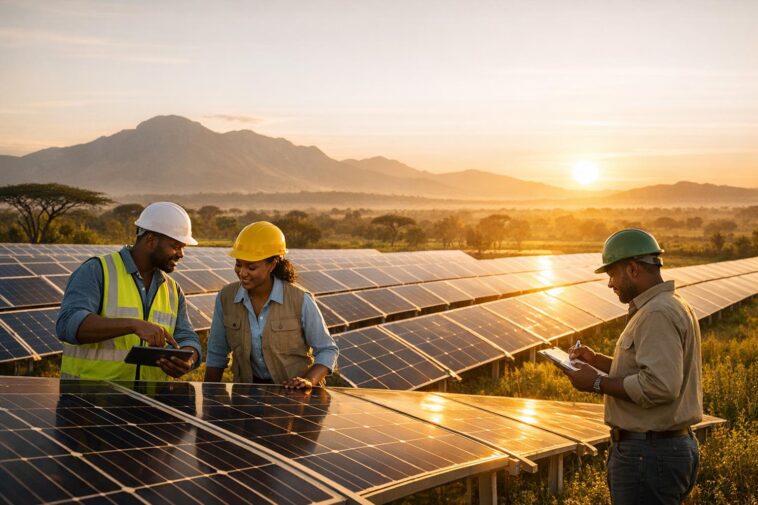
Africa’s green economy is transforming into a global investment hotspot. In 2025, private investments in clean energy surged, with funding jumping from $17 billion in 2019 to nearly $40 billion in 2024. African startups raised $2.8 billion by August 2025, matching the entire previous year. Key sectors include renewable energy, minerals for green tech, and off-grid solutions. However, challenges like high capital costs, limited global energy investment (just 3%), and financial risks persist. Solutions like blended finance, green bonds, and public-private partnerships are helping attract more investors. Major projects, such as Mozambique’s hydroelectric plant and Zimbabwe’s lithium processing, highlight the continent’s potential to reshape global energy markets.

Africa’s Cleantech Investment Growth and Key Metrics 2019-2050

Investment Trends in Africa’s Cleantech Sector
Renewable Energy Investment Growth
The renewable energy sector in Africa is experiencing a surge, driven by falling costs and shifting investor priorities. Solar PV has emerged as the most affordable power source in many African nations, reshaping how investors approach the market. This economic transformation has propelled private sector investments in clean energy to nearly $40 billion in 2024, marking a pivotal moment for the industry.
Investors are increasingly focusing on commercial and industrial solar projects and electric mobility, which carry lower payment risks compared to residential ventures. The electric vehicle (EV) sector has seen remarkable growth, with investments hitting nearly $70 million in 2023 – an eightfold increase since 2021. Large-scale initiatives, such as green hydrogen projects and EV battery production, are also drawing significant foreign investments. For instance, Morocco secured a $6.4 billion deal in 2023 to build an EV battery manufacturing facility. These developments underline Africa’s growing appeal to investors seeking opportunities in renewable energy.
However, challenges persist. Capital costs for utility-scale clean energy projects in Africa are 2–3 times higher than in advanced economies and China. This makes projects more expensive and financing more difficult. To meet its 2030 climate and energy targets, Africa requires $28 billion in concessional funding annually to unlock $90 billion in private investment. Blended finance, where development finance institutions help reduce project risks, has become critical. This approach is also paving the way for innovative tools like green bonds.
Green Bond Market Expansion
Green bonds are becoming a key instrument for financing Africa’s cleantech transition, though their use is evolving. Instead of funding entirely new projects, these bonds are often used to refinance existing "brownfield" projects, freeing up resources for new "greenfield" developments. This strategy, known as asset recycling, allows developers to reinvest in early-stage projects while maintaining momentum in the sector.
The building sector is a notable area of growth for green bonds, supporting energy efficiency projects through green mortgages and creative payment models like on-wage or on-bill plans. Impact platforms are also leveraging bond issuances to securitize loans, enabling local financial institutions to expand green lending. Governments are stepping in with sovereign green bond programs to set benchmarks and stimulate broader corporate bond markets. Given that energy efficiency projects currently receive less than 15% of concessional funding, the role of bond markets is becoming increasingly significant.
FDI Challenges and Capital Allocation
Despite the progress in financing models, Africa’s cleantech sector faces hurdles in attracting stable foreign direct investment (FDI). FDI in the sector fell by 3% to $53 billion in 2023, while international project finance deals dropped by 50% to $64 billion, following a 20% decline in 2022. Yet, there is a silver lining: Africa is securing a growing share of global greenfield megaprojects, particularly in green hydrogen and EV battery supply chains. In 2023, Mauritania announced a green hydrogen project with an estimated investment of $34 billion – an amount far exceeding the country’s annual GDP.
Despite representing 20% of the global population, Africa accounts for less than 2% of global clean energy spending. The financial instability of state-owned utilities, with system losses averaging 15% in 2020, creates high payment risks for private investors. Additional challenges, such as currency volatility and underdeveloped local financial systems, further complicate the investment landscape. Blended finance is becoming increasingly important as public and development funding has dropped by a third over the past decade, largely due to an 85% reduction in Chinese development finance.
"Emissions reductions provide a powerful reason to invest, but are often not the primary driver for investment in technologies that are increasingly mature and cost-competitive."
– IEA, World Energy Investment 2025
To overcome these barriers, targeted strategies are essential. Credit enhancements, local currency guarantees, and liquidity support mechanisms – such as those trialed in Gabon – are proving effective in improving project bankability. Strengthening regulatory frameworks and developing domestic capital markets will also be crucial to mitigating currency risks and external economic shocks.
sbb-itb-dd089af
Leading Cleantech Projects Across Africa
Solar and Hydroelectric Power Projects
Africa is undergoing a significant shift in its renewable energy landscape, driven by ambitious hydroelectric and solar projects aimed at addressing chronic power shortages. One standout initiative is the Mphanda Nkuwa Hydroelectric Plant in Mozambique, the largest hydroelectric project in southern Africa in five decades. Backed by $6 billion in funding from the World Bank and developed by TotalEnergies, Électricité de France, and Hidroeléctrica de Cahora Bassa, this 1,500-megawatt facility is set to begin operations in 2031. Located about 37 miles downstream from the Cahora Bassa dam, it promises to help close a regional energy gap of 10,000 megawatts.
In Ethiopia, the Grand Renaissance Dam is nearing completion after a $4 billion investment. Once operational, it will generate over 5,000 megawatts of power, effectively doubling the country’s electricity output. Meanwhile, Egypt is advancing its renewable energy goals with a combined portfolio of 2,400 megawatts of hydroelectric and 1,400 megawatts of solar capacity. Across the continent, ongoing construction of 15,600 megawatts of hydroelectric dams and 8,100 megawatts of solar parks is contributing to a total of 32,700 megawatts of clean energy capacity in development.
Efforts to expand grid access are also making headway. In 2024 alone, Mozambique’s Electricidade de Moçambique (EDM) connected 563,000 homes to the electricity grid, with plans to add another 600,000 homes in 2025. These initiatives have significantly increased Mozambique’s electricity access rate from 31% in 2018 to 60% in 2024.
"Mozambique has the resources, gas, hydro, solar, and it’s already the biggest supplier of excess power to southern Africa"
– World Bank President Ajay Banga
In areas where extending the grid is not feasible, off-grid solar solutions are bridging the gap. In Mozambique, for instance, off-grid solar now accounts for 10% of electricity access, particularly benefiting remote rural communities. These projects are not only providing immediate solutions but are also laying the groundwork for long-term transformation, especially as Africa focuses on securing the critical minerals needed for green technology.
Critical Minerals for Green Technology
Africa is a powerhouse for essential minerals used in green technologies, contributing 76% of the world’s manganese and 69% of its cobalt supply. However, less than 5% of these minerals are refined on the continent. This is beginning to change as African nations push for policies aimed at adding value to their resources.
In Zimbabwe, a $400 million lithium sulfate processing plant, developed by China-based Huayou Cobalt, began testing in September 2025. This marks a pivotal step in the country’s efforts to establish a domestic battery value chain. Zimbabwe has also banned the export of unprocessed lithium, signaling its commitment to retaining more value locally. The Arcadia Lithium Mine, for example, has shifted its focus to exporting processed lithium instead of raw ore. Zimbabwe’s Deputy Mines Minister, Polite Kambamura, reinforced this vision:
"If we continue exporting raw lithium we will go nowhere. We want to see lithium batteries being developed in the country"
– Polite Kambamura
Morocco is also emerging as a key player in the electric vehicle battery market. In June 2025, the Sino-Moroccan joint venture COBCO began producing nickel-manganese-cobalt precursor cathode materials for EV batteries. Meanwhile, the Democratic Republic of Congo (DRC) is home to the Manono deposit, believed to be the world’s largest lithium reserve, with an estimated 6.6 million tonnes. Although ownership disputes between AVZ Minerals and Zijin Mining have delayed progress, this deposit remains central to Africa’s role in the global battery metal supply chain.
With lithium demand projected to grow sixfold between 2022 and 2035, increasing Africa’s capacity to process these minerals will be crucial in meeting global climate goals. These developments underscore the continent’s growing importance in the transition to a greener future.
How Africa Attracts Global Cleantech Investors
Blended Finance Models
Africa is leveraging blended finance to tackle the challenges of high-risk perception and commercial viability in its cleantech sector. This approach mixes concessional capital – such as grants, low-interest loans, and guarantees from development finance institutions (DFIs) – with private investment to make projects more appealing to investors. The need for this is clear: utility-scale clean energy projects in Africa face capital costs that are 2 to 3 times higher than in developed countries.
To meet its clean energy goals, Africa requires significant concessional funding every year to attract private investments on a larger scale. Blended finance structures include tools like credit enhancements, currency hedging products (e.g., "The Currency Exchange" or TCX), and liquidity support to mitigate risks such as payment defaults by state-owned utilities. Local currency financing is gaining traction as it shields projects from exchange rate fluctuations and external economic shocks.
This model allows DFIs to focus on early-stage markets or untested technologies, while private investors take the lead in established areas like solar and wind energy. By reducing risk, blended finance is paving the way for governments to implement policy reforms that further boost investor confidence.
Policy and Regulatory Frameworks
Alongside innovative financial models, policy reforms are playing a crucial role in attracting global cleantech investment. For instance, competitive auction rounds in South Africa and Egypt have successfully encouraged private-led solar PV projects while driving down technology costs. Similarly, net metering policies in countries like Nigeria, South Africa, and Kenya are fueling the Commercial and Industrial (C&I) solar sector. This sector is expected to grow at an impressive 39% compound annual growth rate, reaching a market value of $1.6 billion by 2027.
Governments are also introducing national green taxonomies to guide institutional investors and expand sustainable finance initiatives. Countries like The Gambia, Zimbabwe, and Togo are piloting asset recycling programs, which free up funds for new greenfield projects. Meanwhile, nations such as Kenya, Ghana, Senegal, and Rwanda are encouraging consumer investments in energy-efficient appliances and green buildings through on-wage and on-bill payment plans.
Recognizing their potential in hydrogen energy, Namibia and Mauritania are developing common standards for low-emissions hydrogen trade. This effort aims to support long-term supply projects. These policy frameworks address a stark reality: while Africa accounts for 20% of the global population, it attracts less than 3% of global energy investment. As the International Energy Agency highlights:
"African governments also need to create the right enabling environment, ensuring stable regulation and financially reliable utilities."
Public-Private Partnerships
Public-private partnerships (PPPs) are becoming a cornerstone in mobilizing private capital, building on the foundation of blended finance and regulatory reforms. Policy changes are breaking state monopolies, enabling Independent Power Producers (IPPs) and private buyers to engage directly with the grid. South Africa’s Renewable Energy Independent Power Producer Procurement Programme (REIPPPP) is a standout example, contributing about 17% of Africa’s total renewable energy capacity.
In 2024, the NOA Group platform, backed by African Infrastructure Investment Managers (AIIM), achieved financial close on 239 megawatts of wind capacity in South Africa. This included the 140-megawatt Ishwati wind farm, marking a significant milestone as the first major wind project where the buyer is a start-up trading company rather than a state utility. Additionally, South Africa’s state utility, Eskom, has procured around 343 megawatts of utility-scale batteries as part of a broader 500-megawatt Battery Energy Storage System (BESS) initiative to stabilize the grid.
Large-scale projects like Algeria’s Tafouk 1 Mega Solar Project, valued at $3.6 billion, aim to deliver 4 gigawatts of solar energy by 2025, showcasing how PPPs can position countries as regional leaders. Kenya has also emerged as a geothermal powerhouse, with nearly 1 gigawatt of installed capacity, making it the seventh-largest producer globally. This success stems from favorable regulations and effective use of natural resources. As Olusola Lawson, Co-Managing Director at AIIM, notes:
"Transmission is the backbone of the energy transition and scaling up renewable energy must go hand-in-hand with grid expansion."
Africa’s Cleantech Sector Beyond 2025
Expanding Renewable Energy Capacity
Africa has set an ambitious goal: reaching 300 GW of renewable energy capacity by 2030. To achieve this, the continent will need to add 32.5 GW annually from its current baseline of 8 GW. Solar energy is expected to lead this charge, projected to make up 70% of Africa’s installed capacity by 2050 – a staggering 100-fold increase. Wind energy will also play a significant role, growing 35 times to account for 20% of the total capacity.
Hydropower is another cornerstone of Africa’s renewable energy plans. Across Ethiopia, Egypt, Angola, Nigeria, and Tanzania, 15,600 MW of hydropower projects are already under construction. By 2050, Africa’s hydropower capacity is expected to quadruple. Egypt, for example, launched a diverse energy portfolio in October 2024, which includes 2,400 MW of hydroelectric power, 1,400 MW of solar, 2,500 MW of wind, and 1,200 MW of nuclear energy.
East Africa is making waves in geothermal energy. In 2023, Kenya secured $3.2 billion to build two new geothermal plants, solidifying its status as a global leader in this sector. Meanwhile, green hydrogen is emerging as a major export opportunity. Morocco, Namibia, and Mauritania are positioning themselves as global suppliers, with Morocco’s $10.6 billion green hydrogen and ammonia project launched by Total Eren in November 2022. Production is expected to start by 2027. By 2050, Africa could export 40 megatons of hydrogen annually. However, achieving these milestones will require substantial upgrades to grid and transmission infrastructure to handle the increased capacity.
Large-Scale Infrastructure Projects
For Africa to meet its renewable energy goals, annual energy investments will need to jump from $90 billion to over $200 billion by 2030. Grid infrastructure, in particular, is a major challenge. Current investments of $10 billion annually must rise to nearly $50 billion to integrate renewables effectively. African grids currently suffer from line losses averaging 15% – double the global average.
Efforts are already underway to expand cross-border transmission networks and create regional power pools. In 2023, a 1,700-kilometer transmission line connecting Senegal, the Gambia, Guinea, and Guinea-Bissau was completed, enabling clean energy sharing. Another key project is the 500-kilometer Kenya–Tanzania Interconnector, designed to allow power-surplus nations to export electricity to their neighbors.
Morocco is also making strides. In April 2021, Vinci Energies signed a $324 million contract to construct 500 kilometers of high-voltage power lines and 1,000 kilometers of distribution networks to support renewable energy integration. Meanwhile, Nigeria is moving forward with a 4,800 MW nuclear plant, currently in the pre-construction phase. Overall, Africa’s clean power capacity is expected to increase by 278% as existing and planned projects come online.
Africa’s Economic Transformation Through Cleantech
Beyond energy production, Africa’s cleantech sector is poised to reshape its economy. Despite supplying 75% of the world’s manganese, 70% of cobalt, and 20% of copper, Africa captures less than 1% of the manufacturing value from these resources. By increasing domestic processing and manufacturing, the continent could boost the market value of its processed minerals by nearly 75%, reaching $120 billion by 2040.
The Democratic Republic of Congo is already leading the way, attracting $130.7 million in mineral exploration investment in 2024 – the highest in Africa. Additionally, Africa’s rich mineral deposits and growing renewable energy capacity make it an ideal location for producing “green” commodities. For instance, low-emissions iron, which is valued at more than four times the price of raw iron ore exports, is a promising opportunity.
Electric vehicle (EV) production is another area of growth. Africa’s EV manufacturing is expected to rise from nearly zero today to 4 million units annually by 2035, eventually reaching 5 million by 2050. Achieving these milestones will require significant investment – about $2.9 trillion in cumulative capital expenditure between 2022 and 2050. Encouragingly, clean energy investment has already tripled, growing from $17 billion in 2019 to nearly $40 billion in 2024.
As McKinsey emphasizes:
"Africa has the fastest-growing population in the world… Meeting their needs with cost-efficient, sustainable energy sources will be vital to the continent’s socioeconomic development."
These developments highlight Africa’s growing influence in the global green economy, as it continues to balance sustainable energy expansion with economic transformation.
Von der Leyen Unveils Historic EU–South Africa Clean Energy Pact! Africa’s ENERGY Future Begins NOW!
FAQs
What challenges do investors face in Africa’s cleantech sector?
Investing in Africa’s cleantech sector presents a range of challenges that can make even the most promising opportunities feel daunting. One of the biggest hurdles is the lack of access to financing. While Africa is home to about 20% of the world’s population, it only attracts roughly 3% of global energy investments. Why? Many investors see the region as high-risk. Cleantech projects often demand significant upfront capital and take longer to yield returns compared to the typical venture capital timeline, which makes them less appealing to traditional investors.
Then there’s the issue of economic instability. Factors like currency devaluation, inflation, and financial volatility across various African markets can scare off investors. These economic shifts don’t just create uncertainty – they can also erode the value of funds already committed. On top of that, policy and market infrastructure gaps add another layer of complexity. High import duties on renewable energy components and inconsistent regulations across countries make it harder to scale clean technologies effectively.
Tackling these challenges will require a collaborative approach. Stronger partnerships between the public and private sectors, innovative financial tools like currency hedging, and thoughtful policy reforms could help lower costs and make projects more attractive to investors.
What role do green bonds play in financing Africa’s green economy?
Green bonds are playing a crucial role in financing Africa’s expanding green economy. In 2024, sustainable debt issuances, including green bonds from governments, utilities, and private developers, hit a record high of $13 billion. These funds are directed toward transformative projects such as large-scale solar and wind farms, off-grid renewable energy systems, clean transportation networks, and energy-efficiency improvements. They offer the long-term, low-cost capital essential for cleantech initiatives that require extended payback periods.
By following international green bond standards and combining public guarantees with private investment, African issuers are successfully appealing to global investors who focus on ESG-compliant assets. This growing financial support is vital for boosting renewable energy capacity, upgrading power grids, and advancing the continent’s sustainable development efforts.
Why are critical minerals important to Africa’s cleantech growth?
Africa’s cleantech sector is on the rise, and critical minerals are at the heart of this growth. These minerals power technologies like solar panels, wind turbines, batteries, and hydrogen fuel systems – tools essential for the global shift to renewable energy. With its vast reserves, Africa holds the potential to play a major role in the clean-energy supply chain worldwide.
But the real opportunity lies beyond just mining these resources. By investing in refining processes, material production, and manufacturing, Africa can capture a larger share of the economic benefits tied to renewable energy technologies. This approach not only strengthens global supply chains but also attracts investments that prioritize environmental and social responsibility. The result? Industrial growth and a more resilient economy.
Critical minerals aren’t just raw materials – they’re a foundation for Africa’s green transition and its growing influence in shaping the future of sustainable energy.
Related Blog Posts
- The State of Venture Capital in Africa in 2024
- 5 African Startups Advancing Battery Recycling
- Top 5 Regions for MobilityTech Funding in Africa
- Nigeria & Kenya Lead as Africa’s Big 4 Dominate 2025 Funding