Grace Ashiru
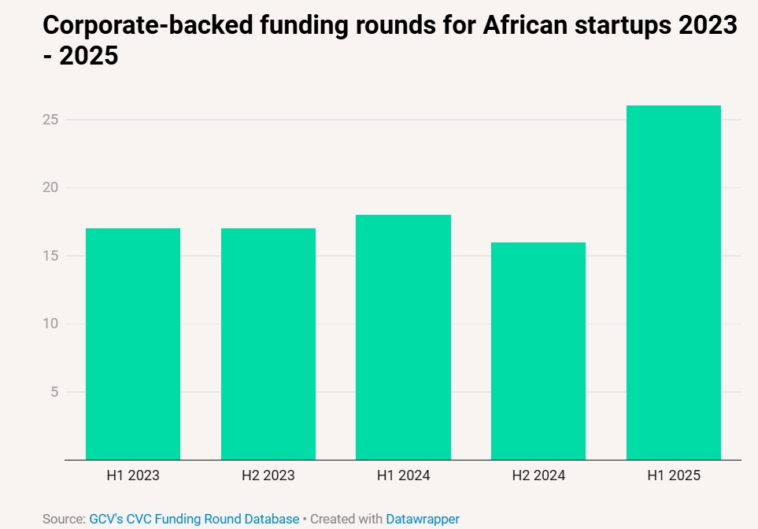
Corporate venture capital investment in African startups just hit a three-year high. In H1 2025 alone, 26 corporate-backed deals were recorded—a 44% increase over previous half-year periods. More importantly, this surge marks a deeper shift: African startups are no longer just raising foreign capital. They are building global companies from African bases, acquiring European assets, and attracting strategic investors from Asia, the Middle East, and beyond.
This is not a short-term spike. It is a structural change in how Africa connects to global corporate capital.
H1 2025 Performance Snapshot
- 26 corporate-backed deals in H1 2025
- 44% increase from the prior ceiling of 18 deals per half-year
- Highest level since the post-2022 market correction
- First sustained rebound after a flat H2 2023–H2 2024 period
Why This Moment Matters
Between H2 2023 and H2 2024, corporate participation stagnated. That period now looks less like decline and more like a reset. H1 2025 represents the first clear signal that corporates are re-entering Africa with intent, not experimentation.
WHAT CORPORATE VENTURE CAPITAL REALLY MEANS
Traditional venture capital focuses primarily on financial returns, shorter exit timelines, and portfolio diversification. Corporate venture capital, by contrast, combines financial upside with strategic alignment. These investors deploy capital to secure technology access, protect supply chains, deepen distribution, or future-proof core businesses.
This distinction explains why corporate investors are often more patient, more selective, and more operationally involved.
Strategic Examples From H1 2025
Examples from H1 2025
- Flour Mills of Nigeria invested in OmniRetail ($20M Series A) – a manufacturer backing the B2B ecommerce platform it uses
- Hollard Group (South African insurance) backed Naked Insurance ($38M Series B+)
- MediaTek (Taiwan semiconductor) invested in Egyptian chip startup InfinLink ($10M)
- PepsiCo’s Kgodiso Fund backed South African agtech Khula ($7M)
WHO IS ACTUALLY DEPLOYING CAPITAL IN AFRICA
Corporate capital into Africa is no longer dominated by Europe and North America alone. Asian and Middle Eastern corporations are increasingly active, often with quieter but deeper engagement models.
Indian and Japanese firms are expanding venture partnerships. Gulf-based corporations are investing strategically in infrastructure-adjacent technology. Chinese capital remains highly present, particularly in Nigeria, even when it is less visible externally.
What This Signals for Founders
This diversification reduces dependence on any single capital corridor. It also changes negotiation dynamics: founders are no longer pitching only financial upside but positioning themselves as long-term strategic partners in global value chains.
LOCAL AFRICAN CORPORATES STEPPING UP
Nigerian Corporates
- Flour Mills of Nigeria → OmniRetail ($20M Series A)
- Using platforms they depend on, investing to secure strategic advantage
Moroccan Corporates
- Attijariwafa Bank: Dedicated ventures unit
- OCP (fertiliser group): Multiple funds including Bidra Innovation Ventures ($250M fund, up to $5M checks)
Why This Is a Structural Shift
When African corporates invest locally, it anchors innovation within the continent. It also reduces the pressure for premature exits driven by foreign timelines and increases the likelihood of long-term ecosystem building.
GEOGRAPHIC CONCENTRATION REMAINS REAL
The Big Four Still Dominate
Corporate-backed deals remain heavily concentrated in Egypt, South Africa, Kenya, and Nigeria. These markets offer scale, regulatory familiarity, and established startup infrastructure.
At the same time, H1 2025 recorded first-ever corporate-backed deals in countries such as Tunisia, Ghana, Ethiopia, Togo, and Uganda—small numbers, but important signals.
The Opportunity Outside the Core Hubs
For founders outside the big four, the challenge is capital access—but the upside is differentiation. Being the first scalable platform in a less crowded market can position a startup as a regional gateway, particularly for corporates seeking frontier exposure without excessive competition.
FINTECH DOMINATES: 50% OF ALL CORPORATE DEALS
Fintech Winners by Country
Nigeria: $162.8M+ (disclosed amounts)
- Moniepoint
- Opay
- OmniRetail
South Africa
- Naked Insurance ($38M Series B+)
- Other insurance-tech plays
- More mature financial sector attracting different deal types
Egypt, Seychelles, Kenya
Remaining fintech deals.
THE SEYCHELLES CRYPTO HUB
12 startups in Seychelles raised corporate-backed funding in H1 2025.
8 of 12 were crypto startups.
Why Seychelles
- Positioned as offshore financial center
- Crypto-friendly jurisdiction
- KuCoin (crypto exchange, China origin) based there
- KuCoin participated in 7 of 12 funding rounds
Notable Deals
- Mango Network (blockchain tech): $13.5M from KuCoin + VCs (February)
- Yellow Network (decentralized clearing): $10M from Consensys + others (September 2024)
For African Founders
Seychelles offers a crypto-friendly regulatory environment but is limited beyond that sector.
AGRITECH: THE EMERGING OPPORTUNITY
Growing Corporate Interest
H1 2025 Agritech Deals
- 2 corporate-backed rounds
- Signals increasing corporate attention to agriculture technology
Deal 1: Khula (South Africa) – $7M
What They Do
Digital marketplace connecting farmers with customers.
Corporate Backer
PepsiCo’s Kgodiso Fund.
Why PepsiCo Cares
- Secures supply chain
- Supports smallholder farmers
- Gains early access to innovation
Deal 2: Kumulus Water (Tunisia) – $3M
What They Do
Technology producing drinking water from air.
Corporate Backer
Spadel (Belgian mineral water company).
Strategic Rationale
- Global water scarcity
- African solutions scale globally
- Direct relevance to core business
OCP’s Innovx
Younes Addou, VP Agribusiness, OCP Innovx:
“Africa has the potential to solve global food security problems and become the world’s global carbon sink if the continent’s 270 million small farmers can be connected and mobilised in the right way.”
Investment Thesis
- 270 million small farmers
- Need innovation ecosystems
- Cross-border replication
Innovx Fund Size
- $250M fund
- Up to $5M per deal
IT SECTOR: SEMICONDUCTORS AND SOFTWARE
Deal 1: InfinLink (Egypt) – $10M
- Semiconductor chips with optical connectivity
- Corporate investor: MediaTek
Deal 2: Qme (Egypt) – $3M
- Software startup
- Corporate investor: AHOY (UAE-based)
Why So Few IT Deals
- Focus on fintech/agritech
- Different talent requirements
- Less obvious local market fit
But
- Egypt emerging as tech hub
- North Africa–Middle East corridor forming
Why Corporate VCs Matter
- Distribution
- Customer references
- R&D resources
- Regulatory navigation
Example
MediaTek investing in InfinLink provides global access, validation, and easier European entry.
Longer Hold Periods
- Less pressure for premature exits
- More time to build properly
European Corporates as Buyers
- Spadel → Kumulus Water
- PepsiCo → Khula
HOW FOUNDERS CAN POSITION FOR CORPORATE CAPITAL
Match Strategy, Not Just Sector
The most successful corporate-backed founders are not pitching trends; they are solving problems that sit directly inside corporate value chains.
- Financial infrastructure that lowers operational friction
- Agritech that stabilises supply
- Deep tech that complements existing R&D gaps
Think Partnership Before Capital
Corporates invest when collaboration is already obvious. Founders who approach them as future partners, not just financiers, consistently attract stronger terms and longer-term support.