Kevin Mwangi
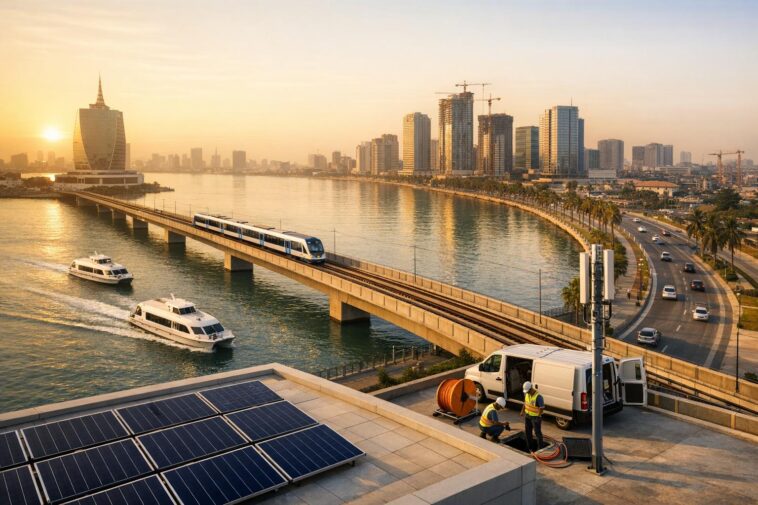
Lagos is transforming into a tech-driven megacity, creating opportunities for companies to provide cutting-edge solutions. Here’s what you need to know:
- Fiber Optic Expansion: Lagos plans to extend its fiber network to 6,800 kilometers by 2026, connecting 94% of health centers and 97% of schools.
- Eko Atlantic City: A new urban hub for 250,000 residents, featuring smart infrastructure, independent utilities, and IoT-ready systems.
- Transportation Overhaul: The Lagos Rail Mass Transit and Omi Eko Waterway projects aim to serve millions with tech-enabled rail and hybrid electric ships.
- AI-Powered Security: Over 450 smart cameras deployed, with plans for 10,000 CCTV units to enhance safety and traffic management.
Opportunities for tech companies include IoT solutions, smart energy systems, digital payment platforms, and AI-driven surveillance tools. With a young, tech-savvy population and growing infrastructure, Lagos is primed for innovation.

Want to contribute to Lagos’ smart city vision? Collaborate with local agencies like LASRIC and align with Lagos’ 2030 Smart City Plan for success.
TOP 5 PROJECTS TRANSFORMING LAGOS INTO A FUTURISTIC CITY
sbb-itb-dd089af
Major Smart City Projects in Lagos
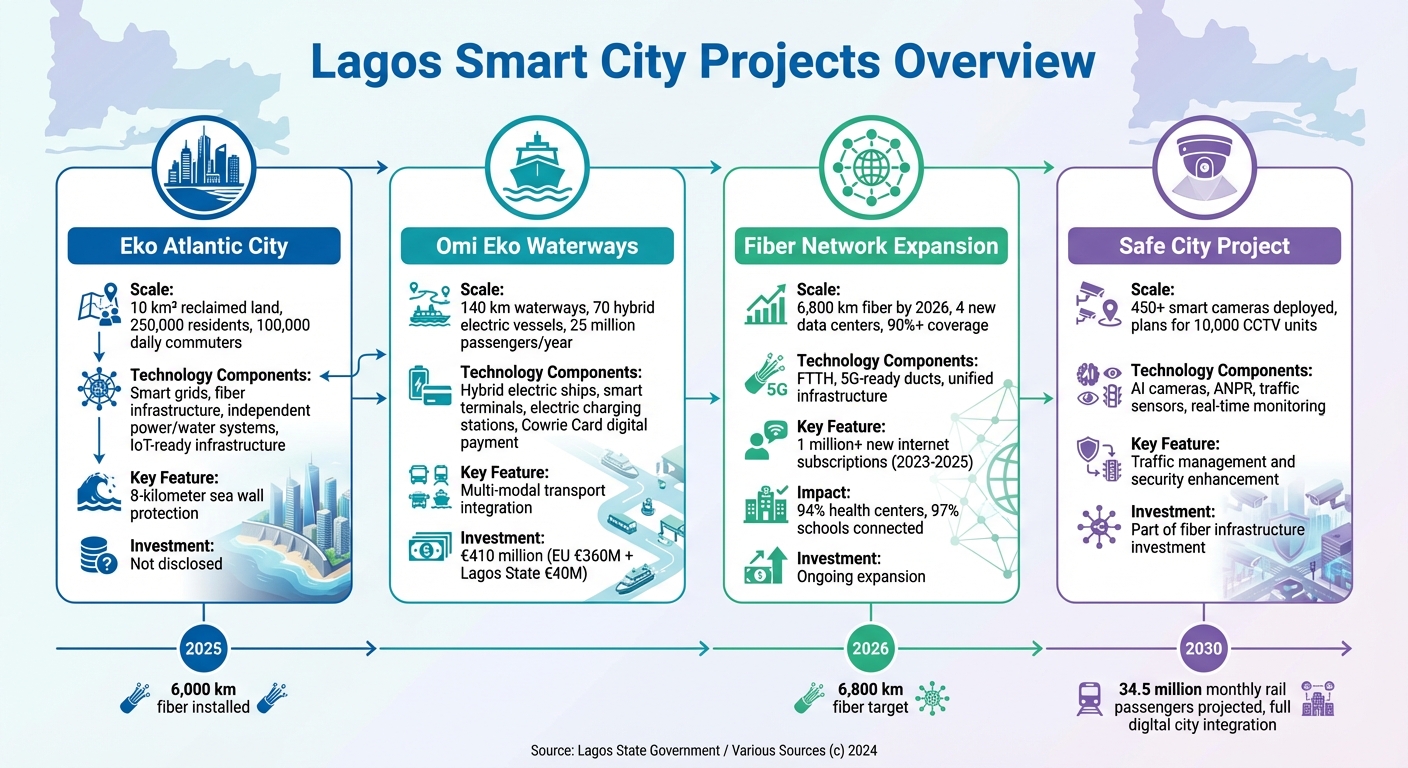
Lagos Smart City Projects: Key Infrastructure Investments and Technology Components
Lagos is undergoing a significant transformation with ambitious infrastructure projects that blend urban development with advanced digital technologies. These projects aim to address pressing challenges like traffic congestion, inconsistent power supply, and public safety concerns. At the same time, they create opportunities for tech companies to collaborate with the government and introduce innovative solutions.
Metro Smart City: A Connected Urban Development
One of the standout initiatives is Eko Atlantic City, a bold urban development built on 10 square kilometers (approximately 3.9 square miles) of reclaimed land from the Atlantic Ocean. Designed to house 250,000 residents and accommodate 100,000 daily commuters, the city features independent power plants, advanced water treatment systems, and an 8-kilometer (about 5-mile) sea wall known as the "Great Wall of Lagos" to protect against storms and rising sea levels.
The city’s infrastructure is built around high-speed internet, with fiber-optic cables embedded into its design. This enables smart-home automation, real-time building management, and utility monitoring systems. Targeting high-end markets, Eko Atlantic City provides a platform for tech solutions like IoT, energy optimization, and building automation. Its independent power systems further open up opportunities for renewable energy integration and advanced energy management platforms.
Lagos Rail Mass Transit: Technology-Enabled Transportation
In addition to urban development, Lagos is revolutionizing its transportation network. The Lagos Rail Mass Transit system is a multi-line network projected to serve over 34.5 million passengers monthly by 2030. Its Red and Blue lines connect key residential and commercial areas, integrating seamlessly with the Omi Eko Waterway Project. This €410 million initiative is turning 140 kilometers (about 87 miles) of inland waterways into a tech-enabled transport system.
Mr. Oluwadamilola Emmanuel, General Manager of LASWA, highlighted the project’s ambition:
"The project is a visionary initiative aimed at transforming Lagos’ inland waterways into a world-class transportation network."
The waterway system will feature 70 hybrid electric ships capable of transporting 25 million passengers annually. Funding for this project includes contributions from the EU, the French Development Agency, the European Investment Bank (€360 million), and Lagos State (€40 million).
Both the rail and water transport systems utilize the Cowrie Card, a digital payment platform managed by LAMATA as part of a multi-modal strategy. This setup offers opportunities for tech companies to develop digital ticketing systems, IoT-based fleet monitoring, predictive maintenance tools, and real-time passenger information systems. Additionally, Lagos has partnered with Huawei Technologies to establish Intelligent Transport System (ITS) sites equipped with ANPR cameras and Traffic Management Solution devices.
Digital Infrastructure: Fiber Optics and 5G Networks
Lagos’s commitment to tech-driven growth continues with its expansive fiber-optic network. By October 2025, the city had installed 6,000 kilometers (approximately 3,728 miles) of fiber-optic cables, reaching over 90% coverage. Plans are in place to extend this to 6,800 kilometers (about 4,225 miles) by the end of 2026, along with the addition of four new data centers to support the network.
Engr. Olufemi Daramola, Special Adviser on Infrastructure for Lagos State, described the initiative’s scope:
"We’re not just laying cables – we’re plugging our city into the future."
This fiber backbone has already driven over one million new internet subscriptions between 2023 and 2025. It also supports the Safe City Project, which has deployed 450 smart surveillance cameras across key areas like Alapere and Allen Avenue to enhance traffic management and security using AI.
The widespread fiber deployment enables the development of location-based services, urban analytics platforms, digital twin technologies, and smart building applications.
| Project | Technology Components | Scale | Investment |
|---|---|---|---|
| Eko Atlantic City | Smart grids, fiber infrastructure, independent power/water | 10 km² reclaimed land, 250,000 residents | Not disclosed |
| Omi Eko Waterways | Hybrid electric ships, smart terminals, electric charging | 140 km waterways, 70 vessels, 25M passengers/year | €410 million |
| Fiber Network | FTTH, 5G-ready ducts, unified infrastructure | 6,800 km fiber, 4 data centers | Ongoing expansion |
| Safe City Project | AI cameras, ANPR, traffic sensors | 450+ cameras, multiple corridors | Part of fiber investment |
How Tech Companies Can Participate in Lagos’s Smart City Projects
Tech companies have a unique chance to contribute to Lagos’s ambitious smart city initiatives by offering tailored solutions. These efforts should align with Lagos’s 2030 Smart City Plan, which is part of the broader Project THEMES development framework. The plan aims to digitize every community in Lagos by 2030, creating a connected and efficient urban environment. Additionally, collaborating with the Lagos State Science, Research and Innovation Council (LASRIC) opens doors for innovation, as the council oversees a $640,000 (250 million naira) budget dedicated to advancing fields like AI, robotics, and sustainable energy.
IoT and Data Analytics: Real-Time Infrastructure Solutions
Lagos’s smart city vision heavily relies on IoT and data analytics to tackle infrastructure challenges. For example, Intelligent Transport System (ITS) sites already deployed across the city can be enhanced with predictive maintenance tools for the rail system, air quality monitoring, and urban planning analytics. These technologies allow for better decision-making and resource allocation.
With Lagos investing in 6,000 kilometers (about 3,728 miles) of fiber infrastructure, tech companies can build cloud-based IoT applications for areas like remote learning, telehealth, and smart building management. This digital foundation also supports energy innovations, creating new opportunities for businesses to deliver integrated IoT solutions that connect seamlessly with existing transit and tax platforms.
Smart Energy Management: Grid and Renewable Integration
Lagos’s push for renewable energy aligns perfectly with its smart city goals, offering a fertile ground for energy tech providers. A notable example is Huawei Nigeria Digital Power’s 150K series inverter, introduced in August 2024, which boosts energy efficiency for businesses in Lagos.
Tech companies can step in with tools like smart grid management systems, real-time energy monitoring, and platforms for integrating renewable energy sources. With over 60% of Nigeria’s population under 30 and a rapidly growing tech ecosystem (11.6 times since 2017), reliable energy is vital for powering tech hubs, co-working spaces, and residential areas. This is especially crucial for Lagos’s fintech sector, which dominates the local tech scene, with seven out of the top 10 companies being fintech firms. Ensuring consistent power and secure networks will be key to fostering a resilient urban ecosystem.
Security and Surveillance: AI-Powered Monitoring Systems
Security is another cornerstone of Lagos’s smart city transformation. The city plans to deploy up to 10,000 CCTV cameras to improve safety and traffic management. Governor Babajide Sanwo-Olu envisions a network of intelligent cameras that not only enhance security but also collect valuable urban data.
Tech companies can contribute by providing AI-powered surveillance systems, facial recognition technology, and cybersecurity solutions. Using local cloud services ensures reduced latency and compliance with regional requirements. Advanced analytics platforms can also help law enforcement identify trends and enhance public safety for Lagos’s 15 million residents.
| Technology Area | Key Opportunities | Example Applications |
|---|---|---|
| IoT & Data Analytics | Real-time monitoring, predictive maintenance | Traffic optimization, environmental sensors, fleet management |
| Smart Energy | Grid management, renewable integration | Solar inverters, energy monitoring, demand response systems |
| Security & Surveillance | AI monitoring, facial recognition | CCTV networks, incident response, cybersecurity platforms |
Challenges Tech Companies Face in Lagos’s Smart City Market
Lagos’s ambitious plans to develop into a smart city present both opportunities and hurdles for tech companies. To succeed, firms must navigate a maze of regulations, establish strategic partnerships, and design solutions that can handle the demands of a city with nearly 15 million residents. Tackling these challenges early can save time and resources.
Government Regulations and Compliance Requirements
Operating in Lagos requires companies to meet various regulatory demands. For instance, the NDPA 2023 mandates the appointment of a Data Protection Officer (DPO). For projects involving physical infrastructure – like fiber optic cables or telecom towers – permits must be obtained through the Lagos State Infrastructure Maintenance Regulatory Agency (LASIMRA).
In 2026, LASIMRA introduced the Telecommunication Infrastructure Regulatory System (TIRS), a platform that automates permit approvals, reducing human interaction by 99%. Prince Oyekanmi Elegushi, LASIMRA’s General Manager, highlighted the platform’s benefits:
With TIRS, telecom companies will apply for infrastructure permits entirely online, cutting down physical visits and delays.
For security and surveillance providers, compliance with the Cybercrimes (Prohibition, Prevention, ETC) Act 2015 (revised in 2024) is critical. Violations, such as unauthorized access or data breaches, can result in fines up to ₦5,000,000 (around $12,800). Meanwhile, transportation tech firms must work with the Vehicle Inspection Service (VIS), which uses smart cameras to monitor speed violations. Offenders receive fines of ₦50,000 via SMS.
| Regulatory Body | Focus Area | Key Action Required |
|---|---|---|
| LASIMRA | Telecom Infrastructure | Use TIRS platform for permits |
| NDPA | Data Privacy | Appoint a Data Protection Officer (DPO) |
| VIS | Transportation | Integrate with smart camera systems |
| NCAIR | AI Deployment | Align with draft National AI Strategy standards |
Clearing these regulatory hurdles is just the first step. Building strong local partnerships is equally important.
Working with Local Partners and Stakeholders
Collaboration is key to thriving in Lagos’s smart city ecosystem. Agencies like the Lagos State Science, Research and Innovation Council (LASRIC) offer funding and support for projects in AI, robotics, and sustainable energy. Partnering with LASRIC can unlock government resources and initiatives.
Huawei Technologies demonstrated the value of collaboration in 2025 by teaming up with the Lagos State government to install four Intelligent Transport System (ITS) sites featuring ANPR cameras and Traffic Management Solution (TMS) devices. Similarly, partnerships with established local firms like Interswitch, Flutterwave, and SystemSpecs have shown how public-sector digitization can lead to lasting relationships. For example, SystemSpecs’ Remita platform has streamlined government financial operations.
Development managers like JLL, which oversees Talent City Lagos in the Lekki Free Zone, also play a critical role in simplifying stakeholder management for large-scale projects. These collaborations not only help companies navigate the local landscape but also ensure their solutions align with Lagos’s urban challenges.
Adapting Solutions for Lagos’s Growing Urban Population
With nearly 15 million residents – 66% of whom are under 30 years old – Lagos demands solutions that are both scalable and cost-effective. Recent projects using composite materials highlight the importance of durable, adaptable infrastructure.
Data hosting strategies must also evolve. Using local cloud services can minimize latency and ensure compliance with Nigerian data protection laws. Additionally, participation in the state’s Enterprise Architecture Project can help companies integrate their systems with Lagos’s broader AI-driven government services. The city’s plan to install 6,800 kilometers (about 4,225 miles) of fiber optic ducts underscores the need for solutions that connect seamlessly to this unified network.
The new metro rail system, projected to transport 34.5 million passengers monthly, highlights the necessity for transport technologies that can handle massive volumes. Sabitiyu Abosede Lawal, a Senior Lecturer at Lagos State University, summed up the broader requirements:
Creating smart cities in Nigeria requires more than just technological progress; it requires a robust legal framework that aligns innovation, governance, and community needs.
Tech companies that take a comprehensive approach – balancing scalable technology with community priorities and regulatory compliance – will be best positioned to thrive in Lagos’s smart city transformation.
Conclusion: Tech Company Opportunities in Lagos’s Smart City Development
Lagos’s journey toward becoming a smart city presents a wealth of opportunities for tech companies. The city’s ambitious plan to lay 6,000 to 6,800 kilometers (around 3,728 to 4,225 miles) of fiber optic cables by 2030, along with transformative projects like the Red and Blue Metro lines, which are expected to move 34.5 million passengers monthly, highlights an immediate need for solutions in IoT, data analytics, and AI-powered systems. This infrastructure expansion is the foundation for advanced technological integration.
To seize these opportunities, tech companies need to align their innovations with key state initiatives. This means collaborating with projects such as the Metrofibre Project, the Safe City network, and the Lagos Digital Services Platform. As Commissioner Olatubosun Alake aptly put it:
A truly digitized city requires seamless integration between physical and digital systems.
Success in Lagos’s evolving tech landscape depends on three critical factors: building partnerships with agencies like LASIMRA and LASRIC, creating scalable solutions to serve the city’s 20+ million residents, and ensuring local data infrastructure aligns with compliance needs. With $22 million in foreign investment bolstering fiber expansion and the establishment of hyperscale data centers like Kasi Cloud‘s $250 million facility in Lekki, the scale of infrastructure development is undeniable.
Tech companies that concentrate on areas of high demand – such as intelligent transport systems, cybersecurity for digital governance, smart energy grids, and educational technology initiatives like the Digital Leap program, which aims to train 50,000 residents – are well-positioned to drive urban transformation across West Africa. The time to act is now.
FAQs
Which Lagos smart city project is easiest for startups to enter?
One of the standout opportunities within Lagos’s smart city development is the ₦31 billion innovation fund. This fund is designed to support startups, innovation hubs, and research institutions, offering them access to critical funding as well as research and development opportunities. For businesses eager to become part of Lagos’s expanding smart city ecosystem, this initiative serves as a solid starting point. It’s a chance to not only grow but also to actively shape the future of innovation in the city.
What permits and privacy rules must tech companies follow in Lagos?
Tech companies operating in Lagos are required to adhere to the Nigeria Data Protection Act, 2023. This legislation outlines rules for managing data privacy, ensuring security, and processing personal data lawfully. Businesses must also integrate privacy-by-design principles into their operations. Collaborating with the Nigeria Data Protection Commission is essential to meet these requirements and encourage responsible advancements in technology.
How can foreign tech firms find trusted local partners in Lagos?
Foreign tech companies looking to establish a foothold in Lagos can benefit from working with trusted local partners. Collaborating with well-known companies involved in significant smart city projects, such as Talent City Lagos, is a great starting point. Additionally, teaming up with leaders in sectors like fintech, telecom, and infrastructure can provide valuable insights into navigating the local business environment.
Another smart approach is participating in industry events and trade fairs, which serve as excellent platforms for networking and building connections. Engaging with government-supported programs, like those spearheaded by the Lagos State Science, Research, and Innovation Council, can further strengthen partnerships and open doors to credible opportunities.
Related Blog Posts
- African Tech Hub Comparison: Lagos vs Nairobi vs Cape Town
- Best Cities in Africa for Startup Talent in 2025
- Lagos Digital Highway Explained: The Real Impact on Traffic, Data, Smart City Tech & Jobs
- Lagos Digital Highway: Map, Route, Cost, Completion Date & Impact on Fiber and Smart City Tech