Grace Ashiru
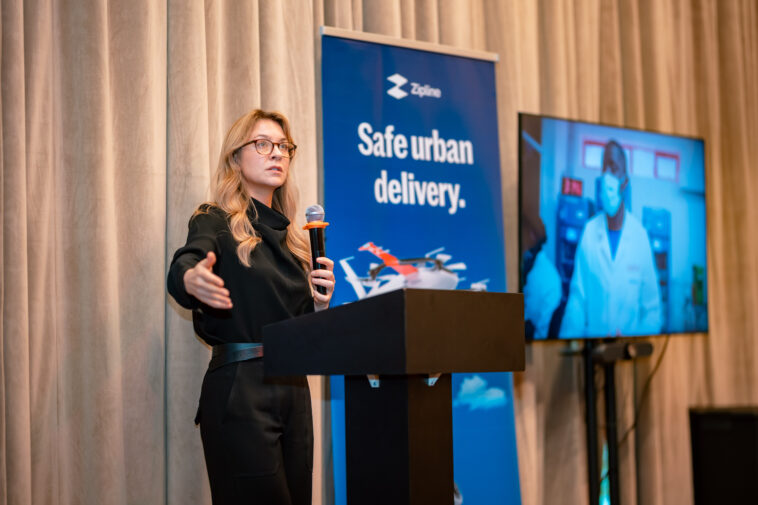
The Government of Rwanda has signed a historic expansion agreement with Zipline, marking the first milestone under Zipline’s recent $150M pay-for-performance award from the U.S. Department of State. Building on its legacy as the first country in the world to launch Zipline’s autonomous delivery service in 2016, Rwanda will now become the first country with full nationwide autonomous logistics coverage, the first country in Africa with Zipline’s urban delivery system, and the first country in Africa with an autonomous delivery testing center. The expansion reinforces Rwanda’s status as a global leader in AI, robotics, and autonomous logistics, delivering cost-effective, life-saving healthcare for millions.
“Rwanda and Zipline have been working together for years to harness technology for the good of our people. We have witnessed the extraordinary impact of drone delivery — saving time, saving money, and saving lives,” said Honorable Paula Ingabire, Minister of ICT and Innovation of the Republic of Rwanda. “With this partnership, we will now expand to urban delivery, bringing these benefits to even more communities. We thank the U.S. Government for supporting Zipline’s expansion and for joining us in building the foundation for Africa’s future in healthcare and innovation.”


Rwanda will be the first in Africa to introduce Zipline’s urban delivery system, Platform 2 (P2), enabling ultra fast, quiet and precise deliveries in dense urban environments such as Kigali, where approximately 40% of the country’s healthcare demand is concentrated. P2 is currently used to deliver 100,000 retail and food items in the United States with dinner plate accuracy to homes, office buildings, hotels, and public spaces.
“In 2016, Rwanda made a decision that changed health access forever. Rwanda did not ask whether it had been done before. It asked whether it could work and whether it could save lives. They tested it, measured it, and when the data proved the impact, they scaled it,” said Caitlin Burton, CEO of Zipline Africa. “Today, Rwanda is doing it again. This is a global first — not because the technology exists, but because the leadership exists. That leadership is why the U.S. Government is backing Rwanda’s expansion, and why Zipline is investing beyond our contract in research, technology, and high-skill jobs here in Rwanda. This partnership is setting a new global standard for how innovation should be deployed.”
Rwanda will also add a new long-range distribution center in Karongi District, complementing Zipline’s existing hubs in Muhanga and Kayonza. This third site will expand delivery capacity to districts beyond the Nyungwe Forest, including those bordering the Democratic Republic of Congo (DRC). The new hub is built on the border between Rwanda and the DRC, a symbol of peace between the two countries. Within Rwanda, the Karongi hub is expected to serve approximately 200 health posts and 60 major health facilities, reaching more than 2.9 million people. With this expansion, Zipline’s nationwide network in Rwanda will cover over 11 million people and support ~350 local jobs.
“Rwanda pioneered autonomous logistics for the world, proving it to be more reliable, more responsive, and less wasteful than traditional logistics systems. With the addition of a third hub in Karongi District and service in Kigali soon, Rwanda is creating a single, seamless system that serves all Rwandans equally,” said Pierre Kayitana, Country Director, Zipline Rwanda.
The U.S. government will provide upfront infrastructure funding to Zipline to enable the scale-up and the government of Rwanda has committed to paying for ongoing operations. This approach reflects Rwanda’s long-standing commitment to building self-reliant, efficient health systems and ensures the expansion is financially durable, nationally operated, and integrated into Rwanda’s broader strategy for resilient, technology-driven healthcare.
Zipline will also establish a new AI and robotics testing facility in Rwanda — the company’s first overseas research and development hub. The facility will support testing of aircraft performance, new safety systems, and next-generation logistics software. The testing center in Rwanda will play a critical role in developing local talent and improving the performance of our aircraft and software in a variety of different climates and weather conditions, ensuring that technology built for the world is also built by the world.
To date, Zipline’s autonomous delivery network has enabled on-demand access to blood, vaccines, and essential medicines. The system reduces waste, equalizes access, boosts economies, and improves health outcomes, including a 51% reduction in maternal deaths.
All Zipline delivery and logistics data from operations in the country integrates into Rwanda’s national health information and emergency response systems, strengthening real-time visibility, outbreak detection, and coordinated emergency response. This capability supports Africa CDC’s vision of resilient, technology-driven, and equitable health systems, strengthening early-warning capacity, so countries can respond faster and ensure essential services reach every community.
Rwanda is demonstrating that autonomous delivery works at national scale, in real-world conditions, as part of a government-led system. That lesson matters far beyond Rwanda as African governments seek to solve intractable health challenges once and for all.