Kevin Mwangi

South Africa faces a major internet access problem, with 25% of its population – about 15 million people – lacking connectivity, especially in rural areas. The Democratic Alliance (DA) is advocating for Starlink, SpaceX’s satellite internet service, to address this issue. However, current regulations require foreign telecom companies to transfer 30% ownership to historically disadvantaged groups, a rule that has delayed Starlink‘s entry.
The DA proposes using an alternative investment model, Equity Equivalent Investment Programmes (EEIP), allowing companies like SpaceX to invest in local infrastructure and skills development instead of transferring equity. This approach could connect 5,000 rural schools and improve access for millions of South Africans. Neighboring countries have already approved Starlink, while South Africa remains stuck in regulatory debates.


Minister Solly Malatsi has pushed for reforms to remove these barriers, but political resistance, especially from the ANC, remains strong. The debate centers on balancing transformation policies with the urgent need for digital access. Public feedback shows overwhelming support for the DA’s proposal, highlighting the demand for better internet access to unlock economic and educational opportunities in underserved areas.
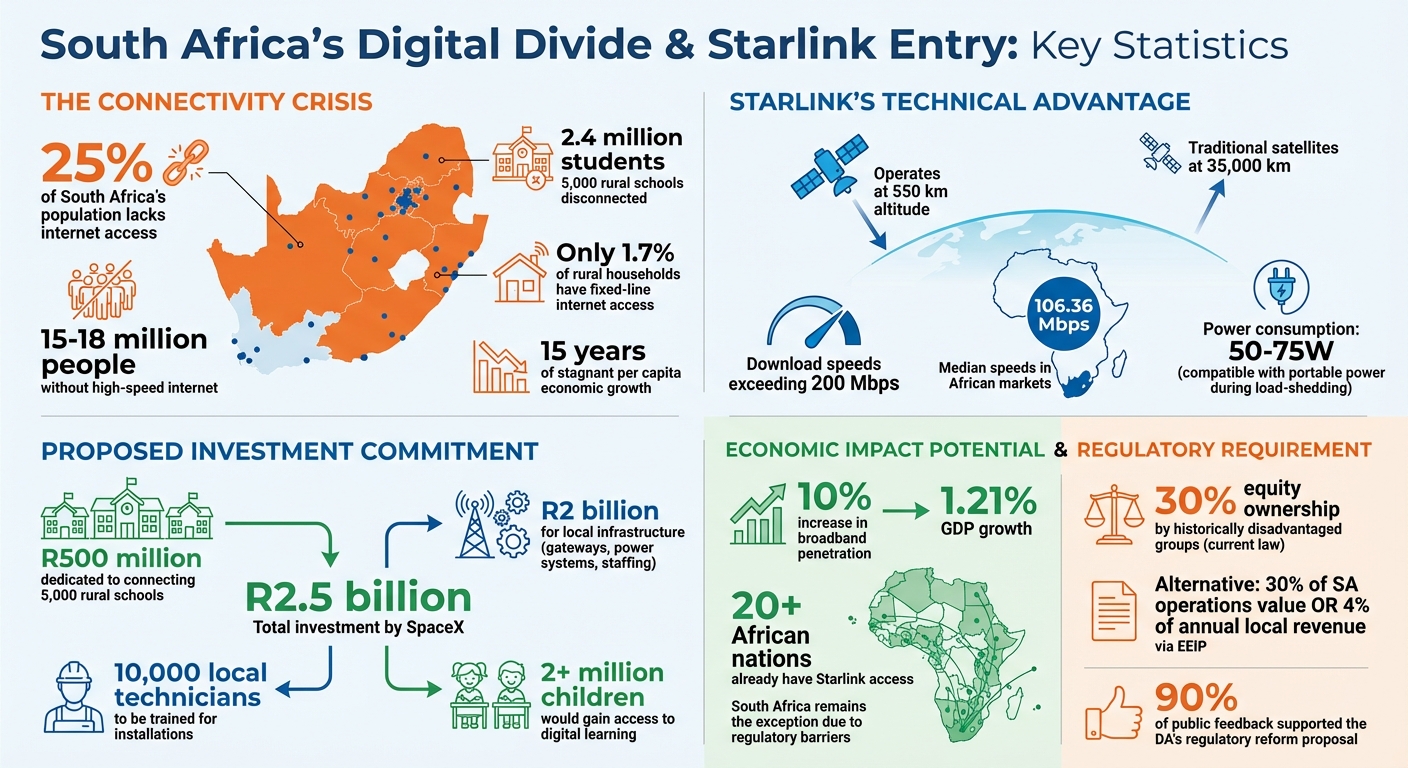
South Africa’s Digital Divide: Starlink Entry Statistics and Impact
South Africa’s Internet Connectivity Problems
Limited Access in Rural Areas
In South Africa, over 18 million people and 2.4 million students across 5,000 rural schools remain disconnected from high-speed internet. The root of the issue lies in the sparse populations of these areas, paired with the steep costs of building infrastructure. Traditional solutions like fiber networks and mobile towers often fall short in reaching these remote regions.
"Unfortunately, more than 18 million people in South Africa lack access to high‐speed internet." – Starlink
The telecommunications industry has undergone a massive transformation over the past two decades. What was once a voice-call-driven sector is now dominated by data services. However, South Africa’s Electronic Communications Act, written nearly 20 years ago, still reflects a voice-centric era, making it ill-suited for today’s data-heavy demands. This outdated framework exacerbates the digital divide, impacting not just education but also hindering local economies.
Economic and Social Impacts
The lack of reliable internet has a ripple effect on South Africa’s economy. Businesses, particularly in logistics, manufacturing, and small to medium enterprises (SMEs), face operational inefficiencies due to poor connectivity. Even critical services like emergency response and public safety are compromised, with slower reaction times and reduced coordination in areas without dependable internet.
"High-speed internet supports people and industries across the board, from logistics and manufacturing to public safety and emergency response. It helps businesses work more efficiently, bridges the digital divide and spurs local growth." – Starlink
Beyond businesses, individuals also feel the strain. Many South Africans struggle to access online job platforms, remote work opportunities, and digital skills training. While terrestrial networks could theoretically close this gap, the reality is that building such infrastructure takes years and costs billions – resources that often never reach rural areas. This leaves millions disconnected, limiting both social and economic progress.
The Democratic Alliance‘s Push for Starlink
Policy Advocacy and Proposals
The Democratic Alliance (DA) has placed a strong focus on bringing Starlink’s satellite internet services to South Africa, highlighting its potential to drive economic growth and expand digital access. Central to their plan is leveraging Equity Equivalent Investment Programmes (EEIPs), which allow companies to meet transformation requirements through alternative investments rather than transferring 30% local equity.
Through the EEIP framework, companies like SpaceX can fulfill their obligations by investing in local suppliers, supporting small and medium-sized enterprises (SMEs), and contributing to skills development, infrastructure, and research. The DA argues that this model not only attracts foreign investment but also aligns with South Africa’s socio-economic objectives. By utilizing EEIP, the party aims to accelerate digital access, particularly for underserved communities. Citing research, they emphasize the economic impact of connectivity: a 10% increase in broadband penetration can lead to a 1.21% rise in GDP.
"Research shows that every 10% increase in broadband penetration can drive a remarkable 1.21% growth in GDP." – Solly Malatsi, Minister of Communications and Digital Technologies
Before gaining ministerial authority, the DA actively campaigned for regulatory changes. This included organizing public protests, such as a march in July 2023, to oppose ownership rules they argued were hindering competition and job creation in the digital sector. When the government opened the proposed regulatory changes for public feedback, 90% of respondents supported the shift.
Minister Solly Malatsi’s Role
Minister Solly Malatsi has been a key figure in advancing the DA’s efforts to bring Starlink to South Africa. Since taking office, he has spearheaded regulatory reforms aimed at easing the path for satellite internet providers. In May 2025, he published a draft policy for public comment, and by December 2025, he issued a formal directive to the Independent Communications Authority of South Africa (ICASA). This directive urged ICASA to amend licensing regulations to align with the ICT Sector Code, particularly addressing the 30% local ownership requirement for telecommunications licensees.
"The stark reality is that policy uncertainty around the 30% employment equity requirement has stifled progress towards universal internet access." – Solly Malatsi, Minister of Communications and Digital Technologies
Malatsi has defended the revised regulations against critics who argue they undermine transformation goals. He maintains that the policy ensures fair regulatory practices while offering global companies a way to contribute significantly to local development. SpaceX publicly endorsed the updated directive in August 2025. The minister views Starlink’s entry as a critical step toward bridging the digital divide, particularly in rural areas where traditional networks have failed to connect millions of South Africans.
Regulatory and Logistical Barriers
Equity Transfer Rules for Foreign Firms
South Africa’s Electronic Communications Act requires that foreign-owned communications licensees allocate at least 30% of their equity to historically disadvantaged groups. This regulation, rooted in the principles of Black Economic Empowerment, has uniquely delayed Starlink’s entry into South Africa, even though it operates in over 20 other African nations.
"As we have it right now, our legislative frameworks are still a barrier to leapfrog into the future" – ICASA Chair Mothibi Ramusi
In response, a new ministerial directive has introduced the concept of "deemed ownership", allowing companies to meet licensing conditions through alternative investment programs.
Infrastructure Investment as an Alternative
To address the ownership requirements, some companies, including SpaceX, have proposed alternative investment strategies. In August 2025, SpaceX outlined a plan to invest R2 billion in South Africa, with R500 million dedicated to connecting 5,000 rural schools. These proposals are part of the Equity Equivalent Investment Programme (EEIP), which assesses contributions based on either 30% of the value of South African operations or 4% of local annual revenue. Acceptable contributions include funding for local suppliers, skills training, infrastructure development, job creation, research, and digital access initiatives.
SpaceX has also pledged to train 10,000 local technicians to handle installations and ongoing maintenance. However, despite these commitments, logistical obstacles remain. Licensing approvals at municipal, provincial, and national levels frequently cause months-long delays. Additionally, ICASA must formally update its ownership regulations before Starlink can utilize the EEIP mechanism to apply for licenses.
For now, Starlink remains unauthorized in South Africa. Some residents, however, have found a workaround, accessing the service through regional roaming from neighboring countries. These regulatory and logistical hurdles are the final barriers that must be overcome before Starlink can contribute to reducing South Africa’s digital divide.
Potential Benefits of Starlink in South Africa
Better Access for Rural Communities
Starlink’s low-Earth orbit satellites operate at just 550 km (342 miles) above the Earth, compared to the 35,000 km (21,750 miles) altitude of traditional satellites. This closer distance allows for download speeds exceeding 200 Mbps, with median speeds in some African markets reaching 106.36 Mbps. For rural South Africa, where only 1.7% of households have fixed-line internet access, this technology eliminates the need for costly fiber-optic installations or mobile towers – solutions that local ISPs often deem unprofitable in remote areas.
The benefits go far beyond simply getting online. A R500 million initiative to connect 5,000 rural schools could provide access to digital learning tools for over 2 million children. Dr. Cleeve Robertson, CEO of the National Sea Rescue Institute, highlighted another critical use case:
"Starlink’s satellite internet service will revolutionise our ability to respond to emergencies, especially in remote and underserved areas. Reliable, high-speed internet access can be a game-changer for our volunteers and the lives they work tirelessly to save."
Rural healthcare facilities could also benefit by using telemedicine to serve patients who currently have to travel long distances for basic medical care. Additionally, with a power draw of just 50–75W, Starlink’s system works well with portable power stations, making it a practical solution during load-shedding or in off-grid areas. These advancements have the potential to transform rural communities, providing the foundation for economic growth and improved quality of life.
Economic Growth and Innovation Opportunities
Reliable internet access is a springboard for local businesses and new ideas. Farmers, for example, can use real-time weather data and modern agricultural tools, while small businesses can tap into global markets, expanding their reach like never before.
Starlink’s R2.5 billion investment commitment includes approximately R2 billion earmarked for local infrastructure, such as gateways, points of presence, leased land, power systems, and staffing. This investment could establish South Africa as a key hub for satellite operations in the region, creating jobs and opportunities for local contractors in construction, fiber installation, and security.
Strategic partnerships add another layer of opportunity. Sunil Taldar, CEO of Airtel Africa, underscored this potential:
"This partnership with SpaceX is a significant step to demonstrate our continued commitment to advancing Africa’s digital economy through strategic investments and partnerships."
These collaborations could also support cellular backhauling, where Starlink links rural base stations to expand mobile network coverage into underserved areas. For a country grappling with 15 years of stagnant per capita growth, such connectivity improvements could ignite innovation and economic activity in regions that have long been left behind.
sbb-itb-dd089af
Political Resistance and Debates
Concerns Over Transformation Policies
Regulatory challenges have slowed Starlink’s rollout in South Africa, but the real battle lies in the political arena. The debate over relaxing existing rules has stirred significant divisions within South Africa’s Government of National Unity. The African National Congress (ANC) insists that all telecommunications companies must comply with the Electronic Communications Act, which mandates at least 30% equity ownership by historically disadvantaged groups. For many ANC hardliners, any easing of these empowerment laws threatens to undo decades of progress in addressing racial inequalities.
Elon Musk’s public criticism of South Africa’s empowerment laws, labeling them as "openly racist", has only fueled the ANC’s opposition. Khusela Sangoni Diko, Chair of the Portfolio Committee on Communications and Digital Technologies, made the party’s position clear:
"Minister Malatsi should know that when it comes to transformation in the ICT sector, the law is clear on compliance and that circumventing the law to favor business interests is unacceptable."
Internally, the ANC is divided. Some members back Trade Minister Parks Tau’s idea of a R100 billion ($5.3 billion) transformation fund, where foreign companies would contribute 25% of their operational value instead of transferring equity. However, critics, including the BEE Chamber, have dismissed this proposal as ineffective, likening it to "mosquito repellent" for potential investors. These disagreements highlight the growing tension within the party and set the stage for broader legislative and coalition-level debates.
Coalition and Parliamentary Tensions
The Starlink issue has become a litmus test for the Government of National Unity’s cohesion. In December 2025, Minister Solly Malatsi directed ICASA to accept Equity Equivalent Investment Programmes as an alternative to the ownership requirement. This decision sparked immediate backlash from the Portfolio Committee on Communications, which accused the Minister of overstepping his authority and bypassing Parliament.
Opposition parties have also weighed in. The Economic Freedom Fighters oppose the proposal, portraying Musk’s potential market entry as a risk to national security and local employment. On the other hand, the Democratic Alliance (DA) argues that strict ownership rules are stifling much-needed investment. With nearly 25% of South Africans still lacking internet access and the economy showing no per capita growth in the past 15 years, the DA sees these rigid policies as a major obstacle to progress.
Starlink offers to connect 5,000 rural schools
Conclusion
The Democratic Alliance’s (DA) push for Starlink represents a major step toward reshaping South Africa’s digital landscape. With Minister Solly Malatsi’s directive set for December 2025, the plan leverages Equity Equivalent Investment Programmes to allow SpaceX to meet its obligations while preserving local ownership structures.
That said, this initiative faces political challenges. The African National Congress (ANC) and the Portfolio Committee on Communications have expressed opposition, viewing the changes as a potential threat to transformation policies. Meanwhile, public opinion paints a very different picture: during consultations, 90% of comments favored the proposed policy adjustments. This overwhelming support highlights a widespread demand for better internet access, particularly in underserved areas.
"This alignment will help attract more investment, support meaningful transformation and improve the lives of South Africans, especially those in rural and underserved communities who still lack access to high-speed internet", Malatsi stated when unveiling the policy direction.
The road ahead will require coordinated efforts between the government, regulators, and international partners. Starlink’s willingness to collaborate with local ISPs for installation and maintenance shows how global companies can integrate into the local economy while delivering cutting-edge technology. Ultimately, the challenge lies with South Africa’s political leadership: can they put aside ideological divides to prioritize the millions still disconnected? With aligned policies and teamwork, the country has a real opportunity to close the digital gap.
FAQs
What challenges are preventing Starlink from launching in South Africa?
Starlink’s attempt to establish itself in South Africa is hitting multiple roadblocks, with regulatory and ownership rules being the biggest hurdles. South Africa’s Broad-Based Black Economic Empowerment (BEE) laws require telecom operators to have at least 30% ownership by historically disadvantaged Black South Africans. However, SpaceX, Starlink’s parent company, has not agreed to transfer ownership or propose an alternative solution, which has stalled its ability to secure the necessary license.
On top of that, the Independent Communications Authority of South Africa (ICASA) has criticized Starlink for offering roaming services without proper licensing. This has even led to service disruptions for some users. Adding to these challenges are the high costs of Starlink’s equipment and opposition from local telecom players, making the rollout even more difficult. Together, these regulatory, licensing, and economic barriers are the key reasons Starlink has yet to launch in South Africa.
What is the Equity Equivalent Investment Program, and how does it apply to Starlink in South Africa?
The Equity Equivalent Investment Program (EEIP) offers foreign companies, like Starlink, a way to comply with South Africa’s mandate for 30% Black ownership without having to sell shares. Instead of transferring equity, companies can contribute in other meaningful ways – such as funding skills development initiatives, supporting Black-owned businesses, or investing in broadband infrastructure – to align with the country’s economic empowerment goals.
For Starlink, this involves presenting a comprehensive plan that clearly demonstrates how their investments will uplift local communities and Black-owned enterprises. This could include initiatives like funding ICT training programs, sponsoring internet access in rural areas, or partnering with local suppliers. If the plan is approved by South Africa’s regulator and communications ministry, Starlink could secure an operating license while simultaneously helping to improve connectivity and supporting empowerment efforts.
How could Starlink improve internet access in South Africa’s rural areas?
Starlink’s satellite network offers a chance to deliver high-speed internet to rural areas in South Africa, where traditional options like fiber or cellular networks are often absent. By using satellite dishes to connect directly, it could bring consistent internet access to communities that have been left behind.
This kind of connectivity could unlock opportunities for online education, telehealth services, e-commerce, and remote work, enabling rural areas to engage more fully in the digital economy. Farmers could benefit from improved access to market data, while reduced reliance on urban migration might inspire local innovation. In essence, Starlink has the potential to boost both economic activity and social integration in these underserved regions.
Related Blog Posts
- Top 7 African Countries Using Partnerships for Rural Internet
- How mmWave Improves Internet Access in Africa
- Starlink Partners with Airtel & Vodacom: From Rival to Ally
- Starlink Faces Import Restrictions in Uganda Ahead of Elections