Kevin Mwangi
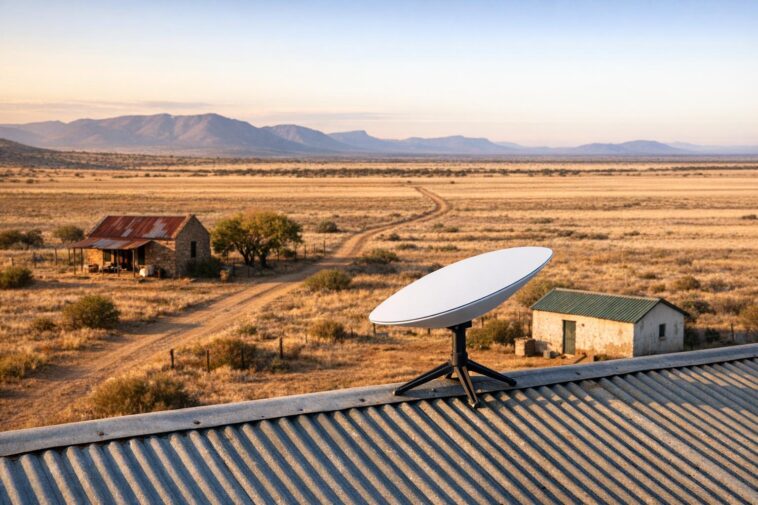
Starlink, SpaceX‘s satellite internet service, is not yet legally available in South Africa as of January 2026 due to regulatory hurdles. While neighboring countries like Zimbabwe and Botswana have approved its services, South Africa’s ownership rules under the Electronic Communications Act have delayed licensing. However, a proposed policy change allowing investment in local initiatives instead of equity transfers could pave the way for Starlink’s entry by late 2026 or early 2027.
Key points:


- Current Status: Unlicensed in South Africa, with regulatory approval expected by March 2026 at the earliest.
- Unofficial Access: Some users import hardware or subscribe via neighboring countries, but this is considered illegal and carries risks.
- Pricing: Estimated hardware costs between $370–$630, with monthly subscriptions ranging from $48–$68 once officially available.
- Performance: Speeds up to 400 Mbps, with latency as low as 77 ms after local ground stations were activated in 2025.
- Hardware: Two kits available – Standard and Mini – with simple self-installation.
For now, South Africans are advised to wait for official licensing to avoid fines and technical issues.
Podcast – Starlink South Africa Explained
Availability and Licensing Status
As of January 23, 2026, Starlink remains unlicensed in South Africa, primarily due to regulatory hurdles.
One major obstacle is South Africa’s Electronic Communications Act, which mandates that national telecommunications licensees must have 30% ownership by historically disadvantaged groups. Starlink addressed the issue, stating:
"Starlink is committed to providing reliable, high-speed internet access across the country… However, we are currently unable to apply for the licenses required to operate due to current ownership rules."
In response, Communications Minister Solly Malatsi has suggested an alternative approach through Equity Equivalent Investment Programmes (EEIPs). These programs would allow global companies to invest in local infrastructure or social initiatives instead of transferring 30% equity. SpaceX has shown support for this proposal, pledging R2 billion (around $110 million) toward local infrastructure projects if EEIPs are approved. While the Department of Communications aims to finalize this policy by March 2026, experts caution that formal amendments could extend into 2027. This ongoing regulatory uncertainty continues to delay Starlink’s entry into the South African market.
Licensing Challenges in South Africa
The Independent Communications Authority of South Africa (ICASA) has not issued new national licenses in 15 years. For new players, this means navigating a complex process of acquiring licenses from existing holders and applying for a transfer, which adds further administrative barriers.
This regulatory stagnation has left South Africa lagging behind its neighbors. Countries like Zimbabwe, Botswana, and Mozambique have already approved Starlink’s services, while South Africa remains one of the few in the region without access. The delay is particularly concerning as over 18 million South Africans still lack access to high-speed internet, and the government has set a goal to connect an additional 5.5 million households by the end of 2026.
The debate over licensing has become politically divisive. Some officials emphasize strict compliance with Broad-Based Black Economic Empowerment (BEE) policies, while others advocate for alternative investment models to fast-track digital inclusion. Meanwhile, Starlink’s official availability map continues to list South Africa as "Pending service coverage or regulatory approval".
Unofficial Access Methods
While official licensing remains stalled, some users have turned to alternative – and often risky – methods to access Starlink.
These workarounds include subscribing through licensed neighboring countries or importing hardware unofficially. However, in May 2025, South African authorities launched investigations into what they termed the "unlawful use and provision" of Starlink services. Inspection teams were deployed to identify and confiscate unauthorized equipment. Chairperson Mothibi Ramusi issued a stern warning:
"Should the investigation yield any breach with regulatory and legislative frameworks, the Authority will explore the applicable enforcement actions within its disposal which may include amongst others lodging a formal complaint with the International Telecommunication Union (ITU)."
In June 2025, Starlink began disconnecting accounts using international roaming. Users were also cautioned about the risks of using non-approved hardware, which could lead to fines or interference issues. Entities providing unlicensed satellite services face penalties of up to R5 million (approximately $276,000) or 10% of daily turnover. Additionally, ICASA warned that non-type-approved equipment could pose safety risks, including harmful radio frequency interference and even potential explosions or implosions.
With over 32,500 South Africans participating in public consultations regarding Starlink’s legal entry, waiting for official licensing remains the safest and most reliable option, rather than resorting to gray-market subscriptions.
Hardware and Setup Requirements
Understanding the hardware and setup process is crucial for preparing for Starlink’s future availability in South Africa, especially with licensing issues still under discussion.
Standard Kit vs. Mini Kit
Starlink provides two main hardware options: the Standard Kit and the Starlink Mini. The Standard Kit includes a standalone Gen 3 Router, capable of covering up to 3,200 ft² (297 m²) and supporting up to 235 devices. On the other hand, the Mini Kit integrates the dish and router into a single, portable unit. This compact setup is ideal for mobility, offering coverage of 1,200 ft² (112 m²), support for 128 devices, and download speeds over 200 Mbps [17,21].
In African markets, hardware pricing typically falls between $200 and $700, depending on the kit you select [19,20].
Once you’ve chosen your kit, setting it up is straightforward and designed for ease of use.
Installation Requirements and Setup Steps
Starlink’s setup process is simple enough for self-installation. It involves just two key steps: plugging in the device and aiming it at a clear, unobstructed view of the sky. The Standard Kit comes with everything you need, including the dish, kickstand, Gen 3 Router, cables, and a power supply.
A clear sky view is critical for uninterrupted service. Obstructions like trees, buildings, or roof overhangs can interfere with the signal. Before mounting the dish permanently, download the Starlink app (available for Android and iOS). The app’s "Check for Obstructions" feature helps you identify the best installation spot, while the Alignment Tool ensures the dish is positioned correctly. If the dish is within 5° of its optimal angle, you’re good to go.
For situations where ground mounting isn’t possible, Starlink offers a variety of mounting accessories [18,21]. The hardware is built to endure extreme weather conditions. As Starlink explains:
"Starlink Kits can melt snow and withstand sleet, heavy rain, and harsh winds".
Connecting the system is equally straightforward. Attach the cable from the dish to port #1 on the router, ensuring it’s securely locked in place. The router’s LED will pulse white as it connects and turn solid white once you’re online.
One important note: the default Wi-Fi network, "STARLINK", does not come with a password. Be sure to use the app right away to set up a unique SSID and password for your network. With proper installation, Starlink promises an average uptime exceeding 99.9%, ensuring reliable connectivity once the service becomes available.
Pricing Structure and Costs
Starlink’s pricing framework offers some clarity despite ongoing licensing challenges in South Africa. While Starlink remains unlicensed in the country, costs in neighboring regions provide a useful reference. The pricing structure typically includes a one-time hardware fee and a recurring monthly subscription.
Hardware and Subscription Costs
Pricing varies across the region. For example, in Lesotho, the standard hardware kit costs R7,400, paired with a R950 monthly subscription. Across the broader region, hardware prices range between R7,193 and R14,519, with monthly fees falling between R580 and R1,075. For South Africans accessing Starlink unofficially via roaming, the monthly subscription is approximately R1,260. Companies like IcasaSePush, which facilitate these unofficial imports, charge about R17,998 for a complete kit.
These prices are primarily for residential users. For businesses, Starlink offers tailored plans. Business Fixed Site plans start at $46 per month for 50GB of data and go up to $385 per month for 2TB. Hardware for these plans costs around $2,500, catering to enterprises that need reliable, high-performance connectivity.
Expected Pricing After Licensing
Once regulatory approval is secured, Starlink’s pricing in South Africa is expected to align with regional norms. The standard hardware kit is likely to cost between R7,000 and R12,000, with monthly subscriptions ranging from R900 to R1,300. This would represent a roughly 25% reduction compared to the current costs associated with roaming.
Additional expenses could include a regulatory fee, similar to Eswatini’s R120 monthly charge, as well as standard VAT and shipping fees of around R450. Ryan Goodnight, Senior Director of Market Access at SpaceX, highlighted the company’s approach to local operations:
"And we set up our own entity in the country, and we seek our own licensing in the country, to become a local ISP. What that means is that we are paying local taxes, we are paying the same local regulatory fees as all other ISPs… we’re also subject to all of the same local laws."
Given South Africa’s persistent load-shedding, factoring in power backup costs is important. A standard Starlink dish consumes between 50W and 75W of power. Even a compact power station like the EcoFlow RIVER 2 (256Wh) can keep the system running for several hours.
sbb-itb-dd089af
Performance: Speed, Latency, and Reliability
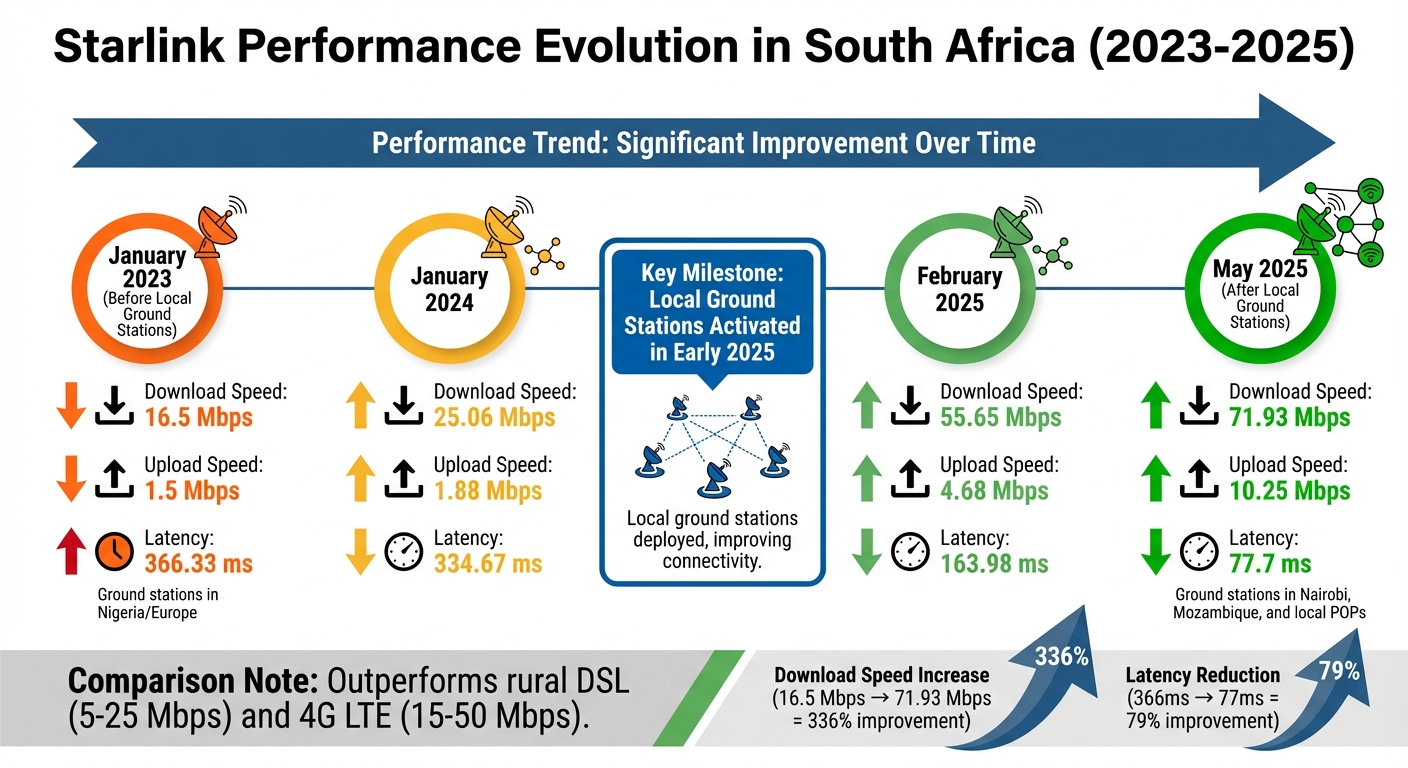
Starlink South Africa Performance Evolution 2023-2025
Expected Performance Metrics
Starlink’s performance in South Africa saw a noticeable boost in 2025, thanks to the activation of local ground stations. Before this, users in 2023 and 2024 dealt with latency exceeding 300 ms because the closest ground stations were located in Nigeria or Europe. By May 2025, South African users were reporting average download speeds of 71.93 Mbps, upload speeds of 10.25 Mbps, and latency of 77.7 ms. This marked a significant improvement compared to January 2023. The deployment of ground stations in Nairobi, Mozambique, and local points of presence (POPs) early in 2025 played a key role in reducing latency.
| Period | Download Speed (Avg) | Upload Speed (Avg) | Latency (Avg) |
|---|---|---|---|
| January 2023 | 16.5 Mbps | 1.5 Mbps | 366.33 ms |
| January 2024 | 25.06 Mbps | 1.88 Mbps | 334.67 ms |
| February 2025 | 55.65 Mbps | 4.68 Mbps | 163.98 ms |
| May 2025 | 71.93 Mbps | 10.25 Mbps | 77.7 ms |
These speeds outperform traditional rural DSL connections (5–25 Mbps) and fixed wireless 4G LTE networks (15–50 Mbps). While fiber still leads with lower latency (5–15 ms) and symmetrical speeds, Starlink offers a reliable high-speed option in areas where fiber infrastructure is unavailable. These metrics provide a foundation for examining other factors that influence performance.
Factors That Affect Performance
Several factors can impact Starlink’s performance, with network congestion being a significant one. For example, in late 2024, speeds in South Africa temporarily dropped to around 20 Mbps as increased adoption in neighboring countries like Zimbabwe and Kenya placed strain on the regional network. To maintain service quality, Starlink paused new sign-ups in overcrowded cities such as Harare and Lusaka.
Obstructions like trees and buildings can also interfere with signal quality. Using the Starlink app before installation is recommended to identify any potential obstructions, as even partial blockages can affect throughput. On the plus side, Starlink’s hardware is built to handle harsh conditions, including heavy rain, strong winds, and snow, with features like snow-melting capabilities.
Another consideration is the type of plan you choose. Residential Lite users often experience slower speeds during peak evening hours (7–11 PM) due to traffic deprioritization. Opting for a higher-tier plan can help ensure consistent performance during these busy periods. Additionally, proximity to ground stations and a higher density of satellites overhead both contribute to faster and more stable connections.
Legal and Regulatory Considerations
Regulatory Framework for Satellite Internet
As of January 23, 2026, Starlink does not have the required legal licenses to operate in South Africa. To comply with the country’s regulations, the Independent Communications Authority of South Africa (ICASA) mandates two key licenses: an Individual Electronic Communications Network Service (I-ECNS) license for managing the physical network and an Individual Electronic Communications Service (I-ECS) license for delivering internet services to customers.
South Africa’s Electronic Communications Act (ECA) also requires telecommunications license holders to have at least 30% ownership by historically disadvantaged groups, aligning with Black Economic Empowerment (BEE) standards. This ownership requirement has proven challenging for Starlink, as the company has stated it cannot meet this equity condition. To address this, Communications Minister Solly Malatsi introduced a draft policy in January 2026 that offers an alternative through Equity Equivalent Investment Programs (EEIPs). These programs allow international companies to invest in local infrastructure or skills development instead of transferring 30% ownership. Starlink has pledged to support rural connectivity initiatives under this framework, pending the policy’s approval. The Department of Communications plans to finalize the EEIP policy by March 2026.
Additionally, all Starlink hardware must pass ICASA’s type approval process to ensure it meets technical standards and avoids radio frequency interference. While companies like Paratus Telecommunications have obtained type approval for specific Starlink equipment, this does not grant them the authority to provide Starlink services to South African consumers. Full licensing, either by Starlink or a local partner, is still required.
Risks of Using Unlicensed Services
Operating within this regulatory landscape comes with risks, especially for those using unauthorized services. Purchasing Starlink equipment through unapproved resellers or relying on international roaming services exposes users to legal consequences. ICASA has deemed these activities unlawful and has deployed inspection teams to monitor and address unauthorized usage. ICASA Chairperson Mothibi Ramusi emphasized the seriousness of this issue:
"Should the investigation yield any breach with regulatory and legislative frameworks, the Authority will explore the applicable enforcement actions within its disposal which may include amongst others lodging a formal complaint with the International Telecommunication Union (ITU)."
The penalties for non-compliance are steep. Unlicensed service providers can face fines of up to R5 million or 10% of their annual turnover per day. Beyond legal risks, using non-type-approved equipment introduces technical dangers, such as harmful radio frequency interference or safety issues. Consumers also face the possibility of being left without support if their service is interrupted or their equipment fails.
Until the EEIP policy is finalized in March 2026, consumers are strongly advised to avoid purchasing Starlink kits from third-party importers or using roaming features. Doing so minimizes the risk of both legal and financial repercussions.
Conclusion
Starlink is making strides in bringing high-speed internet to 18 million underserved South Africans. With a planned policy shift in January 2026 to Equity Equivalent Investment Programs – backed by 77% public support – licensing could accelerate. Starlink’s pledge of R500 million to connect 5,000 rural schools aims to impact roughly 2.4 million learners.
However, affordability remains a big hurdle. Only 20% of South Africans can afford the service, leaving many households unable to access it. These cost concerns are further complicated by unresolved regulatory issues. As previously mentioned, it could take six to nine months for regulatory approvals to be finalized. Until then, using Starlink through unofficial means risks running afoul of local regulations.
For those in remote areas or businesses needing reliable connectivity, Starlink might be worth considering – once official licensing is secured. Keeping an eye on ICASA’s progress is key. You can also use the official Starlink app to check availability in your region. If all goes as planned, Starlink’s licensed service could roll out by late 2026 or early 2027.
FAQs
What are the risks of using Starlink in South Africa before it’s officially licensed?
Using Starlink in South Africa before it receives full licensing carries both legal and service-related risks. Since the service hasn’t yet obtained the necessary government approvals, users could face legal consequences, including fines or penalties, for breaking local regulations. Authorities might also impose restrictions on unlicensed satellite services, making usage even riskier.
On top of that, there’s the possibility of service interruptions or even a complete shutdown if Starlink fails to meet the country’s regulatory and ownership requirements. This could leave users without dependable internet access, which is especially problematic for those who rely on it for critical needs. To steer clear of these potential issues, it’s wiser to wait until Starlink is fully licensed and adheres to South African regulations.
How could new policies affect Starlink’s availability in South Africa?
Proposed policy adjustments in South Africa, such as relaxing licensing rules for satellite providers like Starlink, have the potential to significantly boost its availability. At present, Starlink’s expansion is hindered by strict ownership regulations that block it from securing the necessary licenses to operate officially.
If these changes move forward, they could streamline the licensing process, enabling Starlink to roll out its services faster across the country. This would be a game-changer for rural and remote areas, where reliable internet access is often scarce. By addressing these connectivity gaps, the reforms could help close the digital divide and align with government initiatives aimed at improving digital access. Ultimately, these changes could eliminate major roadblocks and make high-speed internet a reality for more South Africans.
What’s the difference between the Starlink Standard Kit and Mini Kit?
The Starlink Standard Kit and Mini Kit are tailored for different needs, with key differences in size, hardware, and intended use.
The Standard Kit comes with a larger satellite dish, a sturdy tripod mount, a Wi-Fi router, and necessary cables. It’s built for stationary setups, like homes, and delivers higher speeds with reliable coverage – making it a great choice for long-term, consistent internet use.
Meanwhile, the Mini Kit is all about portability. It includes a smaller, lightweight dish and a compact router, designed for travel or temporary setups. While it offers slightly lower speeds compared to the Standard Kit, its portability and ease of setup make it ideal for users who need internet access on the move.
Related Blog Posts
- Starlink Partners with Airtel & Vodacom: From Rival to Ally
- Starlink Faces Import Restrictions in Uganda Ahead of Elections
- South Africa’s DA Pushes for Starlink Entry to Boost Connectivity
- Airtel Africa to Launch ‘Direct-to-Cell’ Satellite Service in 2026