Kevin Mwangi

Launching a satellite in Africa is expensive but increasingly achievable. Costs depend on the satellite’s size, purpose, and launch requirements. For example:
- Design and Manufacturing: A large communications satellite can cost over $320 million, while smaller CubeSats can be built for under $53,000.
- Launch Services: African nations rely on foreign providers like SpaceX, with costs starting at $100,000 for small satellites.
- Regulatory Approvals: Licensing and compliance fees vary by country, adding to project budgets.
In 2025, African nations allocated $426.31 million to space programs, and the number of African satellites is expected to more than double by 2030. Local spaceport development and reusable rocket technology are reducing costs, making space more accessible for governments and startups alike. For instance, Kenya’s Taifa-1 satellite cost only $370,000 to develop and launch.


The future of satellite launches in Africa looks promising, with growing investments, international collaborations, and advancements in satellite and launch technologies driving progress. By 2030, Africa could see over 137 satellites in orbit, transforming its role in the global space industry.
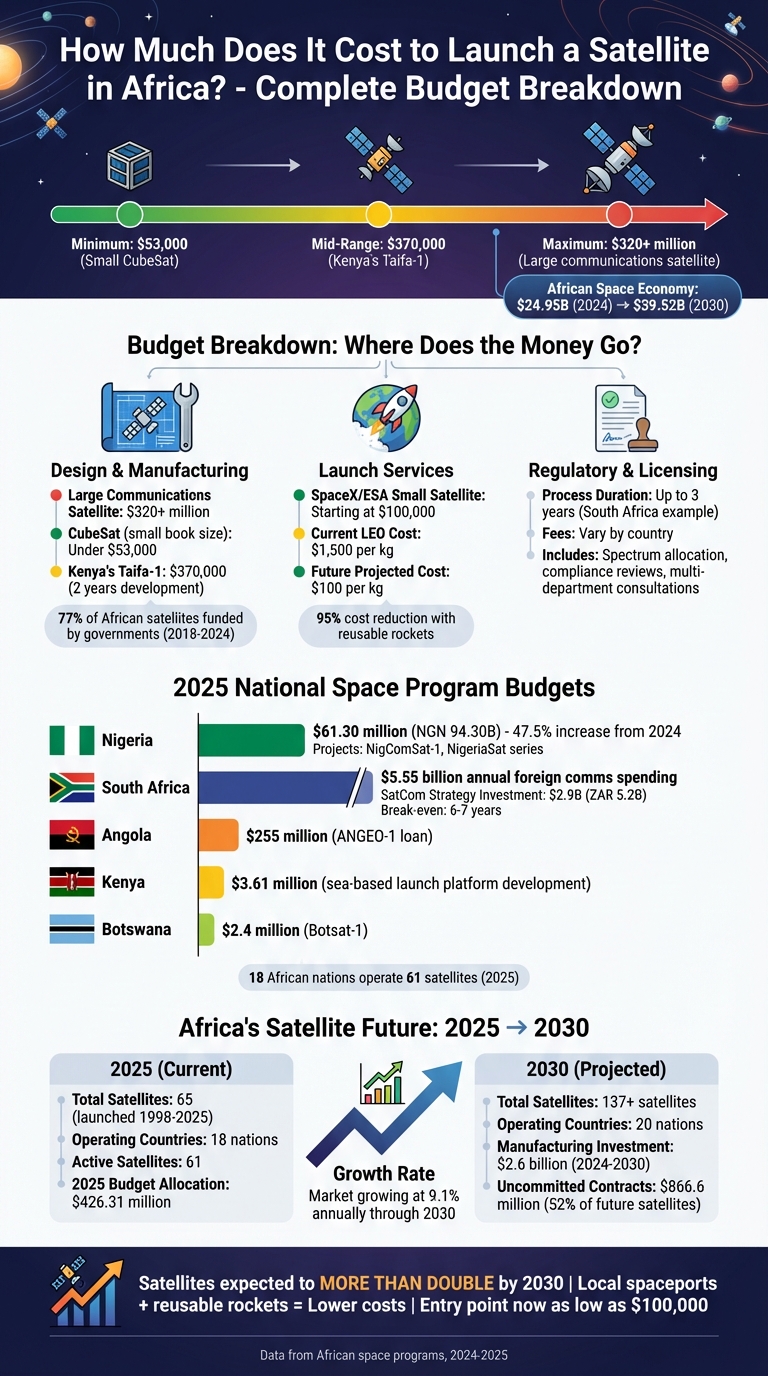
Satellite Launch Costs in Africa: Budget Breakdown by Satellite Type and Country
African countries sending an increasing number of satellites into space
Main Cost Components of a Satellite Launch
Launching a satellite involves three main expense areas: design and manufacturing, launch services, and regulatory approvals. Each of these plays a significant role in determining the overall costs. Below, we break down these components with examples from African satellite projects.
Satellite Design and Manufacturing
The cost of manufacturing a satellite depends heavily on its purpose and size. For instance, a communications satellite weighing over 2,200 pounds can cost more than $320 million to produce. By contrast, a CubeSat – roughly the size of a small book – can be built for less than $53,000.
"A communications satellite can cost over R6 billion and weigh over a tonne. A cube satellite, the size of loaf of bread, can cost under a million rand. It all depends on the mission or purpose of the satellite; what information it should give you."
- Official, South African Department of Science, Technology and Innovation
Satellites designed for geostationary orbit (GEO) tend to be larger and more expensive than those intended for Earth observation. Between 2018 and August 2024, 77% of African satellite launches were funded by governments. Looking ahead, about 52% of planned African satellites – worth $866.6 million – still need manufacturing contractors.
Launch Services and Logistics
Once a satellite is built, the next major expense is getting it into orbit. Africa currently lacks operational launch facilities, so countries must rely on international providers like SpaceX, the European Space Agency (ESA), or Roscosmos. For example, ESA offers small satellite launches starting at about $100,000. Costs also depend on the orbit type – launching to low Earth orbit (LEO) is typically less expensive than reaching geostationary orbit (GEO).
In August 2024, Senegal successfully launched GaindeSAT-1A, a CubeSat developed by Senegalese engineers in collaboration with a French university. It was carried into orbit aboard a SpaceX Falcon 9 rocket launched from California. However, relying on international launches increases logistical expenses. The Middle East & Africa space launch services market is expected to grow at an annual rate of 9.1% through 2030.
Regulatory and Licensing Costs
Navigating regulatory requirements is another key cost driver. These processes often involve consultations across multiple government departments, spectrum allocation fees, and compliance reviews. For example, South Africa’s satellite communication strategy took three years to develop, incorporating extensive consultations and impact assessments before gaining Cabinet approval.
Licensing fees and regulatory requirements vary by country, which can influence both project budgets and timelines. The establishment of the African Space Agency (ASA) under the African Union aims to streamline these processes by coordinating space policies across the continent. Additionally, national security concerns may lead to the formation of specialized satellite organizations to handle operations and protect data sovereignty, further contributing to administrative costs. These regulatory factors significantly shape the feasibility of satellite projects in Africa.
African Satellite Projects: Budget Examples
Nigeria’s Telecommunications Satellite Programs
Nigeria has established itself as a leader in Africa’s satellite initiatives, with projects like the NigComSat-1 communications satellite and the NigeriaSat Earth Observation microsatellite series. In 2025, the country allocated approximately NGN 94.30 billion (about $61.30 million) to its space program, marking a 47.5% increase in local currency from the prior year. However, the depreciation of the naira has reduced its purchasing power for foreign technology and launch services. To address cost and technical hurdles, Nigeria often collaborates internationally. For instance, the NigeriaSat-2 satellite was developed by Surrey Satellite Technology Ltd (SSTL) in the UK after technical assessments by Canada’s Telesat. Similarly, the NigComSat-1 satellite was constructed in China and launched in 2008. Despite having a significantly larger budget compared to Angola’s $5 million and Botswana’s $2.4 million allocations, Nigeria continues to grapple with the challenges posed by currency fluctuations.
South Africa’s Space Infrastructure Investments
South Africa takes a different approach, focusing on long-term infrastructure control. Currently, the country spends around ZAR 100 billion (approximately $5.55 billion) annually on foreign communication services, with ZAR 1.5 billion (about $83.9 million) specifically for satellite communications. In 2021, South Africa introduced its National Communication Satellite Strategy (SatCom), which began with an estimated ZAR 5.2 billion investment – ZAR 4 billion for the satellite launch and ZAR 1.2 billion for operational systems.
"The sooner we take control of infrastructure, the sooner we can control the cost to communicate." – Tebogo Leshope, COO, Sentech
This project is expected to break even within 6 to 7 years of operation. South Africa’s strategy combines national independence with international expertise, thanks to partnerships between the South African National Space Agency (SANSA), Sentech, and global fleet operators.
Other Satellite Projects Across Africa
Across the continent, funding strategies for satellite programs vary widely. By 2025, 18 African nations collectively operated 61 satellites. Many countries are adopting nanosatellite technology to minimize costs while entering the space sector. For instance, Angola secured a $255 million loan for its ANGEO-1 satellite, reflecting an increasing reliance on external financing such as Export-Import banks. Kenya is exploring innovative solutions, allocating $3.61 million in 2025 to develop a sea-based launch platform. Meanwhile, Botswana has budgeted $2.4 million for its Botsat-1 initiative. These examples showcase the diverse and tailored approaches African nations are employing to advance their satellite capabilities.
sbb-itb-dd089af
How Satellite Launch Costs May Change in Africa
Regional Spaceport Development
Africa’s reliance on foreign launch providers has historically driven up costs and left budgets vulnerable to currency fluctuations. However, the development of local spaceports could address these challenges. In November 2024, the Kenya Space Agency, in partnership with Italian collaborators, announced the revival of the Luigi Broglio Space Center. This sea-based platform near Malindi, inactive since the 1980s, is set to relaunch rockets for low-orbit microsatellites. Similarly, in December 2024, the South African National Space Agency successfully tested a sub-orbital rocket at the Denel Overberg Test Range in Arniston, showcasing its potential as a satellite launch site.
Equatorial regions like Kenya offer a natural advantage when it comes to launch costs. Julie Klinger, a professor at the University of Delaware, explains:
"Space launches from equatorial regions – which may not require as much fuel – could mean that African space ports have an important role to play in the coming decades"
Currently, only three of Africa’s 11 launch facilities are operational, leaving ample room for expansion. Feasibility studies for new spaceports are underway in Djibouti and Somalia. Meanwhile, the African Space Agency (AfSA), established in April 2025, is working to streamline efforts across its 55 member states by sharing infrastructure and coordinating launch schedules. These developments align with advancements in satellite technology, which continue to reduce launch expenses.
New Satellite and Launch Technologies
As Africa’s spaceport capabilities grow, evolving satellite technologies are making space more accessible. The rise of small satellites and CubeSats significantly lowers the cost barrier. For instance, in April 2023, Kenya launched Taifa-1, a 3U Earth Observation satellite designed by local engineers for just $370,000 over two years. Kenya’s Defence Principal Secretary, Patrick Mariru, highlighted the cost efficiency:
"The development of this outfit and its launch is very modest. We didn’t get engineers from outside Kenya. It’s only the parts that we sourced from external partners but in terms of fixing it was done by our engineers"
Advances in reusable rocket technology are also slashing costs. Taifa-1 was launched aboard a SpaceX Falcon 9 reusable rocket, contributing to a 95% drop in launch costs to low-Earth orbit, now averaging $1,500 per kilogram. With increasing competition, prices could drop further, potentially reaching $100 per kilogram. Additionally, investment in local satellite manufacturing is projected to hit $2.6 billion between 2024 and 2030, reducing dependence on costly foreign technologies.
More Competition Among Launch Providers
Growing competition between the U.S. and China is driving down launch costs and improving Africa’s negotiating position. This competitive landscape enables African organizations to secure better deals. With contractors yet to be chosen for 52% of future African satellites – valued at $866.6 million – African buyers hold considerable leverage.
The African space economy, valued at $24.95 billion in 2024, is expected to grow to $39.52 billion by 2030, attracting new launch providers to the region. Scott Firsing, an expert in global space diplomacy, emphasizes the role of the African Space Agency:
"The African Space Agency’s role in coordinating satellite launches and data sharing will make these technologies more accessible and cost-effective"
Smaller satellites now have the option to launch as secondary payloads on foreign rockets for as little as $100,000, opening up opportunities for nations with limited budgets. Between 1998 and 2025, African countries launched 65 satellites, but by 2030, that number is expected to more than double, reaching 137 satellites from 20 nations. This growing demand, coupled with increased competition, makes launching satellites in Africa an increasingly viable and attractive option.
Conclusion: Is Launching a Satellite in Africa Financially Feasible?
Launching a satellite in Africa can make financial sense when the mission’s goals align with realistic budgets. The cost of satellites varies greatly depending on their design. For instance, CubeSats are far more affordable than large-scale communications satellites. Thanks to nanosatellites, even startups and smaller nations can now access space, with some projects costing as little as $100,000.
Government investments play a major role in shaping this market. Many African nations view satellites as essential infrastructure rather than just commercial tools. Investing in domestic satellite programs can yield long-term financial benefits, such as reducing reliance on foreign communication providers and promoting data sovereignty and technological independence.
The future of African satellite initiatives depends on focused investments and strategic collaborations. With the African Space Agency coordinating efforts, the continent’s space economy is gaining momentum. Lowering launch costs – currently around $1,500 per kilogram and potentially dropping to $100 per kilogram – will further reduce barriers to entry.
Choosing the right satellite technology for specific mission needs is key. Startups should consider public-private partnerships to share costs, a strategy that has worked well for South African companies like CubeSpace. Focusing on specialized applications, such as agricultural monitoring, disaster response, or resource mapping, can help ensure that satellite data generates tangible benefits.
At present, 18 African countries operate a total of 61 satellites, and projections suggest this number could rise to 137 by 2030. For satellite projects in Africa to succeed, they need well-defined goals and tailored technologies that align with both national and commercial priorities. Whether you’re a government aiming for ICT independence or a startup addressing pressing development issues, Africa’s space sector presents real opportunities that are financially within reach.
FAQs
What factors determine the cost of launching a satellite in Africa?
Several factors come into play when determining the cost of launching a satellite in Africa. These include the type and purpose of the satellite, its size and weight, and the complexity of its design. For instance, smaller satellites like CubeSats are typically less expensive compared to large communication satellites, which demand more advanced technical features.
Major cost drivers include manufacturing expenses, sourcing external components, and the mission’s objectives, such as Earth observation or communication services. Additional costs stem from launch services, regulatory approvals, and logistics. The choice of launch vehicle – whether it’s a commercial option or one backed by a government – also heavily influences the total expense. Furthermore, the funding and priorities of the involved governments or organizations can significantly impact the budget. Costs can vary widely, from a few hundred thousand dollars for smaller-scale projects to hundreds of millions for more ambitious, complex missions.
How will developing local spaceports in Africa affect satellite launch costs?
Developing local spaceports across Africa has the potential to drastically cut satellite launch expenses. By constructing domestic launch sites – like Kenya’s proposed spaceport near Kipini – countries can save on logistical costs, avoid delays, and reduce their dependence on expensive international launch providers. This shift could make launching satellites far more affordable and accessible.
But the benefits go beyond just cost savings. Local spaceports also play a key role in nurturing local talent and advancing technological capabilities. Take South Africa’s satellite project as an example. With an estimated price tag of over $320 million, having local launch options could help trim these costs significantly. As more nations on the continent invest in this kind of infrastructure, the ripple effects could make space activities far more feasible for startups, governments, and organizations throughout Africa.
How does the African Space Agency help lower the cost of launching satellites?
The African Space Agency (AfSA) has been instrumental in making satellite launches more affordable for African nations. Since its launch in April 2025, AfSA has focused on fostering collaboration among countries across the continent. By encouraging resource sharing and coordinating space activities, AfSA helps nations access orbital slots and leverage technical expertise without bearing the full financial burden alone.
AfSA also works closely with international partners like the European Space Agency and the UAE Space Agency. These partnerships open doors to more budget-friendly launch opportunities, making satellite deployment accessible to governments, startups, and organizations across Africa. Through these efforts, AfSA is helping to remove financial obstacles and expand access to space technology.
Related Blog Posts
- 5 Challenges Scaling African Startups
- Airtel Africa to Launch ‘Direct-to-Cell’ Satellite Service in 2026
- Starlink South Africa 2026: Pricing by Package (Roam vs Residential), Speeds, and How to Order
- Which African Countries Have Satellites? Full List + What Each Satellite Is Used For (2026)