Kevin Mwangi

OpenAI Agents in 2026 are autonomous systems designed to handle complex business workflows with minimal human involvement. Unlike traditional chatbots, these agents execute tasks independently – managing processes like transaction reconciliation, customer support, and data analysis. For African startups, this technology offers a way to scale operations efficiently without large teams or deep technical expertise.
Key Insights:

- Efficiency Boost: Companies using OpenAI’s AgentKit report a 70% reduction in iteration cycles and a 75% cut in development time.
- Real Impact: Rwandan startup Kayko onboarded 8,500 businesses into automated ecosystems by early 2026.
- Core Capabilities: Agents handle tasks like real-time web searches, Python-based data analysis, and multilingual customer support.
Applications for African Startups:
- Fintech: Automate KYC processes, fraud detection, and micro-lending assessments.
- E-commerce: Localize content, optimize logistics, and support diverse languages.
- Healthcare: Triage symptoms, schedule appointments, and analyze diagnostics.
- Blockchain: Ensure compliance and track supply chains.
With tools like Agent Builder and the Agents SDK, startups can deploy agents quickly, connect them to APIs, and monitor performance. By leveraging these systems, African entrepreneurs can address resource limitations and create scalable solutions for key sectors like fintech, healthcare, and e-commerce.
What Are OpenAI Agents and What Can They Do?
OpenAI Agents Defined
OpenAI Agents are autonomous systems designed to handle tasks independently. Think of them as team members who don’t just explain processes – they execute them. For example, while a chatbot might guide you on how to process a refund, an OpenAI Agent can log into your system, verify the transaction, process the refund, and even send a confirmation email – all without needing human input.
Each agent is built with three key components: a decision-making model, access to interactive tools (like APIs or CRMs), and a set of clear instructions. This combination allows them to manage complex workflows that usually require human judgment.
"An AI system that has instructions (what it should do), guardrails (what it should not do), and access to tools (what it can do) to take action on the user’s behalf" – OpenAI
This structured design enables the advanced capabilities explored in more detail below.
Core Features of OpenAI Agents
What makes OpenAI Agents so powerful is how their components work together. Advanced models, such as GPT-5 and the "o" series, use chain-of-thought reasoning. This means they don’t just follow pre-set rules – they analyze context, test solutions, and adapt to unique situations.
Agents can perform a variety of tasks, including:
- Accessing real-time information via Web Search
- Reviewing company documents with File Search
- Running Python code for data analysis
- Interacting with web interfaces using "Computer Use" tools
They also process multimodal inputs – text, images, and audio – within a single workflow. On top of that, their memory systems allow them to retain context across conversations. For instance, if a customer reaches out multiple times about the same issue, the agent remembers the entire history and continues seamlessly, eliminating the need for manual reviews.
These capabilities are redefining what’s possible in business operations.
How OpenAI Agents Are Changing Technology
The transition from rules-based automation to reasoning-based systems is reshaping industries worldwide. Traditional software required developers to predict every possible scenario and code specific responses. OpenAI Agents, however, can handle unexpected situations by reasoning through them. This adaptability is especially valuable in fast-changing, unpredictable markets.
For startups in Africa, these agents offer a way to overcome resource limitations. With lean teams and limited budgets, businesses can still achieve impressive results. This is particularly relevant in addressing challenges such as Sub-Saharan Africa’s health workforce shortage, estimated at 5.6 million workers. By automating key processes, agents help bridge these gaps.
"AI is going to be a scientific marvel no matter what, but for it to be a societal marvel, we’ve got to figure out ways that we use this technology to improve people’s lives." – Sam Altman, CEO, OpenAI
Multi-agent systems take this a step further by enabling specialized agents to work together. This collaboration allows startups to build advanced systems without requiring large engineering teams, providing a practical solution for entrepreneurs navigating resource constraints.
sbb-itb-dd089af
8 AI Agent Use Cases for OpenAI Agent Builder! (Insane Results)
What African Startups Can Build With Agentic AI
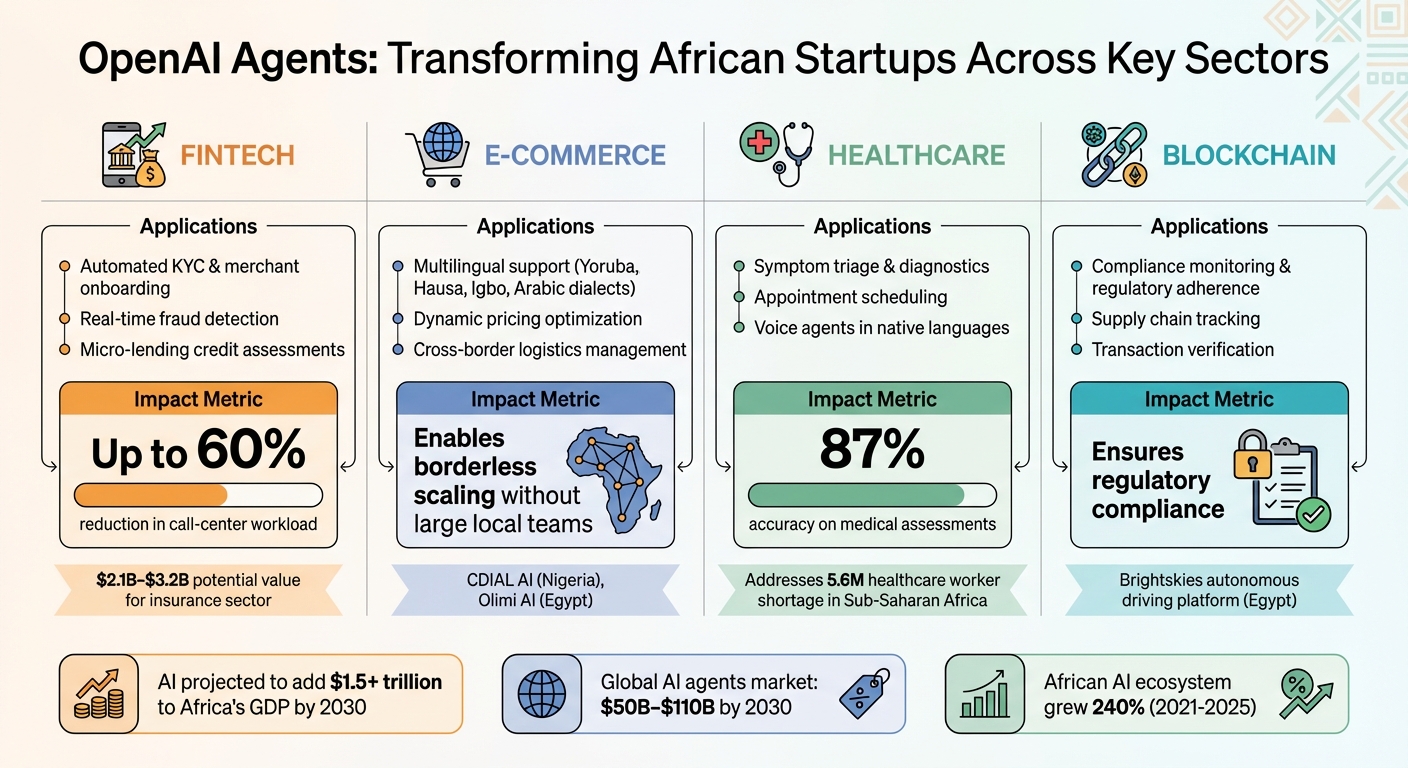
OpenAI Agents Impact Across African Startup Sectors: Applications and Metrics
African startups have a unique opportunity to use AI to address challenges in key sectors like fintech, e-commerce, healthcare, and blockchain. With AI projected to add over $1.5 trillion to Africa’s GDP by 2030, leveraging OpenAI Agents could lead to transformative solutions.
Fintech Solutions With Personalization
The financial sector in Africa often grapples with fragmented mobile money systems and differing KYC (Know Your Customer) requirements. OpenAI Agents can streamline processes by automating merchant onboarding, validating KYC, and detecting fraud in real time. In micro-lending, these agents analyze mobile money histories to assess creditworthiness, offering a more inclusive approach to financial services.
Banks using AI agents for customer service have seen potential reductions of up to 60% in call-center workloads. Similarly, the insurance industry could gain between $2.1 billion and $3.2 billion in value by using generative and agentic AI. These agents can handle claims by cross-referencing policy details, medical records, and payout processes while integrating with local mobile money APIs.
"For Africa, a continent undergoing accelerated digital adoption and facing deep structural service gaps, AI agents may represent a once-in-a-generation leapfrog opportunity." – African Business
E-Commerce Platforms That Scale
African e-commerce startups face hurdles like managing multiple currencies, navigating cross-border logistics, and catering to diverse languages. OpenAI Agents simplify these complexities by localizing product descriptions, providing support across time zones, and optimizing delivery routes with real-time data.
Dynamic pricing becomes achievable when agents analyze competitor prices, inventory levels, and demand trends to suggest adjustments. For customer service, agents handle routine inquiries while escalating more complex issues to human teams. Companies like CDIAL AI in Nigeria are building systems that process Yoruba, Hausa, and Igbo to address local needs. Similarly, Olimi AI in Egypt uses multilingual agents to support customers in Arabic dialects, including Egyptian, Saudi, and Emirati.
Healthcare Automation and Access
A shortage of healthcare workers remains a pressing issue in Sub-Saharan Africa. OpenAI Agents can help by triaging symptoms, analyzing diagnostics, and scheduling appointments. AI-powered educational assistants tested in 15 African countries have already achieved 87% accuracy on science-related questions.
THAKAA, a company operating across the Middle East and Africa, launched the region’s first Arabic-language AI platform in 2026, helping leaders at a children’s cancer hospital streamline operations and decision-making. Using tools like File Search, agents can connect to local medical databases or policies. Voice agents, deployed through the Responses API, assist users in rural areas by communicating in their native languages.
Blockchain-Connected Systems
As crypto regulations tighten, African startups need strong compliance tools. OpenAI Agents can create "compliance rails" to monitor transactions and ensure adherence to regulations. In supply chain management, agents track products from manufacturers to consumers using blockchain records. A notable example is Brightskies in Egypt, which demonstrated an autonomous driving platform in 2026 that integrates agentic AI for navigation and mobility.
With the global market for AI agents expected to reach $50 billion to $110 billion by 2030, these sector-specific applications provide a roadmap for African startups to harness agentic AI effectively.
| Sector | Agent Application | Impact Metric |
|---|---|---|
| Fintech | Automated onboarding and fraud detection | Up to 60% reduction in call-center pressure |
| E-commerce | Multilingual support and dynamic pricing | Enables borderless scaling without large local teams |
| Healthcare | AI-powered triage and diagnostics | 87% accuracy on medical assessments |
| Blockchain | Compliance monitoring and supply tracking | Ensures regulatory adherence |
How to Implement OpenAI Agents in Your Startup
Bringing OpenAI Agents into your startup can turn big ideas into practical, scalable tools that drive real results.
Selecting Your Deployment Method
When it comes to deploying agents, you’ve got two main options: Agent Builder for visual workflows or the Agents SDK for a code-first approach. Agent Builder offers a drag-and-drop interface, perfect for quickly prototyping without diving into code. On the other hand, the SDK (compatible with Python, TypeScript, and Go) provides more control, allowing you to tailor how agents interact with your systems and infrastructure.
Start by using GPT-5 to establish a baseline for performance. Once tasks are validated, you can switch to smaller models like GPT-5-mini or GPT-5-nano for simpler operations. This approach helps manage costs effectively. In regions with limited internet bandwidth, like parts of Africa, lean toward basic models for chat-heavy tasks, while reserving reasoning models (e.g., o1 or o4-mini) for complex processes like fraud detection or supply chain management.
For user interface integration, ChatKit offers a direct solution. But if you need more customization, running the Agents SDK on your own servers is the way to go. For example, Ramp, a fintech company, slashed their deployment time from six months to just two sprints using Agent Builder.
Once your agents are live, the next critical step is connecting them to your external data sources and APIs.
Connecting APIs and Local Data
Agents rely on Tools to interact with external systems, such as APIs or databases. You’ll need to define these functions so agents can query resources like mobile payment systems, health records, or inventory databases. Using structured outputs like JSON schemas and the Model Context Protocol (MCP) ensures smooth integration with your systems.
For proprietary data, such as internal policy documents or medical guidelines, the File Search tool can embed and store this information in a vector database for easy access.
If your startup relies on older systems without modern APIs, the Computer Use tool steps in. It allows agents to navigate websites and fill out forms by interpreting screenshots, making it adaptable to a variety of system capabilities. Additionally, the Responses API streamlines conversation history management by storing it on OpenAI’s infrastructure, which is especially helpful in areas with unstable internet connectivity.
Once your systems are integrated, the focus shifts to monitoring and improving agent performance for long-term success.
Monitoring and Improving Agent Performance
Built-in tracing tools allow you to evaluate agents’ performance automatically. Features like trace grading and model graders assess outputs for relevance, completeness, and brand consistency.
The Prompt Optimizer is particularly useful for refining agent instructions. It can rewrite prompts based on feedback from failed interactions or human annotations, ensuring continuous improvement.
To maintain security and compliance, set up layered guardrails. These can include LLM-based classifiers, PII filters, and regex rules to prevent data leaks and ensure responses align with your brand. For high-stakes actions, like processing refunds or updating sensitive medical records, you can implement thresholds that trigger human intervention after a set number of failed attempts.
"The path to successful deployment isn’t all-or-nothing. Start small, validate with real users, and grow capabilities over time." – OpenAI
Startups that adopt these tools have reported a 30% boost in agent accuracy and a 70% cut in iteration cycles. Using Agent Builder’s version control feature, you can easily revert to previous configurations if performance dips after updates, keeping your workflows stable and efficient.
Conclusion: What OpenAI Agents Mean for African Startups
OpenAI Agents are opening doors for African entrepreneurs to tackle challenges like limited resources, small teams, and fragmented markets. Between 2021 and 2025, the African AI ecosystem expanded by 240%, growing from 2,473 to 5,906 companies. During the same period, African startups secured $2.65 billion in funding between January and October 2025, marking a 56% recovery.
These agents go beyond basic automation by handling end-to-end workflows. Tasks like merchant onboarding, compliance checks, customer support triage, and content localization across multiple languages and time zones become more manageable. This allows startups to scale efficiently, navigating Africa’s diverse currencies, regulations, and languages without requiring massive funding rounds.
What sets these tools apart is their ability to make real-time decisions. By analyzing data such as foreign exchange rates, fuel prices, and inventory levels, agents can suggest immediate actions like adjusting prices or optimizing delivery routes. This agility helps startups seize opportunities quickly and stay competitive.
The results speak for themselves: companies using these tools report app development that’s four times faster, iteration cycles cut by 70%, and a 30% boost in accuracy [7, 8]. Take Rwanda’s Kayko, for example – they onboarded 8,500 businesses, showcasing how technology can drive rapid digital growth. These advancements demonstrate that African startups, even with leaner resources, are capable of competing on a global stage.
FAQs
How can African startups use OpenAI Agents to overcome limited resources?
African startups are finding new ways to overcome resource limitations by leveraging OpenAI Agents. These tools help automate tasks that would otherwise demand significant time or manpower, making processes like customer support, data analysis, and software development far more efficient.
By handling repetitive or complex tasks – such as coding, file management, or responding to customer inquiries – OpenAI Agents free up time and energy for teams to focus on innovation and business growth. With tools like Agent Builder, even teams with limited technical skills can design AI-driven workflows. This not only lowers the barrier to entry but also speeds up development, enabling startups to scale quickly, enhance their services, and remain competitive in challenging environments.
What advantages do OpenAI Agents offer for fintech startups?
OpenAI Agents bring powerful automation tools to fintech startups, simplifying processes like customer onboarding, transaction handling, and compliance checks. By managing these workflows efficiently, they help cut down operational expenses while enhancing the overall customer experience.
Their capabilities also boost precision and dependability in financial operations. Tasks such as fraud detection and regulatory compliance are handled with minimal errors. Plus, their seamless integration with various tools and data sources allows for real-time decision-making and tailored financial services – both critical for pushing fintech innovation forward.
For African startups, these agents help level the playing field. By automating customer support, speeding up app development, and offering scalable solutions with fewer resources, businesses can roll out new products more quickly, connect with customers more effectively, and stay competitive in the rapidly expanding financial sector.
How can OpenAI Agents assist with multilingual customer support for African startups?
OpenAI Agents are transforming multilingual customer support by automating responses in multiple languages. They allow for quick and precise communication, helping businesses handle tasks like answering FAQs, processing refunds, and resolving account-related issues with ease.
With their advanced AI capabilities, these agents deliver interactions that feel natural and conversational, enhancing the overall customer experience. At the same time, they reduce the reliance on large human support teams. For African startups looking to expand and cater to diverse markets, these agents offer a practical way to streamline operations and reach a broader audience effectively.
Related Blog Posts
- The Rise of AI Startups in Africa: Tools, Trends & Talent
- Zoho Insights: Why “Augmented Teams” Are Africa’s AI Future
- Generative AI in African Banking: Enhancing Customer Experience
- OpenAI Launches “Agent” Tools: What It Changes for African Startups, SMEs and Customer Support