Grace Ashiru
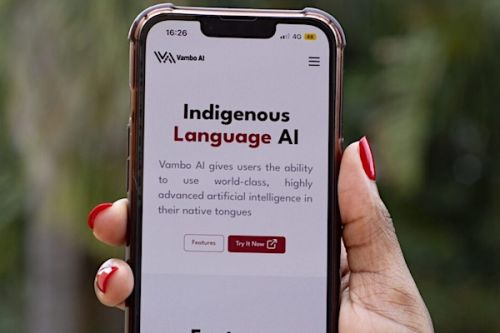
South African technology company Vambo AI has introduced MORENA, a new artificial intelligence language model designed to improve digital services and technological access for speakers of African languages.
The open-weight model contains 1.5 billion parameters and was developed from scratch to support 12 African languages alongside English and French.

The supported African languages include ChiShona, Kiswahili, Hausa, Yoruba, Igbo, isiZulu, isiXhosa, Kinyarwanda, Setswana, Afrikaans, isiNdebele and Nigerian Pidgin.
Vambo AI co-founder Isheanesu Misi described MORENA as the largest openly available African language model trained entirely from scratch.
Unlike systems adapted from existing international AI models, MORENA was developed using a training approach focused on African linguistic requirements.
The company believes this design could improve the affordability and efficiency of artificial intelligence applications across the continent.
A major feature of the model is its approach to tokenisation, the process through which AI systems divide language into smaller units for processing.
Models developed primarily for English can require more processing units when handling certain African languages, increasing computational expenses.
Vambo AI says MORENA processes African languages more efficiently, potentially reducing the cost of operating and adapting AI systems for regional applications.
This could benefit startups, researchers and developers seeking to create digital products in local languages without depending entirely on expensive international technologies.
Misi also claimed MORENA performs better on African text modelling than a Google model with approximately eight times as many parameters.
However, the company has not published the benchmark results or identified the Google model used in that comparison, meaning the performance claim remains independently unverified.
Vambo AI was established in April 2023 by Chido Dzinotyiwei and Isheanesu Misi to develop technology supporting multilingual communication.
Its existing services allow users to write, search, translate and transcribe information, while businesses can access developer tools to build language-based applications.
The company recommends using MORENA as a foundation for further model development and fine-tuning rather than deploying it immediately without adaptation.
Despite the announcement, details concerning the model’s licensing conditions, training datasets and computational costs have not been publicly released.
The development reflects growing efforts by African technology companies to create artificial intelligence systems better suited to the continent’s linguistic diversity.