Grace Ashiru
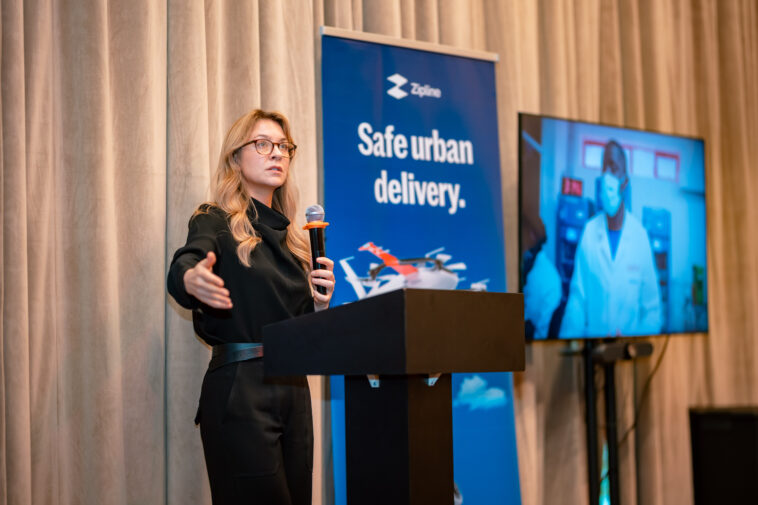
Three new studies show that Zipline’s autonomous logistics network is delivering measurable results across Africa, far beyond the public health use case that it’s best known for.
The findings document a 22% reduction in child fatalities from severe acute malnutrition, a 68% direct return on investment for smallholder pig farmers, and $850 to $1,200 in additional annual household income near Zipline distribution hubs.


“This research shows what communities and governments across Africa have seen firsthand: when essential supplies reliably reach the people who need them, outcomes change,” said Caitlin Burton, CEO for Africa and Emerging Markets at Zipline. “Zipline began by improving access to critical health supplies. Today, the same infrastructure is strengthening nutrition systems, agricultural productivity and local economies.”
Agricultural returns: a 68% return on investment for smallholder farmers
A peer-reviewed study published in Frontiers in Veterinary Science evaluated the impact of Zipline’s aerial logistics model on pig farming in Rwanda, where drone-delivered pig semen was paired with localized training for community animal health workers across eight rural districts. The program, run in partnership with the Rwanda Agriculture and Animal Resources Development Board and Feed the Future Rwanda, set out to test whether reliable, temperature-controlled delivery could turn artificial insemination into a viable income source for smallholder pig farmers.
Key results:
- 17% of the increase in farmers’ income was attributable to Zipline.
- The program generated nearly $129,000 more in direct farmer income than it cost to implement, representing a 68% return on investment.
- Artificial insemination success rates reported by community animal health workers rose from 48.8% to 74.8% after integrating drone logistics.
Nutrition study: a 22% reduction in childhood deaths from severe malnutrition
A separate study evaluated whether Zipline’s drone delivery of ready-to-use therapeutic food (RUTF) changes outcomes for children with severe acute malnutrition in Rwanda. RUTF is the standard treatment for the condition, but when clinics run out, treatment stops. Zipline delivers RUTF on demand from central stock, so facilities no longer have to predict demand or carry excess inventory. The researchers compared 299 Zipline-served and non-served facilities over a five-year period.
Key results at Zipline-served facilities compared to non-served facilities:
- In-hospital childhood deaths from severe malnutrition fell 22%.
- Severe acute malnutrition encounters fell across every age group: 22% in children under 2, 42% in ages 2 to 5, and 84% in children older than 5.
- Severe anemia encounters in children aged 2 to 59 months fell 46%.
Malnutrition-related hospitalisations rose by 21%, but deaths did not. This shows Zipline-served facilities were identifying more children, referring them sooner, and sustaining treatment they previously could not complete. This is one of the largest system-wide reductions ever in severe child malnutrition consultations.
“The protocol for treating malnutrition has not changed. What changed was whether supplies were there when clinicians needed them. That is the variable these studies are measuring – and the results are unambiguous,” said Pedro Kremer, Head of Impact and Research at Zipline.
Economic impact visible from space: $850-$1,200 per household
A third study measured the wider economic footprint of Zipline’s GH3 distribution hub in northern Ghana. Researchers combined a household survey with a satellite analysis of nighttime light intensity benchmarked against 82 comparable locations across the country. The question behind the research was simple: when a logistics hub built to serve the health system arrives in a community, does the surrounding economy change? The results show that it does:
- Households within 2 km of the Zipline GH3 hub gained $850 to $1,200 in additional income per year.
- Household acquisition of liquid assets falls about 27% with every additional 1.5 km from the hub, with a gap of over 30 percentage points between the nearest and farthest communities.
- Improvements in drinking-water access follow the same proximity pattern, 6% near the hub versus 2% farther out.
- Satellite-measured nighttime light intensity, a recognized proxy for local economic activity, is significantly higher near GH3 than at the 82 comparable locations used as benchmarks.
The findings suggest that Zipline’s distribution infrastructure is associated not only with better access to health products, but also with wider economic activity in the communities around its operations.