Grace Ashiru
Dodai, the Ethiopian electric motorbike and battery-swapping startup led by founder and CEO Yuma Sasaki, has added $3 million to its Series A, which brings the total round to $16 million. The extension came from Tokyo Gas, through its corporate venture arm Acario, and Kaneto Capital Management, a Singapore-based family office.
The original $13 million Series A was split between $8 million in equity and $5 million in debt. British International Investment (BII) took part in that round alongside a group of Japanese investors. Before the Series A, Dodai raised $7 million in 2024.


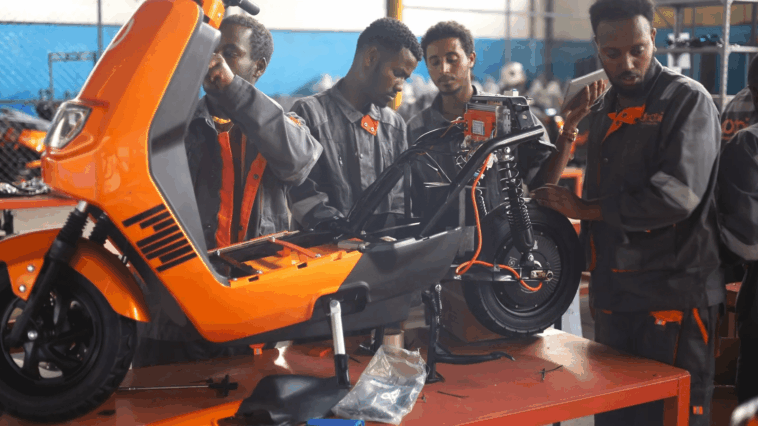
The company’s model is simple. Riders pull into a Dodai station, hand over a depleted battery and leave with a charged one in a few minutes, which they usually do once a day; this saves them from waiting hours for a bike to charge. Dodai assembles its motorbikes locally and owns and runs its swap network, so it controls both the vehicle and the energy supply. It has put more than 2,000 electric motorbikes on the road so far, and nearly its entire team of over 150 people is Ethiopian.
The new money will go toward building out station coverage in Addis Ababa. Within the next 12 months, Dodai wants to reach 3,000 battery-swapping users and 30 stations in the city. Over three years, the target rises to 30,000 users and 1,000 stations, after which the company plans to move into other African cities. Abidjan, Kinshasa, Accra, Dar es Salaam and Cairo are on its list for expansion from 2028.
For Tokyo Gas, a Japanese energy company with more than 140 years of history, the investment fits its interest in infrastructure and energy management. The two companies plan to look at working together on battery and power management, and Acario already backs firms that work on EV-charging management and energy forecasting. Kaneto Capital brings long-horizon capital to the deal, and it has previously supported impact-focused funds, including a Japanese wellness fund managed by SIIF Impact Capital.
Ethiopia’s policy shift gives Dodai a strong tailwind. In January 2024, the country banned imports of petrol and diesel vehicles in a bid to cut its heavy fuel import bill. It also reduced duties on electric vehicles: fully assembled EVs now attract a 15% tax, while locally assembled kits are exempt from import tax. Addis Ababa went further and gave its 12,000 registered motorbikes two years to switch to electric.
Cost is still a real barrier for riders. An electric motorbike in Addis Ababa can sell for more than 350,000 birr (about $2,129), which is close to ten times what many riders earn in a month. Most models cover around 100km on a charge, public charging points are thin on the ground, and maintenance tends to cost more than it does for petrol bikes. Dodai also faces competition from local player Belayneh Kinde Group and Chinese manufacturer Yadea.
The company’s success will depend heavily on how quickly it can build a dense, reliable station network across Addis Ababa, because riders will only commit to swapping if a station is always close by. That is exactly what this extension is meant to pay for.