Grace Ashiru
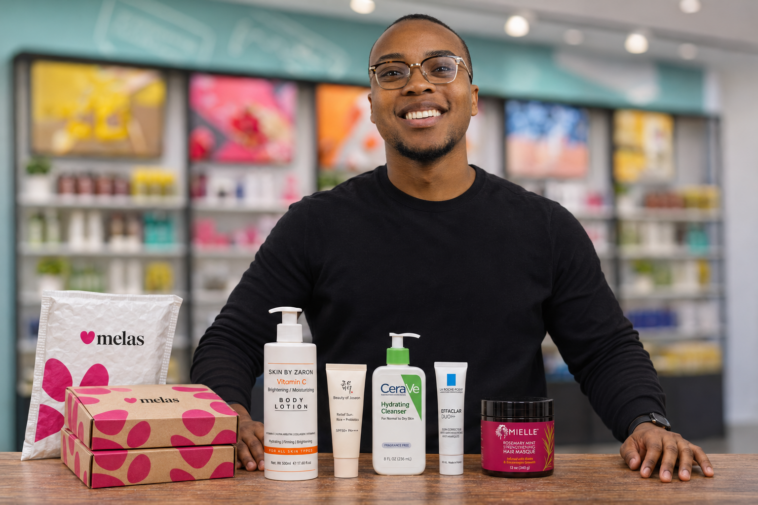
A bathroom shelf can tell a surprisingly personal story. It might be a body lotion first recommended by a relative in Lagos, a hair product used since childhood in London, a Korean serum discovered online, or a French pharmacy cleanser bought on a friend’s advice.
Together, those products make up someone’s routine. Finding them, understanding them and buying them again should feel straightforward.


That is the opportunity behind Melas Beauty, the UK beauty retailer founded by Ola Adeloye. With skincare, haircare and body care under one roof, the business is building a shopping experience that gives particular attention to the African and Caribbean diaspora while welcoming customers from different backgrounds.
Made for Every Look And Shade.
The name captures that ambition. Melas stands for Made for Every Look And Shade. Ola’s interest began with his own search for products suited to his skin concerns. Faced with a crowded selection, he wanted clearer answers about what products did, where they belonged in a routine and how to choose between them. That experience became the starting point for Melas, a family-run business combining product selection with practical information. The challenge is familiar enough to be easy to overlook. A shopper can recognise every brand on a page and still struggle to work out what to buy. Someone else may know exactly what they want but need a dependable place to order it. Melas is building around both experiences.
A Growing Market, an Underserved Community
The commercial opportunity is growing. Market research firm Mordor Intelligence estimates that the UK skincare market will generate US$4.84 billion in 2026, rising to US$6.27 billion by 2031, with projected annual growth of approximately 5.3%. Across Europe, the broader beauty and personal care products market is forecast to grow from US$146.93 billion in 2026 to US$180.32 billion by 2031. These forecasts cover the overall market, giving context to the industry in which Melas is building its business. For Melas, the opportunity lies in earning repeat custom within that expanding market. A shopper who finds a familiar body lotion may return for sunscreen, discover a new skincare brand or buy products for the rest of the household. Bringing those purchases together gives Melas a clear commercial ambition: to become the store customers return to as their routines, preferences and needs evolve.
Millions of Consumers, Room for a Better Beauty Experience
The population figures show the scale of the communities it hopes to serve. In England and Wales alone, the 2021 Census recorded 2.4 million people identifying within Black ethnic groups, including approximately 1.49 million Black African people and 623,000 Black Caribbean people. A further 763,000 people identified as mixed White and Black African or mixed White and Black Caribbean. These categories reflect a population spanning long-established British families, people with mixed heritage, and more recent arrivals.
The Black African population in England and Wales grew from approximately 990,000 in 2011 to 1.5 million in 2021. The Office for National Statistics notes that changes between censuses reflect several factors, including migration, births, deaths and how people identify themselves. Across Europe, the reach is larger still. A 2019 European Parliament resolution cited an estimated 15 million people of African descent living in Europe.
That historical estimate uses a broader definition and offers a sense of the diaspora s continental presence. It also points towards the longer-term opportunity for businesses that learn how to serve these communities well. Population, however, tells only part of the business story. What matters to a retailer is whether people can find relevant products and feel confident enough to buy. Research suggests that experience has often fallen short.
Citing the Black Pound Report 2022, the British Beauty Council said nearly four in ten Black female shoppers found it difficult to find cosmetics and skincare. The same report put annual health and beauty spending by the UK’s wider multi-ethnic consumer population at £2.7 billion. That spending figure covers Black, Asian and other multi-ethnic consumers collectively. It demonstrates the commercial importance of taking different shopping needs seriously.
For Melas, the response begins with the shelf.
Melas brings African cosmetics Skin by Zaron and Dudu Osun together with brands including Korean products like Beauty of Joseon, COSRX, SKIN1004, CeraVe and La Roche-Posay. Haircare names include African Pride, Aunt Jackie’s, Cantu and Mielle. The selection lets familiar favourites and newer discoveries live in the same shopping experience.
That combination matters because heritage does not dictate an entire routine. A customer may feel attached to one product through family experience and choose another after comparing its ingredients or price. Different generations within the same household may shop very differently. A store built for the diaspora needs enough understanding to recognise those connections and enough flexibility to accommodate individual tastes.
Melas’s approach also puts everyday questions closer to the buying decision. How does a sunscreen look on deeper skin? Where does a serum fit into a routine? What kind of product is intended for textured hair or protective styles?
Which body-care options address the concern a customer actually has? The company’s stated selection priorities include hyperpigmentation, visible white cast, textured hair, protective styles, breakage and body dark marks. Its aim is to make those considerations easier to navigate through clearer product information and guidance. This is where an independent retailer can earn a place in a competitive sector.
Each question gives it a chance to improve a product description, reconsider what it stocks or explain a choice more clearly. Over time, those decisions determine whether a customer returns. There is an opportunity for brands too. When a retailer gives a product context, shoppers can understand why it deserves consideration. For an African beauty brand reaching a UK audience, a useful description, dependable availability and placement alongside complementary products can help turn curiosity into a first purchase.
What Comes Next for Melas Beauty
Melas’s proposed next phase builds on that role. The ambition is to broaden its selection of African and Caribbean beauty brands, deepen relationships with suppliers and develop more practical guidance around complete routines. Customer questions and purchasing patterns would help determine which products and categories receive further investment. Community would also have a greater role in that development.
Customer feedback, creator collaborations and educational content could bring more real routines into the shopping experience, showing how products fit into different lives, budgets and preferences. Serving diaspora communities elsewhere in Europe is a longer-term opportunity to explore as the UK business develops.
The immediate work is to build the product range, service and customer understanding that would make such an expansion worthwhile.For now, the promise is close to home. Someone should be able to open Melas, find a product they recognise, understand one they have never tried and leave with a clearer idea of what belongs in their routine.That is the beauty store Melas is working to build.