Kevin Mwangi

Starlink now offers reliable internet in South Africa, even in remote areas. With download speeds exceeding 400 Mbps and over 99.9% uptime, it’s a game-changer for connectivity. Two main plans are available:
- Residential Package: Fixed-location service with unlimited data for ZAR 950/month or a 250GB plan for ZAR 540/month. Speeds range from 100 Mbps to 400+ Mbps.
- Roam Package: Mobile-friendly service at ZAR 900/month for 100GB of high-speed data, with reduced speeds after the limit. Includes a pause option for ZAR 95/month.
Both require a hardware kit (ZAR 6,800 for Standard or ZAR 5,600 for Starlink Mini). However, Starlink isn’t officially licensed in South Africa. Many users register in neighboring countries like Mozambique or Namibia to access the service. Installation is simple, and a 30-day trial ensures satisfaction. Choose based on your needs: fixed-location stability or on-the-go flexibility.


TCS | Starlink in South Africa – separating fact from fiction
1. Roam Package
The Roam package caters to mobile users, offering dependable internet connectivity across South Africa and over 150 other countries. It supports connectivity on the move and includes the option to pause the service when not in use, making it convenient for travelers and remote users alike.
Pricing
The Roam package is priced at ZAR 900 per month, providing 100GB of high-speed data. Once the 100GB limit is reached, speeds are reduced to less than 1 Mbps for downloads and 0.5 Mbps for uploads. This is a significant upgrade from the previous 50GB allowance offered before January 2026. Additionally, users can activate a Standby Mode for $5 per month (approximately ZAR 95) to keep their network access reserved during periods of inactivity.
Speeds
Performance tests conducted in remote, mountainous regions reveal impressive average speeds of 127 Mbps download, 17 Mbps upload, and 46 ms latency. Joe Supan, a Senior Writer at CNET, shared his experience:
"was shocked how well it worked in the backcountry"
Under optimal conditions, the Starlink Mini hardware can even achieve download speeds exceeding 200 Mbps.
While the speeds are competitive, accessing the Roam service requires specific hardware.
Hardware Costs
To use the Roam package, you’ll need one of the following hardware options:
- Standard Kit: Priced at ZAR 6,800
- Starlink Mini Kit: Costs approximately $299 (around ZAR 5,600)
The Starlink Mini Kit is a favorite among travelers due to its compact size, reduced power consumption, and integrated WiFi router.
Usage Scenarios
Thanks to its features, the Roam package is highly adaptable, particularly for users who need mobility. It’s ideal for remote work in areas outside major cities, cross-border travel, or even seasonal use. The ability to pause and resume the service monthly adds to its practicality for those with changing connectivity needs.
2. Residential Package
The Residential package is tailored for fixed locations, offering high-speed, low-latency internet to households in South Africa. Unlike the mobility-focused Roam option, this plan emphasizes stable and consistent performance – perfect for households and remote workers who need dependable internet at home.
Pricing
Starlink provides two pricing options for residential users. The standard Residential plan is priced at ZAR 950 per month and includes unlimited high-speed data. For those looking to save, there’s the Residential – 250GB plan, available at ZAR 540 per month. Both plans come with a 30-day trial period, allowing users to return the hardware for a full refund if they’re not satisfied. These options strike a balance between affordability and performance.
Speeds
The Residential package delivers impressive download speeds ranging from 100 Mbps to over 400 Mbps, depending on location. With latency levels between 30–40 ms, it supports smooth 4K streaming, HD video calls, and low-lag gaming. The network boasts an uptime of over 99.9%, and SpaceX is aiming for gigabit-class speeds (1 Gbps) by 2026 with the deployment of its third-generation satellites.
Hardware Costs
The Standard Kit is currently available at a discounted price of ZAR 6,800, reduced from its original price of ZAR 12,000. The kit includes a satellite dish, a Gen 3 router, a power supply, and a mounting tripod. Installation is straightforward: just plug in the device and point it toward the sky. The Starlink app can guide you in finding the best placement by identifying obstructions like trees or buildings. Since the dish consumes 40–60 W during operation, South African users might consider pairing it with a portable power station or UPS to stay connected during load-shedding.
Usage Scenarios
With its strong performance and flexible pricing, the Residential package is ideal for fixed-location use, particularly in rural or suburban areas where fiber internet is scarce. It can handle multiple 4K streams, regular video conferencing, and online gaming with ease. The choice between unlimited and 250 GB plans allows users to tailor the service to their specific needs and budgets.
sbb-itb-dd089af
Pros and Cons
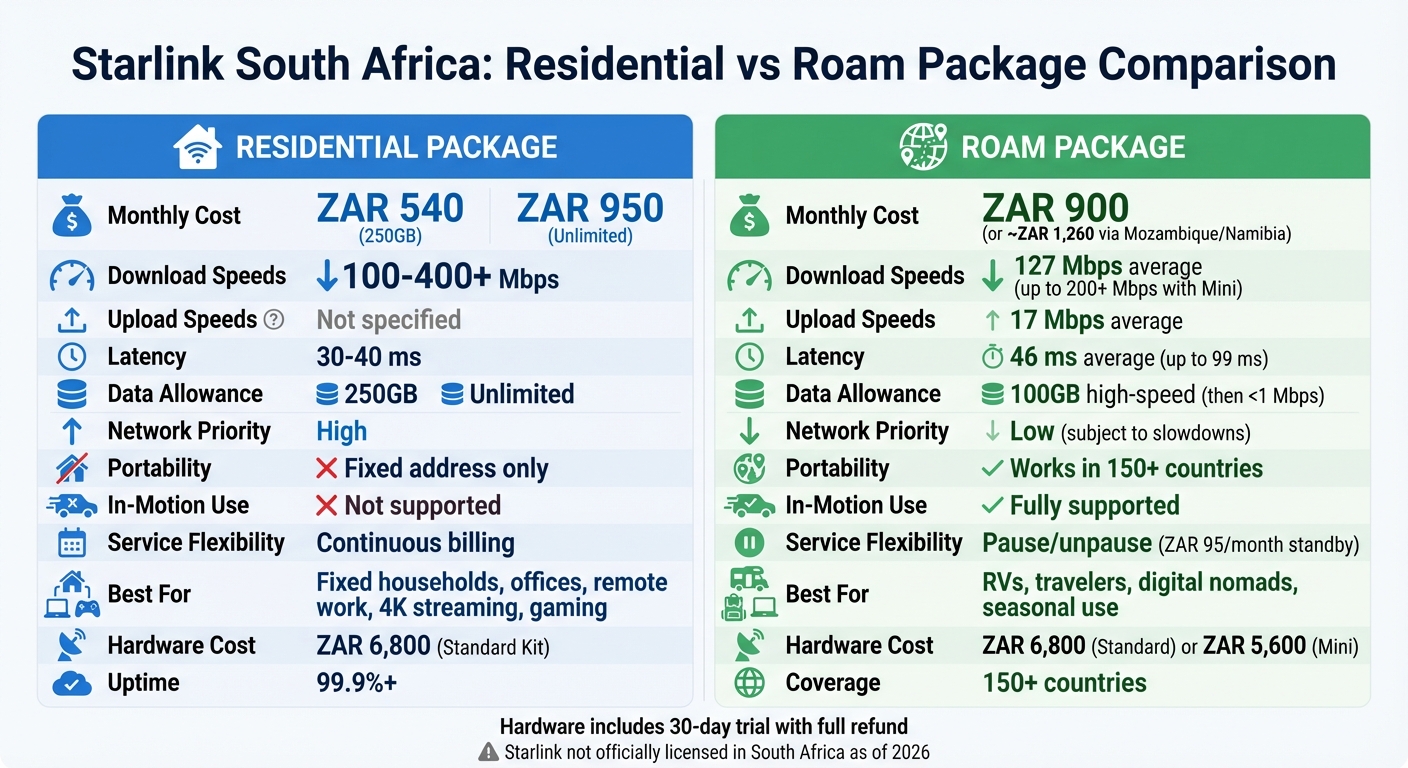
Starlink South Africa Package Comparison: Residential vs Roam Plans 2026
Here’s a breakdown of the strengths and limitations of each package. The Residential package is tailored for fixed locations, offering a stable and prioritized connection. With latency as low as 30–40 ms and download speeds of up to 400+ Mbps, it’s perfect for households that stream 4K content, engage in online gaming, or support remote work. The downside? It’s tied to a single registered address, so portability isn’t an option.
On the other hand, the Roam package is built for users on the move. It works across more than 150 countries, supports connectivity while in motion, and allows users to pause and resume service through its Standby Mode. However, it comes with lower network priority, meaning speeds can drop during high-traffic periods. SatelliteInternet.com explains, "Roam plans can see latency up to 99 ms”. The table below highlights the key differences between the two packages:
| Feature | Residential Package | Roam Package |
|---|---|---|
| Best For | Fixed households and offices | RVs, campers, and travelers |
| Network Priority | High (top priority for Max tier) | Low (subject to slowdowns during peak times) |
| Portability | Tied to a registered address | Requires an unobstructed sky view |
| In-Motion Use | Not supported | Fully supported |
| Service Flexibility | Continuous monthly billing | Pause/un-pause via Standby Mode |
| Monthly Cost | ZAR 540 or ZAR 950 | ZAR 900 |
Currently, Starlink isn’t officially licensed in South Africa, which has led many users to register Roam plans in neighboring countries like Mozambique or Namibia. According to EcoFlow, "The uncapped Mobile Roam plan linked to a Mozambican or Namibian address is the cheapest option, currently about R1,260 per month”. While this workaround is practical for now, it reflects the shifting regulatory environment. Once Starlink secures official licensing in South Africa, Residential plans may offer better pricing and enhanced network priority.
How to Order Starlink in South Africa
As of January 2026, Starlink isn’t officially licensed in South Africa. However, many users have found a workaround by registering their hardware in neighboring countries like Mozambique or Namibia and using the Roam plan to access the service back home.
Before you dive in, make sure your installation site has a clear view of the sky. Download the Starlink app for iOS or Android and use the "Check for Obstructions" tool to spot any potential signal blockers, such as trees, chimneys, or buildings. Once you’ve got a clear sky view, you’re ready to get started.
Getting the Hardware Kit
To begin, you’ll need the Starlink hardware kit, which includes a satellite dish, Wi-Fi router, tripod, power supply, and cables. You have two options for purchasing:
- Self-importing: Costs range between ZAR 9,000 and ZAR 11,000.
- Local resellers: Expect to pay around ZAR 12,000 to ZAR 13,000.
Installation is simple. Plug everything in and follow the app’s instructions to align the dish toward the open sky.
Choosing the Roam Plan
Once your hardware is set up, you’ll need to register for the Roam plan. This plan is ideal for mobility and works in over 150 countries. To register, you’ll need an internationally capable payment card. If you register in Mozambique or Namibia, the plan costs about ZAR 1,260 per month. It also offers the flexibility to pause the service whenever you like.
Trial Period and Refund Policy
Starlink offers a 30-day trial period. If the service doesn’t meet your expectations, you can return the hardware for a full refund.
Aaron W. shared his experience:
"Absolute game changer! There’s no overpromising and underdelivering like our old slow provider. Plug it in and show Dishy the sky, that’s it!"
Conclusion
Each Starlink package is tailored to meet different connectivity needs. The Residential package is perfect for fixed locations, offering prioritized, low-latency service that’s great for activities like streaming, video conferencing, and online gaming. Pricing for this plan varies based on usage, making it a flexible choice for households that rely on reliable internet for remote work or 4K streaming.
On the other hand, the Roam package is built for users on the move, providing coverage in over 150 countries. It includes a pause feature for times when you’re not traveling. However, it operates with lower network priority and higher latency (up to 99 ms), which could mean slower speeds during peak times. Priced at approximately ZAR 1,260 per month, this plan is ideal for digital nomads, RV travelers, or those needing internet access at remote or seasonal locations.
When deciding between these options, consider your specific needs and usage patterns. For more details on setting up your service, check out the ordering section.
It’s important to note that Starlink’s official launch in South Africa is delayed due to ICASA‘s 30% local ownership requirement. In the meantime, some users are accessing the service through unofficial channels. Be sure to verify the current legal status before making a purchase. Additionally, use the Starlink app’s obstruction checker to ensure your installation site has a clear view of the sky for optimal performance.
FAQs
How can I use Starlink in South Africa if it’s not officially available?
If Starlink hasn’t officially launched in South Africa yet, you might still be able to use it through the Roam plan, which includes international roaming. This plan lets users connect in various countries, including South Africa, even if local licensing is still in progress. The plan offers options for both limited and unlimited data, charged on a monthly basis.
Another option some users explore is setting up Starlink equipment on their own. This involves purchasing the satellite dish and necessary hardware from either official sources or third-party sellers. However, doing so comes with legal and regulatory risks if the service isn’t approved locally. It’s crucial to understand local laws and keep track of Starlink’s licensing status to avoid any issues.
While these approaches may work, always weigh the legal risks carefully and stay updated on Starlink’s official rollout in South Africa.
What’s the difference between Starlink’s Residential and Roam packages in South Africa?
The main distinction between Residential and Roam packages comes down to their intended use, pricing, and data offerings.
Residential plans are built for stable, home-based internet usage. They deliver speeds of up to 100 Mbps, with pricing starting at $40/month for basic service. If you need more, options like Residential Lite are available at $80/month, while the full Residential plan costs $120/month and may include unlimited data, depending on the specific plan.
On the flip side, Roam plans cater to those who need reliable internet while traveling. These plans offer portable connectivity across more than 150 countries. Pricing begins at $50/month for 50 GB of data, and there’s an unlimited data option at $165/month. One standout feature of Roam plans is the ability to pause and resume service whenever needed, adding extra flexibility.
In summary, Residential plans are your go-to for fast and dependable internet at home, while Roam plans are perfect for staying connected globally, no matter where your travels take you.
What equipment do I need for Starlink, and how much does it cost?
To get started with Starlink, you’ll need a user terminal, which comes with a satellite dish and a Wi-Fi router. The satellite dish connects directly to Starlink satellites, while the router distributes internet access throughout your home or office. The equipment is built to withstand harsh weather conditions and is designed for straightforward installation.
As of 2026, the hardware costs a one-time fee of approximately $500 to $600. Monthly service plans vary based on your needs, ranging from $50 to $165. For instance, the Roam plan provides 50GB of data for $50 per month, while unlimited data plans are priced at $165 per month.
This setup delivers reliable, high-speed satellite internet, making it an excellent option for areas where traditional internet services are unavailable or limited.
Related Blog Posts
- Starlink Partners with Airtel & Vodacom: From Rival to Ally
- South Africa’s DA Pushes for Starlink Entry to Boost Connectivity
- Airtel Africa to Launch ‘Direct-to-Cell’ Satellite Service in 2026
- Starlink in South Africa: Pricing, Availability, Setup Guide & Legal Status (2026 Update)