Grace Ashiru
The Brutal Physics Problem Sitting in the Room
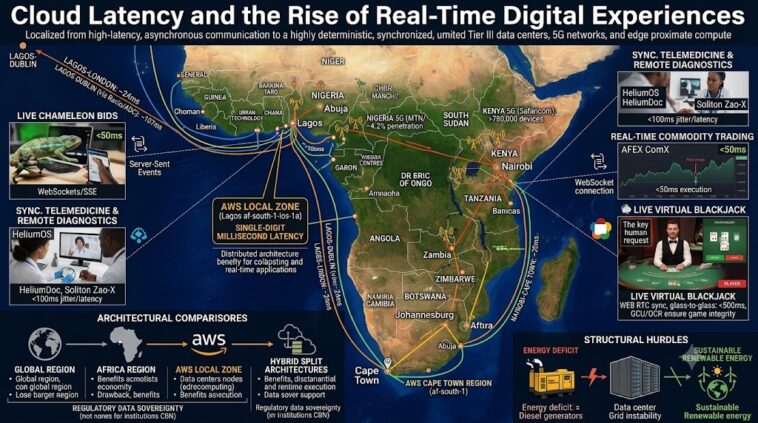
Let’s be real for a second. You can buy the most advanced switching hardware on the planet, but nobody has figured out how to bribe the speed of light. Network latency is not a software bug; it is a brutal geographic reality dictated by the refractive index of silica glass. For the last ten years, tech hubs in Lagos and Nairobi were essentially held hostage by the physical distance to hyperscale data centers sitting in Dublin or Virginia. A data packet shot through submarine optical fiber from Nigeria to London faces a theoretical minimum round-trip time of about 48 milliseconds. The catch? That number is an absolute fantasy. Once you factor in routing logic, intermediate network hops, and Transport Layer Security handshakes, your actual application layer response time casually breaches the 200-millisecond mark. Human perception tolerates that lag if you are just scrolling through static content. If you try running a synchronized, state-dependent application on that same connection, the entire illusion shatters instantly. The threshold for real-time digital ecosystems demands a latency budget strictly below 50 milliseconds. We had to stop routing traffic across oceans.
The Telco Paradox (And Why 4G Still Pays the Bills)
Capital expenditure in the radio access network tells a highly conflicted story right now. Frankly, telecommunications operators are dumping billions into 5G rollouts, but the retail adoption curve remains brutally flat in certain macroeconomies. MTN Nigeria poured hundreds of millions to push 5G population coverage past eleven percent recently. Look closer and you realize that out of that massive investment, 5G actually commands barely four percent of the mobile market share. Consumers simply are not biting. Severe currency depreciation makes importing 5G-capable smartphones a financial nightmare for the average user. Even when they can afford the handset, paranoid battery drain concerns keep those high-speed radios switched off entirely. Old-fashioned but reliable 4G LTE remains the true engine for internet traffic across West Africa. East Africa tells a much stranger story. Safaricom actually stopped waiting for retail consumers to catch up in Kenya. They pivoted aggressively toward enterprise adoption, hooking up thousands of businesses across all 47 counties to high-bandwidth pipelines for internet-of-things deployments and smart warehousing. The infrastructure is bifurcating based purely on regional economic realities rather than technological enthusiasm.


Pushing the Data Center Down to Street Level
An upgraded local cell tower means absolutely nothing if the core database still sits in a different hemisphere. The only viable engineering solution requires physically dragging the compute power down to the local metropolitan edge. Institutional money knows this perfectly well. We are watching a frantic land grab for carrier-neutral Tier III data centers across the continent, spearheaded by operators like Equinix, Raxio, and Africa Data Centres. Amazon Web Services entirely changed the architectural board by deploying a Local Zone directly in Lagos. Developers used to beg for decent routing to the Cape Town region to scrape by with 96-millisecond pings. Today, an engineering team can spin up a virtual machine inside the Lagos Local Zone and hit mobile users with single-digit millisecond latency. Regulatory frameworks like the Central Bank of Nigeria’s data residency laws practically force these localized deployments to keep financial data within borders, creating massive headaches for systems architects. Software teams are abandoning sluggish global managed databases and aggressively building localized, self-hosted environments just to keep transaction speeds viable.
The Millisecond Margin in the Casino
Those localized edge nodes are the exact infrastructure unlocking wildly asynchronous use cases. Standard HTTP requests are functionally obsolete for continuous data streams because they require a fresh handshake for every single payload. WebSockets and Web Real-Time Communication (WebRTC) have entirely taken over the backends of modern edge applications. Let us look at the interactive entertainment sector as the absolute apex of state synchronization. When an iGaming operator streams a round of live virtual blackjack to a user in Nairobi, the broadcast infrastructure operates more like a high-frequency trading floor than a television studio. The human dealer pulls a card from the physical shoe. Optical character recognition hardware digitizes the suit instantly, and the central betting engine updates the game state. If the video feed drops even a fraction of a second behind the user’s betting window, the psychological trust in the platform disintegrates. Margin for error does not exist here. Premium operators bypass legacy video streaming protocols entirely because standard buffering introduces unacceptable delays. They route uncompressed packets directly through local edge nodes to guarantee the digital interface matches the physical table exactly.
The Synchronization of the Clinic and the Grain Hustle
We can shift that exact same WebRTC infrastructure over to the healthcare sector, and it becomes a matter of actual survival. Rural healthcare in this region historically relied on a terrible triage model: someone emails a low-resolution clinical photo to a doctor in Europe and waits 48 hours for advice. Startups like Helium Health took a sledgehammer to that asynchronous nightmare. Their engineers leverage high-definition video tools like the HeliumDoc platform through optimized local networks to enable real-time, synchronous triage. This bypasses the chronic shortage of physical hospital staff entirely. The industry is already looking ahead to the telesurgery frontier. Surgeons plan to utilize remote robotic arms—paired with specialized bonding technology like Soliton’s Zao-X—to execute precise incisions based on ultra-low latency cellular connections. In that remote operating room, a 100-millisecond network jitter translates directly to a severed artery.
You see this same intolerance for lag reshaping the agricultural financial markets. Physical commodity trading across the continent used to be a notoriously opaque, fragmented nightmare dominated by aggressive middlemen. Digital commodity exchanges like AFEX changed the rules of the game instantly. Through their digital trading platforms, independent brokers in rural areas can suddenly trade spot contracts for raw cashew nuts or cocoa based on real-time warehouse inventory levels. This environment demands flawless, continuous market synchronization. Picture the financial risk if a broker executes a buy order based on a price displayed on their screen, but a 300-millisecond lag means the central matching engine already processed an institutional block trade. That slippage destroys capital on the spot. Digital exchanges prevent these discrepancies by relying heavily on persistent WebSocket connections tied directly to local cloud infrastructure. This ensures every terminal updates simultaneously without a hint of perceptual delay.
The Diesel Engine Keeping the Cloud Afloat
Nobody really wants to admit the glaring physical vulnerability underneath this whole digital renaissance. Every single fault-tolerant edge node or massive cloud zone immediately turns into expensive dead weight when the local power grid fails. These hyperscale facilities gorge on electricity—often requiring tens of megawatts of continuous juice. Frequent blackouts across primary tech hubs force infrastructure operators to burn a staggering amount of diesel fuel just to prevent catastrophic server shutdowns. We are effectively powering the future of frictionless, real-time connectivity with raw, combustion-engine grit. Edge nodes will continue to decentralize, and latencies will keep dropping toward zero. The true ceiling on this digital economy will not be dictated by the speed of fiber optics. It will be decided by whoever figures out how to keep the batteries charged when the national grid goes dark.