Grace Ashiru
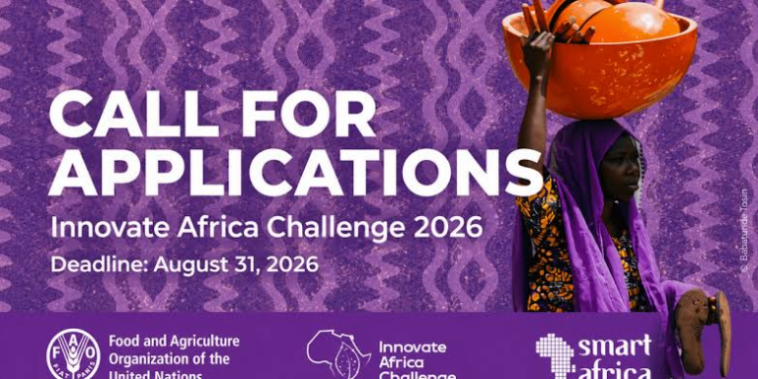
The Food and Agriculture Organization of the United Nations, working with the Smart Africa Secretariat, has opened the third edition of the Innovate Africa Challenge, a continent-wide push to get artificial intelligence solutions for climate-smart agriculture out of the lab and into farmers’ hands. This year’s theme, “From Ideation to Deployment,” signals a deliberate change in emphasis from previous rounds: rather than rewarding clever concepts, the challenge is built around identifying one proven AI-driven solution and actually deploying it within a Smart Africa member state, in partnership with national governments, FAO country offices, and agricultural stakeholders on the ground.
The challenge exists because African agriculture is under mounting pressure from several directions at once: increasing climate variability and extreme weather, food insecurity paired with shrinking natural resources, limited access to timely agricultural information, low digital adoption among farmers, fragmented data systems, skills gaps in digital agriculture, and persistent inequality affecting smallholder farmers, women, youth, and rural communities. AI and digital tools have real potential to address these problems, but a huge share of promising innovations never make it past the pilot stage into widespread use. This challenge is explicitly designed to close that gap by backing technologies that have already proven they work and are ready to scale.

Earlier editions built real momentum, engaging innovators from more than 40 African countries, promoting AI tools for climate resilience, and helping deploy AI-enabled weather stations that give farmers better information for decision-making. This third round aims to build directly on that foundation by backing technology capable of delivering measurable results in actual farming conditions, not just in pilot programmes.
The 2026 challenge is looking for solutions across a defined set of priority areas: precision agriculture and input optimisation, crop yield prediction and forecasting, pest and disease surveillance and early warning, climate risk modelling and adaptive decision tools, and water and natural resource management. Whatever gets selected needs to integrate cleanly with national agricultural information systems, digital extension platforms, and government-led agricultural programmes, and it needs to work in the messy reality of African farming: incomplete or infrequent data, low-connectivity and mobile-first environments, multiple languages, and diverse local farming contexts. Solutions also need to produce practical, explainable recommendations that farmers, extension officers, and policymakers can actually act on.
Deployment will be concentrated in five Smart Africa member states: Rwanda, Kenya, Ghana, Malawi, and Uganda, implemented in partnership with the relevant national ministries for agriculture, ICT, and innovation, alongside FAO country offices.
To qualify, applicants need to be legally registered entities or teams with a track record of building AI solutions, with a minimum team of two people who spend at least half their working time on the project. Startups need to sit at a Technology Readiness Level between 3 and 6, be funded anywhere from pre-seed through Series A, and have a solution that’s already working, deployed, or ready for deployment, backed by evidence of prior pilots, customer engagements, or validated use. Applicants also need to show they have the technical capacity to deploy in another African country beyond their home market, and they need to comply with responsible AI, privacy, and data protection requirements. Preference will go to startups already operating within Smart Africa member states, organisations serving smallholder farmers, women, and youth, and teams with existing partnerships involving ministries, research institutions, or agricultural extension systems.
On the responsible AI front, applicants are expected to use transparent and explainable approaches, actively identify and mitigate bias across gender, geography, and farming systems, respect farmer data ownership with informed consent where required, and maintain confidentiality throughout the process. Startups keep ownership of their existing IP, while Smart Africa retains rights over the challenge’s outputs and any resulting implementation frameworks, with future scale-up arrangements to be governed by separate contracts.
Applications go through the official FAO STI portal. Given the direct overlap with agritech and climate resilience, this is a solid one to flag for founders in your network working on precision agriculture or farm-data tools.